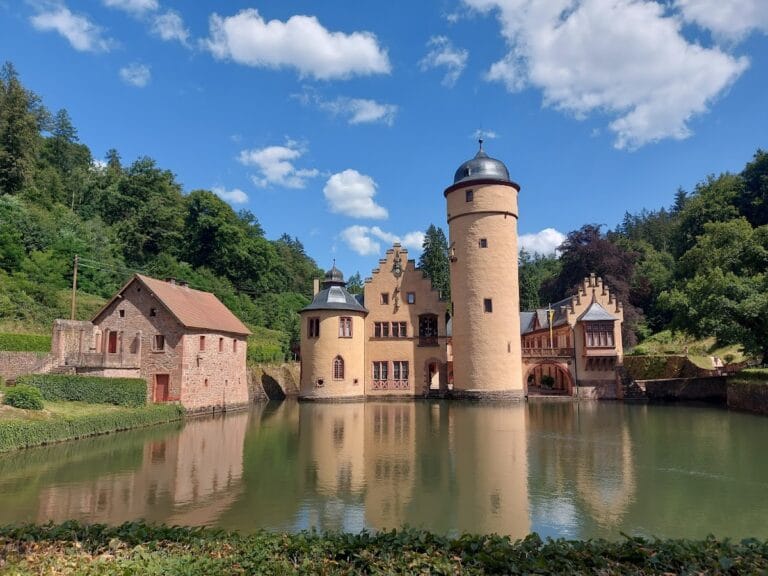
Schloss Weyberhöfe: A Historic Hunting Lodge and Estate in Sailauf, Germany


Site at a Glance
- Rating
- 4.6
- Popularity
- Low
- Country
- Germany
- Primary era
- Early Modern
- External website
- Open
- Eras represented
- Medieval, Early Modern, Modern
- Civilizations
- German, Holy Roman Empire
- Site type
- Domestic
- Remains
- Elite Residence
On this page11 sections
History
Schloss Weyberhöfe is a historic hunting lodge and estate in Sailauf, Germany, established in 1265 by Werner von Eppstein for the Electors of Mainz. The lodge stood at the beginning and end of several routes across the Spessart, a wooded low mountain range in central Germany, including the Lohr or Mainz Road, also known as the Electors’ Way, the Roman Road toward Orb, and the route through Keilberg, Posthalterkreuz, and Rohrbrunn toward Esselbach and Lengfurt.
Foundation and early history
Werner von Eppstein founded the lodge under the name castrum vivarum. The name has been associated with a game park, suggesting that the original complex included a stone tower, farm buildings, and an enclosed area for game. Werner von Eppstein died at the lodge in 1284.
The estate later became connected with the administration of the surrounding territory. Carved stone coats of arms identify it as the seat of the Zentgraf of the “Cent vorm Spessart.” A Zentgraf was an official responsible for administering a regional judicial and administrative district. The settlement appears as Weiber, with a house, on Paul Pfinzing’s map of the Spessart, dated 1562/1594.
Destruction and rebuilding
The hunting lodge was destroyed during the Margrave’s War in 1552, a conflict that caused widespread damage in parts of the German lands. It was rebuilt in 1557 under Elector Daniel Brendel von Homburg. The estate’s name changed gradually from vivarum to vivar, wiber, and weiber, eventually developing into the modern form Weyber.
The estate from the seventeenth to nineteenth centuries
In 1681 Michael Sickenberger of Großkrotzenburg became the tenant and later the farm manager of the estate. He operated sheep breeding at Weiberhof and became its hereditary leaseholder. His sons and descendants continued to hold this role until the nineteenth century.
During the nineteenth century, the estate supported several types of production. It belonged to the Mairie of Sailauf in 1812, when a Mairie was a municipal administrative unit organized according to the French administrative model. In 1823, Heinrich Gemeiner owned an iron hammer at Weiberhof, along with ironworks near Aschaffenburg and Laufach and another iron hammer at Aschaffsteg in the Hösbach area. The estate had a grain mill and two oil mills in 1824.
Anton Sickenberger owned the estate in 1857, followed by his son Leonhard Sickenberger and, in 1867, Hermann John. In 1876 Georg Winter operated an iron smelter and foundry there, where 35 workers processed Staffelstein iron ore. Franz von Dressler von Scharfenstein was the estate owner in 1897.
Aristocratic residence and hotel
Alexander von Cancrin acquired the estate in 1904 and operated it as an agricultural enterprise. He reshaped the aristocratic residence in the Historicist style, a nineteenth-century approach that revived and recombined forms from earlier periods. The last estate owner, Baroness Alix von Cancrin, died in 1990.
The merchant Edmund Weber subsequently acquired the property. Between 1993 and 1995, he converted it into the Schlosshotel Weyberhöfe, a wellness hotel, while largely following the historical form of the buildings. The project invoked Marx Rumpolt, a court cook to an elector of Mainz.
The restaurant Careme opened in 1998 under chef Juan Amador, who served as head chef at the hotel from 1999 to 2003. The restaurant received its second Michelin star in 2001. A Michelin star is a distinction awarded by the Michelin Guide, and a second star indicates a particularly high level of culinary distinction. Under new management, a hotel complex had been created by 2005, and the hotel was renovated in 2016 and 2017.
Schloss Weyberhöfe is entered in Bavaria’s monument register as a listed architectural monument under number D-6-71-150-2. The protected complex includes the former hunting lodge, now used as a hotel, together with its farm buildings.
Remains
Setting and estate layout
The estate occupies park-like grounds on the Laufach, between the former Electors’ Way from Aschaffenburg to Lohr am Main, now followed by the B 26, and the Frankfurt–Würzburg railway line. It stands at the edge of the Spessart landscape-protection area. The Sailaufbach flows into the Laufach beside the adjoining Weyberhöfe industrial area. The Laufach continues west of the sewage-treatment plant and north of the A3 motorway before flowing into the Aschaff.
Historic buildings
Main building
The historic main building is a sixteenth-century structure with a gabled roof and stepped gables. It forms the surviving architectural core of the former hunting lodge and aristocratic residence. The building now functions as part of the hotel complex.
Farm buildings
Farm buildings remain part of the registered complex. They reflect the estate’s long agricultural role, which included sheep breeding, grain milling, oil production, and later operation as an agricultural enterprise.
Clock tower
A surviving base from a factory chimney associated with the nineteenth-century ironworks was converted into a small clock tower. This feature preserves a physical link to the industrial phase of the estate, when an iron smelter and foundry operated on the property.
Nearby sites