Santi Apostoli: A Historic Romanesque Church in Florence


Site at a Glance
- Rating
- 4.8
- Popularity
- Low
- Country
- Italy
- Primary era
- Medieval
- External website
- Open
- Eras represented
- Medieval, Early Modern
- Civilizations
- Republic of Florence
- Site type
- Religious
- Remains
- Church
On this page25 sections
History
Santi Apostoli is a Roman Catholic church in Florence, Italy, dedicated to the Twelve Apostles and attached to the Archdiocese of Florence under the Roman rite. Its Romanesque character and early history make it one of the city’s oldest and most historically important churches.
Foundation and medieval traditions
A plaque on the façade attributes the church’s foundation to AD 800, supposedly in the presence of Charlemagne, the eighth-century Frankish emperor, and his paladin Roland, a celebrated figure of medieval tradition. Because the plaque was produced several centuries after the events it describes, the church is generally dated instead to around the end of the eleventh century.
Santi Apostoli later acquired the popular title “Old Cathedral of Florence” because of its central role in public celebrations, especially the Scoppio del Carro. The name describes its traditional importance in civic and religious festivities, not its ecclesiastical rank, since the church was never Florence’s cathedral.
The Holy Sepulchre tradition
The Scoppio del Carro is linked by tradition to the First Crusade, the military expedition that captured Jerusalem for the crusaders. Pazzino de’ Pazzi, regarded in this tradition as an ancestor of the Florentine Pazzi family, was said to have been the first to scale Jerusalem’s walls and open the way for the crusaders. Godfrey of Bouillon, a leading commander who became the first ruler of Jerusalem after its conquest, allegedly rewarded him with three fragments of stone from the Holy Sepulchre. Tradition places their acquisition around 1100.
The fragments have been preserved at Santi Apostoli since 1785. On Easter Sunday, they are traditionally used as flints to ignite the colombina, a dove-shaped firework, which then sets off the fireworks of the Scoppio del Carro in Piazza del Duomo.
Renaissance remodelling and later history
The church was remodelled during the fifteenth and sixteenth centuries while retaining much of its medieval character. Its sixteenth-century Renaissance portal is attributed to Benedetto da Rovezzano, and its small bell tower was designed by Baccio d’Agnolo.
The interior was traditionally said to have influenced Filippo Brunelleschi’s return to classical forms and the development of Renaissance architecture. Another tradition holds that Michelangelo persuaded Bindo Altoviti to preserve the medieval church rather than raise its floor and rebuild it. These accounts helped shape the church’s place in the historical understanding of Florentine architecture.
Flood damage and conservation
The flood of 1966 caused extensive damage to Santi Apostoli and to its works of art. Later restoration recovered the church’s primitive mosaic pavement. Conservation has continued to affect the presentation of individual works, including the restoration of the Madonna della Neve altarpiece in 2020 and its return to the church in 2024. The large Glory of Saint Francis de Sales Supported by Angels was relocated to its chapel in 2011.
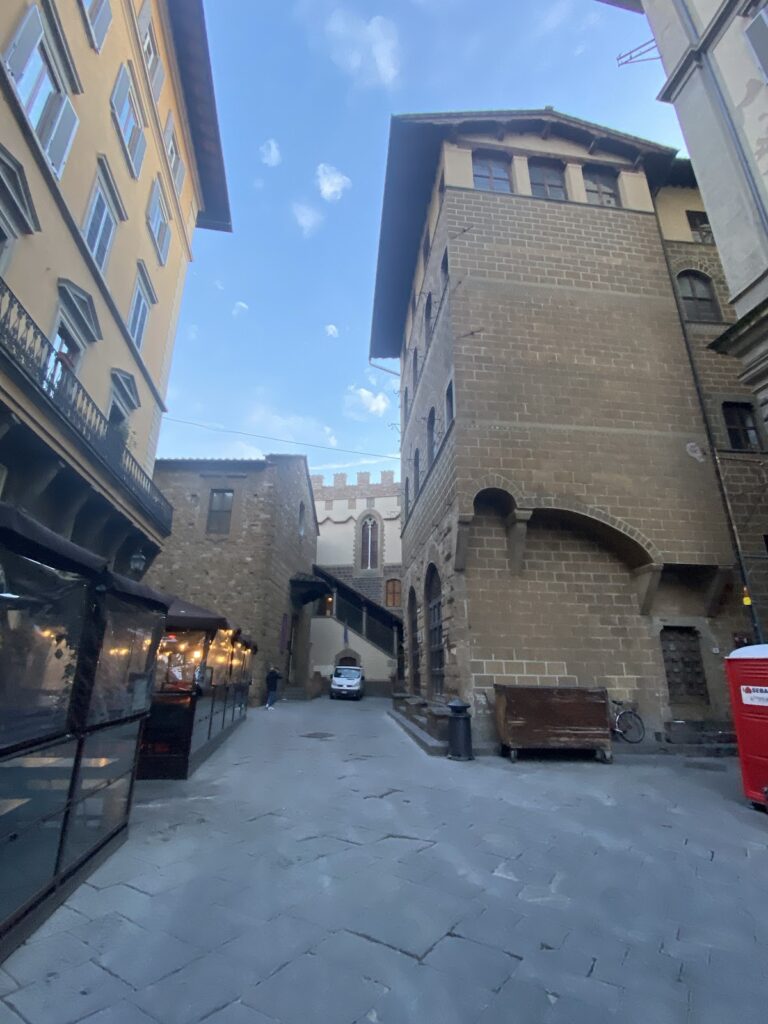
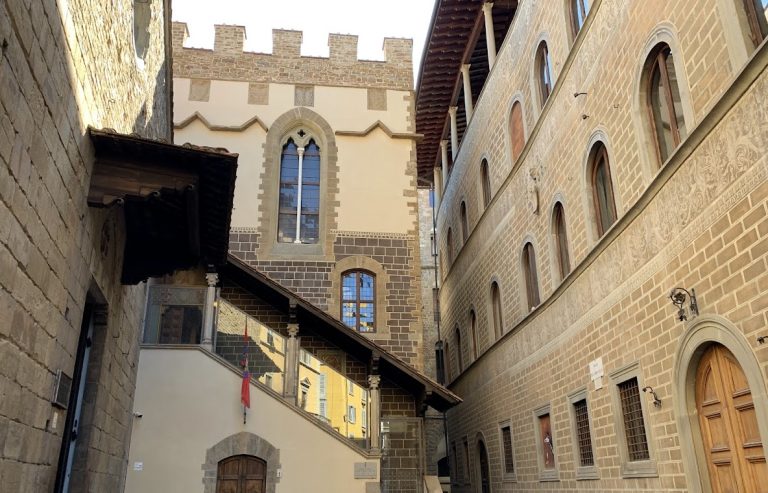
The church stands beside the Palazzo Borgherini-Rosselli del Turco, with its north side bordering Borgo Santi Apostoli. The name of Piazza del Limbo refers to a medieval cemetery for children who died before baptism.
Remains
Santi Apostoli retains a Romanesque façade and a plan influenced by early Christian architecture, with a central nave, two aisles, and a semicircular apse. Round arches rest on columns of green Prato marble, also called serpentine. Their capitals are unequal and were reused from ancient Roman buildings. The first two Corinthian columns are traditionally thought to have come from nearby baths and to date from the first century BC.
Medieval fabric and apse
Roof and pavement
The richly decorated wooden roof has a trussed construction dating from 1333. Restoration recovered a primitive mosaic pavement incorporating numerous tomb slabs associated with prominent Florentine families, including the Acciaiuoli, Altoviti, and Del Bene.
Apse and polyptych
The apse preserves a simple Romanesque structure built from roughly squared stones left visible. Its principal altarpiece is the 1383 polyptych Madonna and Child Enthroned among Angels and Saints and the Adoration of the Magi by Jacopo di Cione and Niccolò Gerini. A polyptych is an altarpiece made from several connected painted panels. Additional saints appear on its predella, the lower section beneath an altarpiece. The work came from the convent of the Poor Clares at Santa Maria di Monticelli.
Altoviti funerary arrangement
The apse also contains the funerary arrangement of Archbishop Antonio Altoviti, created by Giovanni Antonio Dosio between 1573 and 1583. It consists of a marble sarcophagus and a central arched niche linked by two curved volutes to lateral doors. Busts of Charlemagne and Antonio Altoviti by Giovanni Caccini complete the composition. The sarcophagus functions as a cenotaph, a memorial tomb that does not contain the person’s remains.
Eucharistic and commemorative works
Acciaiuoli tabernacle
At the left of the apse stands a polychrome glazed-terracotta Eucharistic tabernacle commissioned from Andrea della Robbia by Giovanni di Piero Acciaiuoli. A payment dated 28 April 1512 records the commission, and Andrea’s son Giovanni may also have participated. The tabernacle is an aedicula, or small architectural shrine, with Corinthian pilasters, perspective columns, and a barrel vault decorated with rosettes. Its door shows Christ rising from the tomb.
The predella depicts two angels supporting a leafy garland containing a chalice and host beneath the inscription “HIC EST PANIS QUI DE COELO DESCENDIT.” Above the door, a circular opening may have held a third Holy Sepulchre stone. The lunette, the semicircular area above an opening, contains the dove of the Holy Spirit, while the upper section shows the blessing Father in bas-relief. White enamel contrasts with the blue ground and brings out the modelling of the details.
Donato Acciaiuoli’s tomb chest
The tabernacle rests on the surviving part of Donato Acciaiuoli’s 1333 sandstone tomb chest, made by an unknown sculptor. Two side panels remain visible, showing the Madonna and Saint John the Evangelist.
Holy Sepulchre stones and holy-water font
A small niche at the front of the left aisle preserves the three traditional fragments associated with the Holy Sepulchre. The same aisle contains a holy-water font by Benedetto da Rovezzano, dating to approximately 1510.
Left-aisle chapels
Altoviti funerary monument
Near the end of the left aisle is the funerary monument for Antonio and Oddone Altoviti. Oddone, who served as prior of the church until 1514, commissioned the work, which Benedetto da Rovezzano made around 1507 to 1508.
Madonna and Child among Angels
The chapel nearest the entrance contains the surviving sinopia of Paolo Schiavo’s fifteenth-century fresco Madonna and Child among Angels. A sinopia is an underdrawing, usually made in red earth pigment, prepared for a fresco. The painting was formerly placed above the entrance portal.
Adoration of the Shepherds
The fourth left chapel contains Maso da San Friano’s Adoration of the Shepherds, painted approximately between 1560 and 1565. Saint Raphael and Tobias and Saint Andrew appear on the side walls; together, these works originally formed a single altarpiece.
Bonciani and Saint Francis de Sales chapels
The third left chapel, under the patronage of the Bonciani family, contains Alessandro Fei’s Archangel Michael Defeating Lucifer, dated approximately 1575 to 1576. The second left chapel holds Anton Domenico Gabbiani’s Glory of Saint Francis de Sales Supported by Angels, commissioned by the Confraternity of Saint Francis de Sales and painted in 1685 and 1686. Its ceiling painting, Glory of Saint Jeanne-Françoise de Chantal, was made by Matteo Bonechi in the early eighteenth century.
Right-aisle chapels
Stoldo Altoviti’s chapel
The penultimate chapel in the right aisle was founded in 1392 by Stoldo di Bindo Altoviti as a simple altar and retains his marble tomb slab. Its altarpiece, Jacopo di Cione’s Madonna della Neve, returned to the church in June 2024 after restoration in 2020, which re-established the work’s original proportions.
Saint Martin and the Del Bene chapels
The first right chapel contains the Charity of Saint Martin, attributed to Cosimo Gamberucci and dated to the final years of the sixteenth century. The second chapel, associated with the Del Bene family, contains Cristoforo Roncalli’s Saint Peter at the Temple Gate Healing a Cripple.
The third right chapel, also associated with the Del Bene family, contains the 1530 funerary monument of Piero Del Bene. Its head is at least partly attributed to Benedetto da Rovezzano. An eighteenth-century relief of Saint Paul is also preserved there.
Altoviti Chapel
The fourth right chapel is the Altoviti Chapel, founded by Bindo Altoviti in 1533. It contains Giorgio Vasari’s Allegory of the Immaculate Conception, commissioned in 1540 and installed in 1541. The painting was Vasari’s first completed altarpiece for a Florentine church.
Bindo Altoviti’s cenotaph
Above the door to the sacristy or adjoining canonical rooms is Bindo Altoviti’s 1570 funerary monument, with an allegory of Charity by Bartolomeo Ammannati. It is a cenotaph because Bindo was buried at Trinità dei Monti while awaiting reburial in Florence, a transfer that never took place.
Additional works
Near the entrance is a tomb with a bust of Anna Ubaldi, the mother of the Gran Prior del Bene, sculpted by Giovanni Battista Foggini. A sixteenth-century chapel dedicated to Saint Bartholomew contains a stucco representation of Saint Paul.
Andrea Orcagna and his younger brother Jacopo di Cione painted Pentecost around 1362 to 1365, probably for Santi Apostoli. Giorgio Vasari saw it in its original position during the sixteenth century. The painting is now held in Florence’s Galleria dell’Accademia.