Basilica of SS. Peter and Alexander: A Collegiate Church in Aschaffenburg


Site at a Glance
- Rating
- 4.6
- Popularity
- Low
- Country
- Germany
- Primary era
- Medieval
- External website
- Open
- Eras represented
- Medieval, Early Modern, Modern
- Civilizations
- Holy Roman Empire
- Site type
- Religious
- Remains
- Basilica
On this page21 sections
History
The Basilica of SS. Peter and Alexander is a historic Roman Catholic church in Aschaffenburg, Germany, built and developed by a collegiate foundation whose origins reach back to the Ottonian period of the tenth and early eleventh centuries. Standing on a hill above the city centre, it grew from an earlier religious settlement into the church of a powerful community of canons and later became a parish church and minor basilica.
From monastery to collegiate foundation
A Benedictine monastery dedicated to Saint Michael occupied the site in the eighth century. During the tenth century, it was transformed into the Collegiate Foundation of Saint Peter and Alexander, replacing an earlier rectangular Carolingian building. The foundation was probably initiated around 950, most likely in 957, by Liudolf, Duke of Swabia, and his wife Ida, the daughter of Duke Hermann of Swabia.
Their son Otto, Duke of Swabia, established the collegiate foundation and its school. The foundation is known from 974, when Otto II granted it churches at Salz and Brendlorenzen, territories in the Spessart, and other possessions. Construction of the collegiate church began from about 975. A collegiate foundation was a community of clergy, known as canons, organized to serve a church and administer its religious and economic resources.
After Otto’s death in 982, Aschaffenburg and the foundation passed to the archbishops of Mainz. Archbishop Willigis of Mainz buried Otto at Aschaffenburg beside the tomb of Liutgard, widow of King Louis III, and her daughter Hildegard. These burials established the church as a dynastic and ecclesiastical memorial site during the Ottonian period.
Power under the archbishops of Mainz
The foundation came increasingly under the authority of the Archbishops of Mainz. Its influence grew alongside Aschaffenburg’s rise after the town received civic rights in 1161. The city later developed as a secondary residence and then as an administrative capital of the Mainz archbishops.
The foundation’s senior officers included two provosts, Markolf in 1141 and Arnold of Selenhofen in 1153, who later became archbishops of Mainz. From 1262, the provost, or head of the foundation, was chosen exclusively from the Mainz cathedral chapter. From 1588, the Archbishop of Mainz automatically held the provostship.
By 1184, the foundation was the city’s largest landowner and a major economic power. It controlled 17 parishes, estates, vineyards, and mills. At different times, its community included as many as 28 canons in the complex and its associated collegiate courtyards, while the chapter reached a maximum of about 40 members.
The foundation’s privileges also caused conflict with the citizens. In 1304, an uprising opposed its exemption from taxes and other rights. The city’s complaint was rejected by the courts, and the foundation continued to enlarge its privileges, including with the support of Emperor Charles IV in 1349.
Reformation, abolition, and parish use
During the disturbances of the Reformation, Archbishop Albrecht of Brandenburg moved his residence from Halle to Aschaffenburg. The collegiate foundation temporarily became part of the episcopal seat. Albrecht was a major sixteenth-century church patron, and the religious art he commissioned or brought from Halle strongly influenced the contents of the church and its associated buildings.
The dissolution of Electoral Mainz in 1801 brought the foundation to an end. Karl Theodor von Dalberg, the last archbishop of Mainz and later Grand Duke of Frankfurt, abolished it in 1802. The collegiate church became a city parish church. The foundation’s revenues passed first to the University of Mainz and, after the Congress of Vienna, to Bavaria as the General School and Study Fund of Aschaffenburg.
The former chapter house had already become the Stiftsmuseum in 1861. Its holdings include archaeological finds from prehistoric, Roman, and early medieval periods, together with ecclesiastical art from Aschaffenburg and the Lower Main region. Much of the collection originated in the collegiate treasury and was formerly kept in the church.
War damage and modern status
Allied air raids and artillery fire severely damaged the church during the Second World War. Reconstruction began in 1946, and the nave returned to worship in 1947. New bells were installed in 1955. By the celebrations of the church’s 1,000th anniversary in 1957, restoration had returned the building to a condition with no visible war damage.
In 1956, anthropologists from the University of Mainz opened the thirteenth-century sarcophagi and confirmed that they contained the remains of Otto, Liutgard, and Hildegard. In 1957, the church and associated buildings were transferred to the Catholic parish foundation of Saint Peter and Alexander. A new crossing altar was consecrated in 1981.
Pope Pius XII elevated the church to a minor basilica on 17 January 1958 through the apostolic letter Quasi civitas. The title is an honor granted to churches of particular historical, religious, or pastoral importance. The building is also protected as a Bavarian historical monument and continues to serve as a Roman Catholic parish church.
Remains
The surviving complex is a cruciform basilica assembled over many centuries. Its fabric combines Ottonian and pre-Romanesque beginnings with Romanesque, Gothic, Baroque, and later Gothic Revival elements. Much of the present complex dates from the twelfth and thirteenth centuries. The east-oriented nave forms the principal axis, while the transept crosses it and creates the church’s cruciform plan.
Church structure and entrances
Romanesque nave
The oldest surviving part is the nave. Its twelfth-century Romanesque pier arcades support the upper walls and clerestory windows. At the western entrance, a round-arched portal from about 1220 has a semicircular tympanum, the field above a doorway. It shows Christ enthroned as ruler of the world, flanked by Saints Peter and Alexander.
Immediately inside the entrance is a hall of 16 late Romanesque columns with richly decorated capitals. The columns probably came from a predecessor of Johannisburg Palace and support the organ gallery. The transept, east choir, and west and northwest portals were built during the first half of the thirteenth century in the Gothic style.
Medieval tower
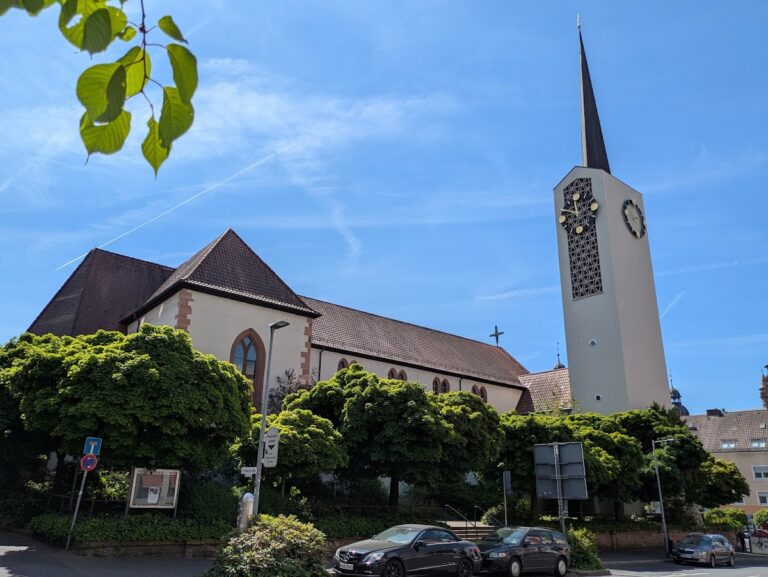
The Gothic tower at the southwest corner of the nave developed during the later medieval period, with its construction placed around 1340 to 1420. Its square two-storey base is strengthened by buttresses and supports an octagonal upper structure containing the belfry. A platform with a continuous openwork parapet runs around the base of the belfry, and Gothic gables are crowned with finials.
An angel was placed on the spire in 1539 and last renewed in 1971. The tower clock bears the date 1714. A second tower at the northwest corner remained unfinished, while the church may have had a twin-tower arrangement during the Romanesque period. The oldest bell dates from the fourteenth century, and the newest bells date from 2005. In that year, the Perner foundry of Passau added small chiming bells to the peal; all the bells use heavy ribs.
Cloister and exterior spaces
Collegiate buildings and cloister
The northern collegiate buildings were incorporated into the complex from the thirteenth century. They form a U-shaped arrangement around a Romanesque cloister built about 1240 to 1245. The cloister has 64 capitals and was restored in the nineteenth century by Georg Eberlein. The former chapter house, whose interiors date from the fifteenth to the seventeenth centuries, now forms part of the Stiftsmuseum.
Staircase and porch
Stiftsplatz connects with the church through a monumental double-flight Baroque staircase built on the former churchyard during the seventeenth century. Sandstone statues of Saints Peter and Alexander, dated 1723, stand between the flights. On the platform is a Crucifixion group by Antonius Wermerskirch from 1699.
An open porch surrounds the west and north sides of the church. Its northern arcades continue the cloister behind the collegiate buildings. The porch walls contain numerous stone reliefs and epitaphs, memorial monuments for the dead.
Maria Schnee Chapel
The Maria Schnee Chapel projects above the northern arcades. Albrecht of Brandenburg dedicated it in 1516. Its facade has a Three Kings group on the upper sections of the buttresses, while a Gothic Revival gable from 1870 carries a relief of Saint Martin. The original sculptures are preserved in the Stiftsmuseum. Two pointed-arch arcades connect the chapel with the northern aisle.
The dedication recalls the Christian legend that snow fell in Rome during summer to mark the site where the Basilica of Santa Maria Maggiore would be built. The chapel originally contained Matthias Grünewald’s Madonna for the Maria Schnee Altarpiece, now known as the Stuppach Madonna and preserved in Bad Mergentheim. A copy by Christian Schad is displayed in Aschaffenburg. The chapel also contains a copy of Grünewald’s Mocking of Christ by August Bresgen.
Choir and transepts
Choir furnishings and memorials
The Gothic high altar was replaced by a canopied Baroque altar made from 1771 to 1774 and consecrated in 1775. Four marble columns support its curved wooden entablature and volutes. The altar table bears a figure of the Crucified Christ, while the area behind it contains the tabernacle, adoring angels, and the Lamb of God.
Sarcophagi of Queen Liutgard and her daughter are set into the left choir wall, and Duke Otto’s sarcophagus is set into the right wall. Other choir features include a heraldic relief from 1722, a polychrome relief from 1524 by Master Wendel showing Otto with sword and shield between two putti bearing the arms of Swabia and Bavaria, and the epitaph of Archbishop Theoderich of Erbach. A funerary monument to Anselm Franz von Ingelheim was made by Johann Wolfgang Frölicher.
A red-and-gold conical silk padiglione, a ceremonial umbrella associated with the status of a minor basilica, marks the church’s papal distinction.
Northern transept
The northern transept contains three bronze works commissioned by Albrecht of Brandenburg from the Vischer workshop of Nuremberg. Peter Vischer the Younger made Albrecht’s epitaph in 1525. Hans Vischer created a relief of the Virgin and Child in 1530, based on an engraving by Albrecht Dürer, and made a bronze canopy in 1536.
The canopy originally stood over a tomb slab in Halle. It now supports the Margaretha Shrine, a gilded wooden reliquary containing relics of several saints. An approximately 1520 painted wooden Crucifixion panel stands above an altar on the transept’s east wall.
Southern transept
The southern transept contains a baptismal font by Konrad of Mosbach, dated 1487. Its coloured half-length reliefs show angels, three of whom hold musical instruments, while others hold a book, the date, and the arms of Archbishop Berthold of Henneberg.
The walls display Isaac Kiening of Speyer’s Adoration of the Magi from 1577. It is flanked by two altar wings from about 1520 associated with the school of Lucas Cranach the Elder. The wings show Saints Catherine and Margaret on the left and Barbara and Agnes on the right. A copy of a panel from the Magdalene Altarpiece, showing Saint Valentine, hangs on the western wall. The original altarpiece, made by Hans Juncker about 1620, is in the Stiftsmuseum.
Nave artworks and later furnishings
Ottonian cross and pulpit
The large Ottonian triumphal cross, probably made around 980, hangs on the northern wall of the central nave. It was probably donated by Mathilde of Essen and Archbishop Willigis in memory of Otto. Its jewelled-style frame recalls the Mathilde Cross in Essen. Christ’s closed eyes and side wound indicate death, while the calm expression conveys the overcoming of death.
Opposite the cross stands an early Baroque pulpit made in 1602 and designed by Hans Juncker. Its pilasters carry figures of Christ Salvator and the four Evangelists. Four stone reliefs depict Old Testament scenes interpreted as anticipations of the New Testament. Figures of Gregory the Great, Jerome, Ambrose, and Augustine represent the principal Western Church Fathers, while Peter, Alexander, and the apostle Andrew appear on the pulpit shaft.
Paintings and memorials
Matthias Grünewald’s Lamentation of Christ, commissioned by the collegiate foundation and painted about 1525 on a fir-wood panel, is displayed in a chapel in the southern aisle. Its format was probably intended for the front of a tomb chest or as the predella of a Crucifixion altar. Christ’s body has been removed from the cross but still bears the crown of thorns. The cross stump and a leaning ladder appear behind him, with Mary and another mourning woman grieving nearby. The coats of arms of Albrecht of Brandenburg and Theoderich of Erbach connect the work with the Mainz archbishops.
Other interior features include several side altars, paintings, epitaphs, and memorial plaques. The chapel beneath the tower contains an allegorical monument to Friedrich Karl Joseph von Erthal by Heinrich Philipp Sommer, dated 1816. Additional works include a nineteenth-century crucifix by Ludwig Voltz from 1862, a painting by Johannes Fischer showing Christ between Peter and Paul, and a nineteenth-century Altar of the Fourteen Holy Helpers incorporating late Gothic elements from the fifteenth century.
The church also contains a Crucifixion group by Zacharias Juncker the Elder from about 1650, the epitaph of Canon Heinrich Reitzmann, who died in 1528, and a copy of a Cranach-school painting of the Mass of Saint Gregory. A modern crossing altar, sacrament house, and base for a wooden Crescent Madonna were made by Max Walter in 1979.
Organ and museum collections
The organ was built in Bonn in 1984 by Johannes Klais as Opus 1619. The slider-chest instrument is 9 metres high and has 55 speaking stops and 3,926 pipes. Its key action is mechanical and its stop action electrical. The instrument was revised in 2013, when its specification was expanded.
The Stiftsmuseum preserves medieval architectural sculpture and bells, Romanesque and Gothic sculpture, small-scale sculpture, Madonnas, vestments, reliquaries, monstrances, chalices, icons, Cranach-workshop paintings, and the Aschaffenburg Game Board, described as Germany’s oldest chessboard and dated about 1300. Its holdings also include the Magdalene Altarpiece and other works formerly associated with the church.
Much of Cardinal Albrecht of Brandenburg’s important painting collection was housed in the church from 1541 to 1803. In 1803, the altarpieces and several Cranach paintings were moved to Johannisburg Palace. Works that survived the palace fire during the Second World War are now displayed in the Aschaffenburg State Gallery. The collection includes about 30 works, some of them polyptychs, by Lucas Cranach the Elder, his son, and their workshop, together with a Crucifixion group by Hans Baldung Grien and paintings by Cranach’s pupils. Grünewald’s works made for the church, apart from the Lamentation, are likewise preserved elsewhere.
Nearby sites