Burg Hauenstein: A Medieval Spur Castle in Germany


Site at a Glance
- Rating
- 4.4
- Popularity
- Very Low
- Country
- Germany
- Primary era
- Medieval
- Eras represented
- Medieval
- Civilizations
- Holy Roman Empire
- Site type
- Military
- Remains
- Castle
On this page10 sections
History
Burg Hauenstein is a ruined medieval hilltop spur castle near Krombach, Germany, in the Bavarian Spessart. It may have been built before 1300 by the bailiffs of Kurmainz, the Counts of Rieneck, or their vassals as part of a westward chain of fortifications. Ceramic finds from the second third of the thirteenth century show that the hill was occupied before the presumed construction date.
Origins and territorial control
The castle is also known as the Räuberschlösschen and appears in historical records as Huwensteyn, with Hohenstein occurring as a less common variant. Hans Gayling zu Hauenstein, called Wesel, was recorded in 1254 and 1262 in connection with a papal bull granting him patronage rights in Babenhausen. His association with Hauenstein has led to the possibility that the castle was an ancestral seat of the Gayling family, although this remains an inference rather than a confirmed fact.
Hauenstein formed part of a defensive network that included the larger Castle Mömbris and Hüttelngesäß Castle. Together, these strongholds helped secure the upper Kahl and Lohr territories under Rieneck influence. The area also lay within competing Hanau and Rieneck interests, despite an inheritance agreement between the two powers in 1296. After the Rieneck-Rothenfels line ended in 1333, these rival claims became more contentious.
Mömbris had returned to Kurmainz in 1337 after another Rieneck line became extinct, and Mainz later granted it as a fief, meaning land or an office held in return for service, to the Gayling family in 1447. The Gaylings may have used Mainz support to redirect their activities toward the northern Odenwald. In 1358, Heinrich Gayling zu Hauenstein served as court marshal to Mainz Archbishop Gerlach of Nassau and received Altheim and Hinteraltheim Castle as a fief. His adoption of the name “Gayling von Altheim” established the family designation later associated with Hauenstein.
The destruction of 1405
After Heinrich became involved in a violent feud with Ulrich II of Hanau, he died without heirs. His inheritance was divided between his brothers Rudolf and Henne. By no later than 1375, the Hanau knight Werner Kolling had been commissioned by his feudal lord, Ulrich IV of Hanau, to build a residential fortified structure at Hauenstein. Kolling financed the expansion himself and also lent money to Mainz Archbishop Konrad II of Weinsberg. The debt had grown by 1394, while Mainz unexpectedly began repaying it in instalments in August 1405.
In spring 1405, troops of the Mainz archbishop captured Hauenstein. They acted for his uncle, King Rupert, who ruled the German kingdom from 1400 to 1410, and were commanded by Hamann Echter, a senior Mainz official in Aschaffenburg. The castle was probably being used as a robber-knight stronghold because an important branch of the Birkenhainer Road passed nearby.
Archbishop Johann II asked Rupert for permission to retain and demolish the castle, but the king refused. Instead, an order dated 18 May 1405 sent mounted troops, marksmen, craftsmen, wagons, carts, firearms, and artillery from Frankfurt against Hauenstein. The castle was destroyed, and everything usable was dismantled. The precise reasons for the campaign, the relationships among Rupert, Mainz, Frankfurt, and Hanau, and the decision to attack a relatively small castle remain uncertain. Hanau probably also participated because Kolling held Hauenstein from that lord.
Later occupation and archaeological investigation
Fiefs held by the Gayling von Altheim are recorded again from 1446. The outer bailey continued to be inhabited, while the later Schloss Hauenstein was destroyed by Swedish troops in 1634–1635 during the Thirty Years’ War, the major European conflict fought from 1618 to 1648. At that time, the property belonged to the imperial general Heinrich Christoph Geyling.
An archaeological excavation authorized in 2017 exposed the southwestern corner of the inner castle, investigated the defensive enclosure around it, and examined the remains of a stone building outside the outer curtain wall. The work recovered extensive medieval material and helped clarify the arrangement and character of the ruined complex. Burg Hauenstein is protected as an archaeological monument under the Bavarian Monument Protection Act. Excavation and deliberate collection of finds require authorization, while chance discoveries must be reported to the monument authorities.
Remains
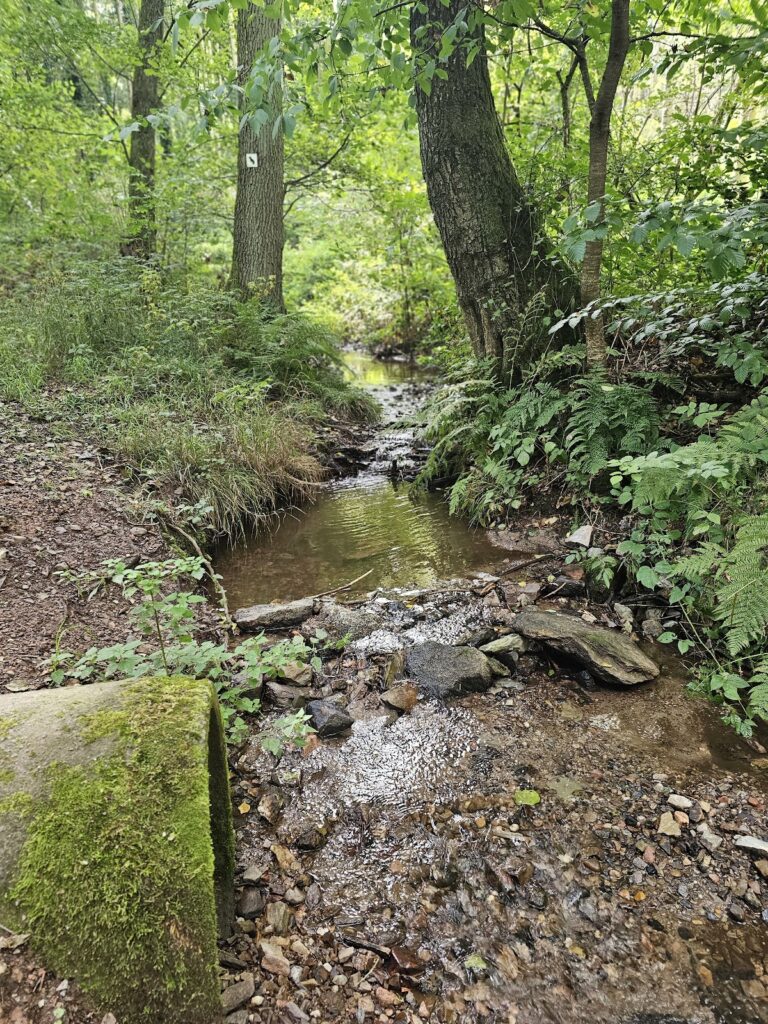
Hauenstein occupied a hill at about 255 metres above sea level above the Schlossgrundgraben, a stream that flows into the Kahl. A depression separated the castle hill from the higher ground now occupied by the large Hauenstein farm. The site was a rubble-stone spur castle, with its defenses and buildings arranged across the projecting hilltop. An earthwork crossing the stream bed could impound the upper part of the watercourse, adding a water-related defensive feature to the position.
Inner castle and defenses
Only slight wall remains survive above ground, together with a cellar and adjoining wall sections on the eastern side of the castle plateau. The 2017 excavation identified a tower at the southwestern corner of the inner castle. Around the castle was a zwinger, a defensive enclosure or passage between the main wall and an outer wall or obstacle. Excavators also found the remains of a substantial stone building in front of the castle wall beside the Schlossgrundgraben.
Residential buildings and archaeological finds
Fortified residence
The principal building was a fortified residential house with a heated living section. Its surviving cellar has masonry walls and a barrel vault, while adjoining wall courses remain to the east. The excavation produced extensive collapse material from the destroyed castle. Among the finds were metal remains from a hanging-light figure, an early halberd, a battle-axe, a pike, horseshoes, crossbow bolts, a trowel, and another halberd.
Many stove tiles were also recovered, including tiles of the Tannenberg type made in Dieburg ware. Their quality indicates that the castle had relatively well-appointed furnishings. The objects from the collapsed layers provide evidence for both the fortified residence and the material life of its occupants.
Stone building outside the castle wall
The substantial stone building beside the Schlossgrundgraben yielded fragments of door portals and a Gothic tracery window. Other recovered material included storage, cooking, and drinking vessels, roof tiles, and a floor tile. These remains identify a built structure with domestic and architectural elements outside the main castle wall.
Outer bailey and approach
The complex probably included an outer bailey in the area of the present large Hauenstein farm. Its buildings included stables, barns, and storage halls. Structures south of the farm, together with documentary evidence, associate this area with the later Schloss Hauenstein. The earlier trade route called the Alte Heuweg is linked with the approach to the ruin, while a branch of the Birkenhainer Road passed close to the castle.