Randenburg: A Medieval Spur Castle in Germany


Site at a Glance
- Rating
- 4.6
- Popularity
- Very Low
- Country
- Germany
- Primary era
- Medieval
- External website
- Open
- Eras represented
- Medieval
- Civilizations
- Holy Roman Empire
- Site type
- Military
- Remains
- Castle
On this page9 sections
History
Randenburg is an abandoned medieval spur castle in Germany, southeast of Alzenau in Bavaria. The Lords of Kälberau probably built it around 1175 as a private stronghold, and they later took the name Lords of Rannenberg. The castle was first mentioned in 1227 and stood roughly in the middle of the Free Court of Wilmundsheim, a medieval judicial territory.
The Rieneck and Mainz conflict
During the thirteenth century, Randenburg acquired strategic importance in the struggle between the Counts of Rieneck and the archbishops of Mainz, who combined ecclesiastical authority with territorial and political power. The castle apparently passed into Rieneck possession by 1258. The conflict ended with the victory of Werner von Eppstein, the elector and archbishop of Mainz. Under the settlement, Randenburg’s fortifications had to be demolished on 17 March 1266.
The destruction may have encouraged Mainz to construct Alzenau Castle about 140 years later. Randenburg probably existed for slightly less than a century, a considerably shorter period than the nearby Forgotten Castle on the neighboring hill.
Attempts to restore the castle
Randenburg remained the subject of later property and political arrangements. An attempt to sell parts of the mountain and the castle remains failed in 1311 after Peter von Aspelt, archbishop of Mainz, exercised his veto. In 1357, Fritze von Rannenberg, a nobleman who held a Mainz fief, sold one-third shares of Rannenberg Mountain, the jurisdiction of Wilmundsheim, and the jurisdiction of Somborn to Ulrich III of Hanau and Eberhard of Eppstein. The three men became joint heirs, and their shares could be transferred only among them.
The agreement also aimed to rebuild a castle on Rannenberg, with each partner holding one-third. Such a construction required the consent of Gerlach von Nassau, another archbishop and elector of Mainz. The Lords of Rannenberg were intended to act as burgraves, officials responsible for administering or commanding the castle. Several rebuilding attempts were blocked by the archbishops of Mainz, after which the site was dismantled and used as a quarry.
Legend and later protection
A local legend links Randenburg with the origin of Alzenau’s name. It says that, after the castle was captured, the castle lord’s wife was allowed to leave with whatever she could carry. She carried her husband over her shoulders and, when he asked her to abandon him, replied that he was “all too near” before dragging him across a nearby hill. According to the story, he later founded a new castle there and called it Allzunah, a name supposedly connected with the later form Alzenau. The story is a local tradition rather than an established explanation of the name.
The Lords of Rannenberg have also sometimes been proposed as the later builders of Ronneburg in Hesse. This connection has not been demonstrated. The two complexes existed at roughly the same time, while Ronneburg is probably older.
Randenburg and the nearby siege fortification are protected as archaeological monuments under the Bavarian Monument Protection Act. The Bavarian State Office for Monument Protection lists Randenburg as archaeological monument D-6-5920-0004. Archaeological investigation and deliberate collection of finds require permission, while chance discoveries must be reported to the monument authorities. An excavation planned for 2019 by ASP, in cooperation with the municipality and local associations, had not taken place by the end of 2020 because of the poor condition of the forest. The planned work was also to examine the nearby siege fortification.
Remains
Layout and defenses
Randenburg was a south-facing spur castle, a fortification built on a projecting ridge and using steep slopes as part of its defenses. It occupied a long, elevated spur above the Krebsbach valley on the western side of the Spessart, between Schanzenkopf and Hahnenkamm, at about 250 meters above sea level. The castle extended for approximately 150 meters and was arranged in a main castle with two outer baileys, or fortified outer courts.
A ring ditch surrounded the complex, while several neck ditches divided and protected its sections. Their courses remain clearly visible in the landscape. Except on the steep southern side, the castle was enclosed by a deep system of ramparts and ditches. The defenses were doubled along the somewhat flatter western side, where the approach was easier.
The outer baileys
The two outer baileys were separated from one another by deep neck ditches. The northernmost was triangular, with its point directed north toward the approach side of the spur. Preliminary investigations between the middle outer bailey and the southern main castle found no stone building elements in the outer courts. They are therefore currently understood as structures that were built only of wood.
The main castle
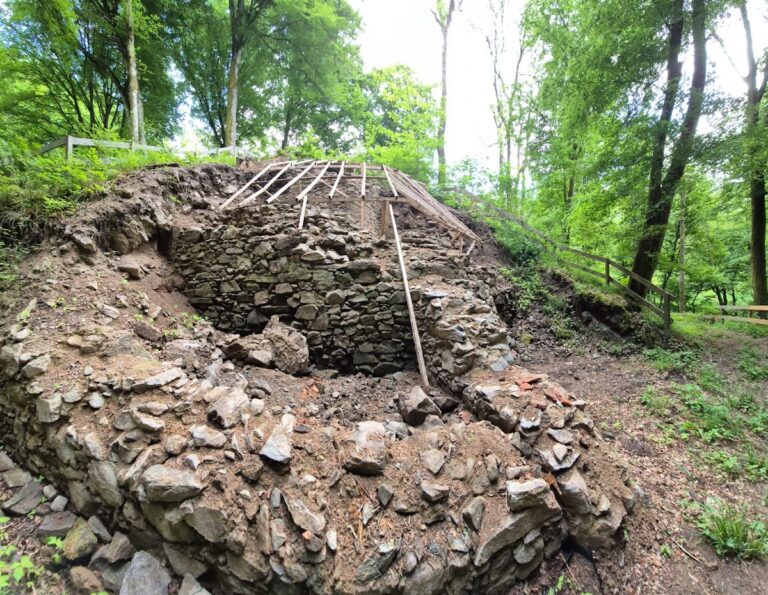
Terrain surveys indicate that the main castle contained a tower and a building immediately to its north, possibly a palas, the principal residential and representative building of a medieval castle, often including a great hall. Two pits, each about 12 meters wide, lie west of the foot of the main castle within the castle area. An elongated crater that remains visible was probably a large vaulted cellar.
The nearby siege fortification
About 300 meters northeast of Randenburg, a small castle-like siege fortification stood on the rising ridge. Its surviving remains include a rampart-and-ditch system and a water source. These features are interpreted as evidence of a siege by troops of the archbishop of Mainz.
Randenburg is now a Burgstall, an archaeological castle site whose buildings have largely disappeared, leaving earthworks or foundations rather than a standing ruin. Ramparts, ditches, earth-covered castle mounds, and the broader defensive layout survive. Illegal bicycle trails threaten these archaeological remains.