Smolny Convent: A Russian Orthodox Monastery and Educational Complex in Saint Petersburg
Site at a Glance
- Rating
- 4.8
- Popularity
- Medium
- Country
- Russia
- Primary era
- Early Modern
- External website
- Open
- Eras represented
- Early Modern, Modern
- Civilizations
- Russian
- Site type
- Religious
- Remains
- Monastery
On this page13 sections
History
Smolny Convent is a former Russian Orthodox women’s monastery in Saint Petersburg, Russia, founded in the eighteenth century under the personal supervision of Empress Elizabeth Petrovna. Planned in the ornate Baroque style, it was intended to become Elizabeth’s retirement residence and a major religious and educational complex.
Foundation under Elizabeth Petrovna
Elizabeth ordered the convent beside Smolny House, a small palace at Smolny Court where she had lived during her youth. The planned establishment included a cathedral, domestic churches, an exceptionally high bell tower, and an educational institution for girls from noble families. It was intended to accommodate 200 nuns and was classified in 1764 as a first-class monastery, the highest category in the imperial system.
The cathedral foundation stone was laid on 30 October 1748. After the foundations of the ensemble had been completed, construction of the walls began in May 1751. Bartolomeo Rastrelli, an Italian-born architect in Russian imperial service known for monumental Baroque buildings, designed the complex. Its buildings were substantially completed by 1769, although finishing work on the cathedral continued until 1835.
The projected bell tower was designed to be exceptionally tall, potentially making it the tallest building in Saint Petersburg and, at that time, in Russia. It was never built. The decision was connected both with the interruption of funding and with examination of the architectural model for the ensemble, rather than with financial difficulties alone.
Transformation into an educational centre
By 1764, five nuns remained at the monastery, and the convent was dissolved. Catherine II, Elizabeth’s successor, established the Educational Society for Noble Maidens there on 28 June 1764. The institution provided for 200 pupils from hereditary noble families. Nuns from other monasteries were initially expected to teach them, but they could not carry out the educational work, and the monastery’s intended role came to an end. An alternative tradition places the formal closure in 1822, attributing it to the lack of sisters.
A department for girls of non-noble origin opened north of the convent in 1765. It trained future seamstresses, governesses, and housekeepers, becoming the Alexandrovsky School in 1842 and the Alexandrovsky Institute in 1891. A separate building for the Smolny Institute for Noble Maidens was erected south of the convent in 1808. The institute remained there until it closed in the summer of 1917.
By imperial order, the Widows’ House moved into the former convent in autumn 1809. This institution provided residence and support for widows, and it used the churches of Saint Catherine and Saints Zachariah and Elizabeth. It continued operating until the Revolution and was abolished in 1917.
Later religious and institutional history
A new women’s monastery with the same Resurrection Novodevichy identity was founded by decree of Nicholas I in 1848. It represented a continuation of the Smolny convent tradition, although it was a separate foundation.
The cathedral remained in liturgical use until 1923, when the Petrograd Soviet closed it. The building was subsequently used as a warehouse and transferred to the Museum of the History of Leningrad in 1969. A concert and exhibition hall opened there in 1990. The cathedral returned to the Russian Orthodox Church in the 2010s, and liturgical use was restored in January 2016.
Restoration of the cathedral’s upper facades, cupolas, dome, and crosses took place in 2015 and 2016. A project to restore the Church of Saints Zachariah and Elizabeth, the convent buildings, and their corner churches began in 2017, while work on that church had been underway since 2018. Restoration of the Church of Saint Catherine began in 2021, after the building had housed the archive of the Leningrad regional Communist Party committee during the Soviet period.
In the twenty-first century, former convent buildings accommodated departments of Saint Petersburg State University, including sociology, international relations, and political science, as well as a municipal committee concerned with law, public order, and security. The former convent ensemble is protected in Russia as a cultural-heritage monument of federal significance.
Remains
Monastery Ensemble
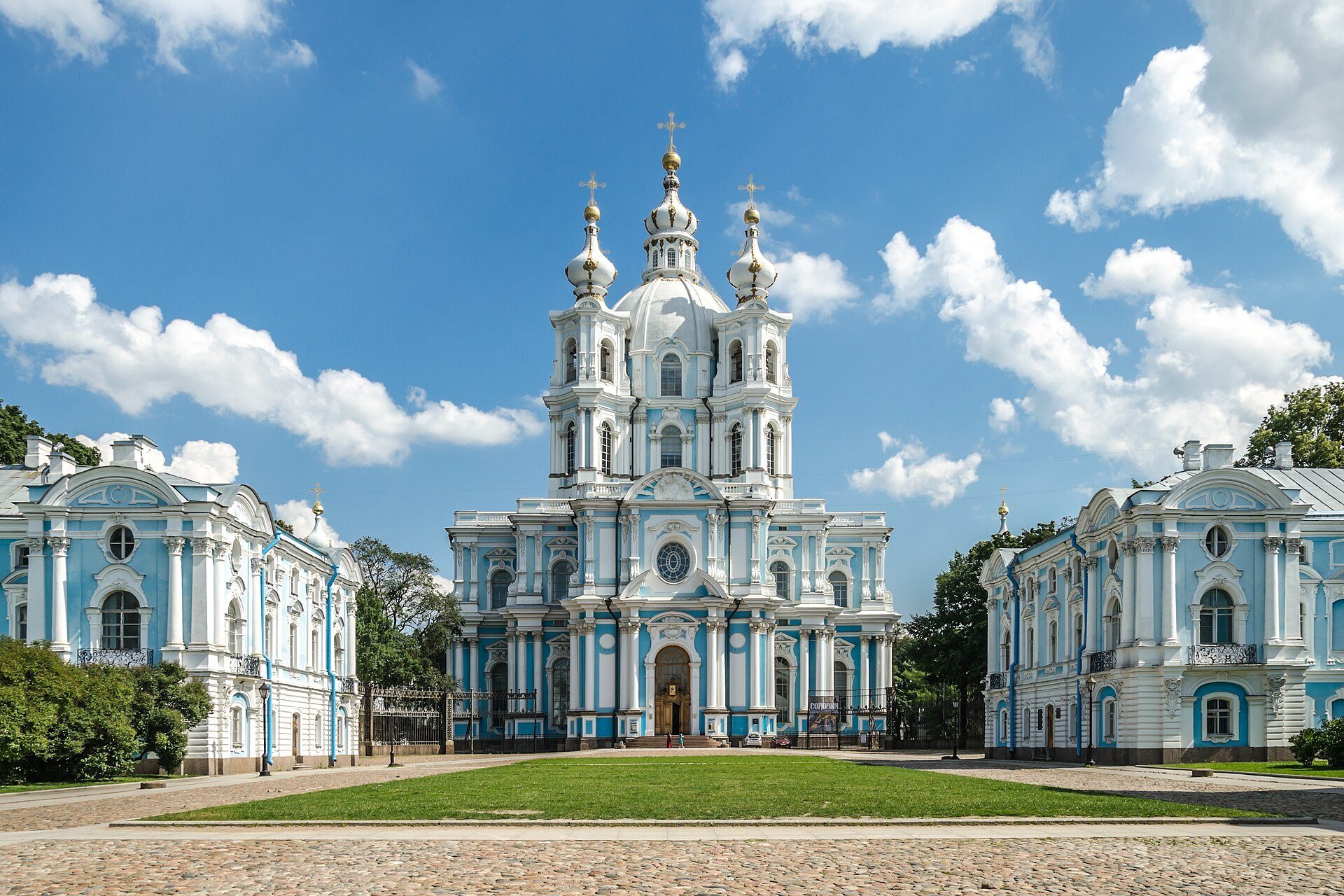
Smolny Convent stands on Rastrelli Square on the left bank of the Neva. Its commonly used name derives from the locality’s earlier association with processing pitch for shipbuilding and ship maintenance. The ensemble was planned as a cross-shaped quadrangle of residential buildings, with four corner towers, a central five-domed Resurrection Cathedral, and a stone perimeter enclosure.
Resurrection Cathedral
The Resurrection Cathedral forms the centre of the ensemble. Its blue-and-white exterior and five domes are arranged around closely grouped towers that give the building a tall, slender profile. Vasily Stasov completed the cathedral in 1835, adding an interior in the Neoclassical style, which draws on the forms and proportions of ancient Greece and Rome. The cathedral was consecrated that year, with the main altar dedicated to the Resurrection and the side altars to Saint Mary Magdalene and Righteous Elizabeth. It now functions as an Orthodox church and cultural venue.
Projected Bell Tower
The original plan included a tower of exceptional height as part of the quadrangle. Its proposed scale would have made it the tallest building in Saint Petersburg and, at the time, in Russia. The tower remained a project rather than a completed part of the ensemble, and the surviving complex is organized around the cathedral and the four corner towers.
Corner Towers and Churches
Church of Saint Catherine
The Church of Saint Catherine occupies the second floor of the northeastern clock tower. It was consecrated on 4 August 1764 and repaired in 1894. Restoration began in 2021, following the building’s later use as the archive of the Leningrad regional Communist Party committee.
Churches of Saints Zachariah and Elizabeth
The Church of Saints Zachariah and Elizabeth occupies the third floor of the northwestern tower. It was consecrated on 5 February 1765. The same tower later contained a Lutheran Chapel of Saint Mary on its second floor. Consecrated on 14 October 1865, the chapel was subsequently moved to the southwestern tower. Restoration of the Church of Saints Zachariah and Elizabeth was underway from 2018 as part of the wider restoration project begun in 2017.
Churches of Saint Alexander Nevsky
The Church of Saint Alexander Nevsky associated with the Educational Society for Noble Maidens was consecrated on 18 August 1808 in the southeastern convent tower. A separate Church of Saint Alexander Nevsky, associated with the Alexandrovsky Institute, was consecrated on 23 November 1867. It occupied a floor above the Church of Saints Zachariah and Elizabeth.
Associated Educational Buildings
The former convent buildings and the structures connected with its educational institutions survive with varied institutional uses. The northern department for girls of non-noble origin, the southern building of the Smolny Institute for Noble Maidens, and the convent churches formed part of the wider complex that developed around the cathedral during the eighteenth and nineteenth centuries.