Sheremetiev Palace: A Russian Noble Estate and Museum of Music in Saint Petersburg
Site at a Glance
- Rating
- 5
- Popularity
- Very Low
- Country
- Russia
- Primary era
- Early Modern
- Eras represented
- Early Modern, Modern
- Civilizations
- Russian
- Site type
- Domestic
- Remains
- Elite Residence
On this page16 sections
History
Sheremetiev Palace, also known as the Fountain House, is a historic Russian noble estate in Saint Petersburg, Russia, established in 1712 and developed through the eighteenth and nineteenth centuries in the Russian Baroque style and later forms. Peter the Great granted the land beside the Fontanka River to Field Marshal and Count Boris Sheremetiev, one of Russia’s leading military commanders and its early counts, on the condition that he build a residence there. The estate stood beyond the main Sheremetiev residence on the Spit of Vasilyevsky Island and remained with five generations of the family’s senior comital branch until 1917.
Formation of the estate
Pyotr Borisovich Sheremetiev inherited the property in 1719. During the 1730s, a large pond was dug on the estate, and the excavated soil was used to raise the roadway of what is now Liteyny Prospect. On the site of earlier wooden buildings, G. D. Dmitriev built a new one-storey stone palace in the late 1730s and early 1740s. Savva Chevakinsky and the serf architect Fyodor Argunov added a second storey and remodelled the building in the Russian Baroque style during the early 1750s.
After the deaths of his wife and daughter, Pyotr Borisovich moved to Moscow in 1768, although work on the estate continued. When he died in 1788, the property passed to his son Nikolai Petrovich, who began living there regularly in the late 1790s and settled in the Fountain House in 1796. He employed Ivan Starov to remodel the interiors, followed by later work from Giacomo Quarenghi and Andrei Voronikhin. The estate also contained a family serf theatre and orchestra, performing institutions maintained by the Sheremetiev household before the abolition of serfdom.
Nineteenth-century expansion
After Nikolai Petrovich’s death in 1809, the estate passed to his six-year-old son, Dmitri Nikolayevich. Empress Maria Feodorovna established a guardianship over the property because of the heir’s age. Between 1811 and 1813, an Office Wing and adjoining Hospital Wing were built on the site of an orangery facing Liteyny Prospect. In 1821, Domenico Quadri built the three-storey Fountain Wing beside the Fontanka, and a Choir Wing was later constructed between it and the Hospital Wing for singers of the Sheremetiev chapel, which had developed from his father’s serf choir.
Dmitri Nikolayevich’s service in the Cavalier Guard Regiment brought fellow officers to the palace, giving rise within the regiment to the expression “living at Sheremetiev’s expense.” The artist Orest Kiprensky visited frequently from 1824 and painted portraits of the count’s associates. In late May and June 1827, he painted his well-known portrait of Alexander Pushkin in a studio at the palace.
During the 1830s and 1840s, Ivan Corsini remodelled parts of the interiors, designed the Fontanka railings and gates in 1838, and built the Garden Wing in 1845. The palace hosted musical evenings at which performers included Mikhail Glinka, Hector Berlioz, Franz Liszt, Pauline Viardot, Rubini, and Barteneva. A North Wing was added in 1867 to a design by Nikolai Benois. After Dmitri Nikolayevich died in 1871, the estate was divided between his sons Sergei and Alexander, and the Fountain House passed to Sergei Dmitrievich Sheremetiev.
Division and transformation
In 1874, Alexander Serebryakov built new five-storey blocks that divided the estate into two sections. Income-producing buildings lined Liteyny Prospect, while the ceremonial part remained on the Fontanka. During the early twentieth century, the Garden Gates, grotto, Hermitage, orangery, Chinese gazebo, and other garden structures were demolished. The riding hall and stables were converted into a theatre hall in 1908, now associated with the Drama Theatre on Liteyny, and two-storey commercial pavilions were added in 1914.
Sergei Sheremetiev maintained a large family archive at the palace and supported the activities of historical societies, including the Society of Lovers of Ancient Writing and the Russian Genealogical Society. After the 1917 Revolution, he voluntarily accepted nationalization of the property. From 1918 to 1931, the palace housed a Museum of Noble Life and Serf Life in the eighteenth to twentieth centuries, later incorporated into the Historical and Everyday-Life Department of the Russian Museum. Its collections came from the Sheremetiev holdings, but they were subsequently dispersed among state institutions. Some works went to the Hermitage and the Russian Museum, while parts of the library went to the Russian National Library.
Twentieth-century institutions and memorial associations
In 1935, the right wing became the House of Entertaining Science, organized by Yakov Perelman, and also housed the Main Administration of the Northern Sea Route, the maritime route along Russia’s Arctic coast. The House of Entertaining Science closed in 1941 after the beginning of the Second World War. After the war, most of the palace was occupied by the Arctic and Antarctic Research Institute until 1989.
Restoration begun in the late 1980s and continued during the 1990s enabled the ceremonial suite on the second floor to reopen as part of a museum. Since 1990, the palace has housed the Museum of Music, a branch of the State Museum of Theatre and Music. The south wing contained service apartments for museum employees, and Anna Akhmatova, a major Russian poet of the twentieth century, lived within the complex from the 1920s until 1952. Her residences are associated with the south garden wing and, for the later period, the north wing. The Anna Akhmatova Memorial Museum has operated in the complex since 1989.
On 22 March 2015, memorial plaques were installed through the Last Address civic initiative for Nikolai Punin and Genrikh Kaminsky. Both men had been arrested and later died in Soviet forced-labour camps before being rehabilitated for lack of evidence of a criminal offence. In 2001, the palace complex entered the Unified State Register of Cultural Heritage Sites of the Peoples of the Russian Federation as a cultural heritage site of federal significance.
Remains
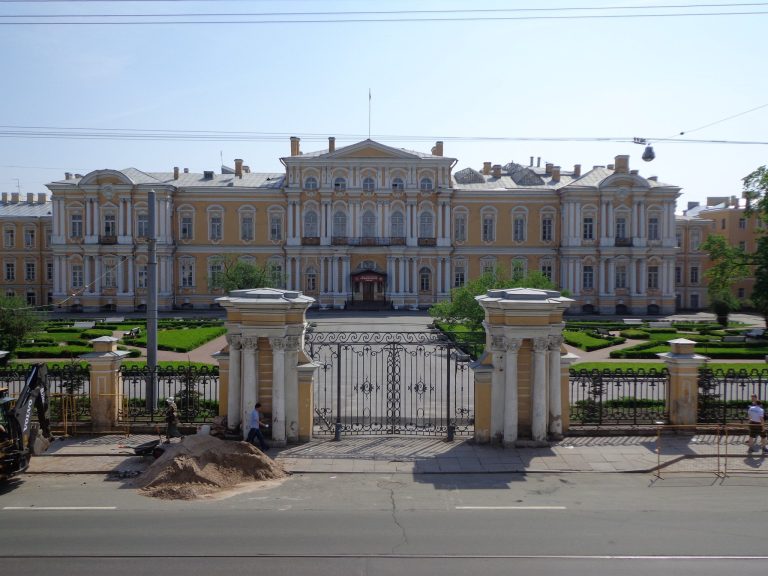
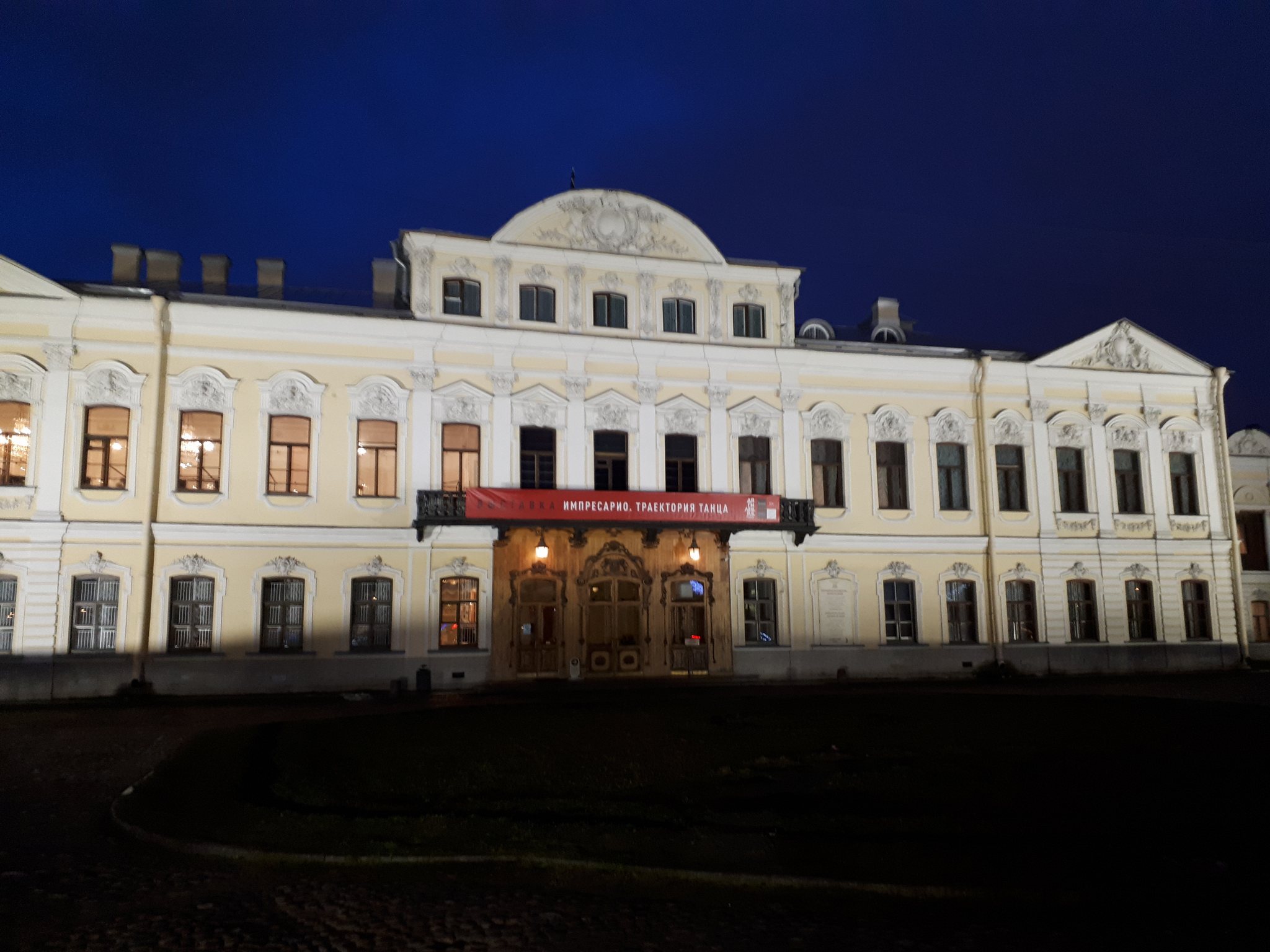
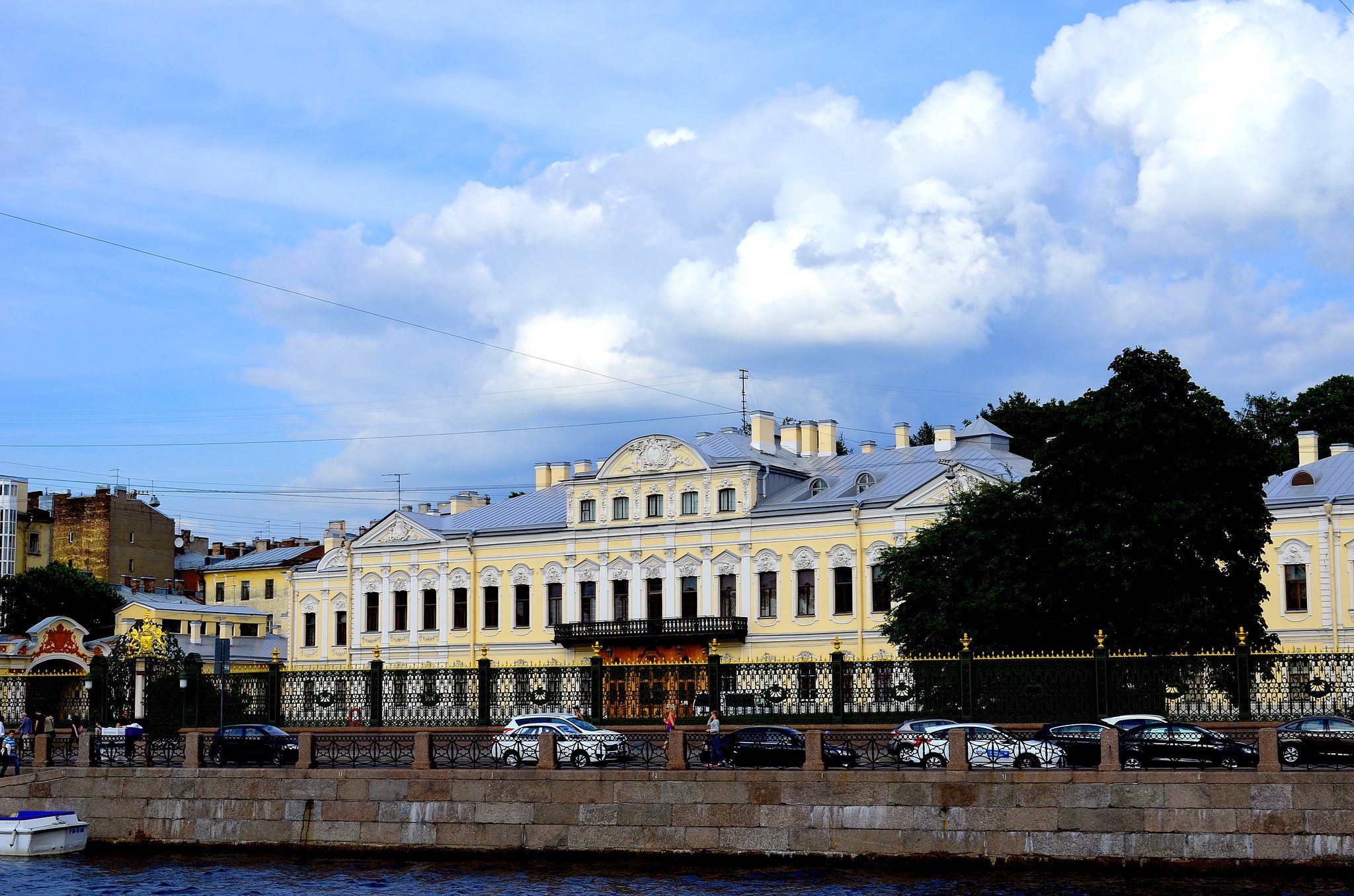
The surviving complex is organized around the main palace at the rear of a formal courtyard open toward the Fontanka. Its architectural character combines Russian Baroque with later eclectic alterations. The principal building, originally a one-storey stone structure, was raised to two storeys. Its central facade has pilasters and a mezzanine crowned by a segmental pediment containing a Sheremetiev heraldic cartouche. Slightly projecting end sections of the side wings are decorated with pilasters and triangular pediments.
Main palace and ceremonial interiors
Main palace
A wooden balustrade with statues on pedestals originally ran along the roof. The centre of the building had a tall, two-flight entrance porch, and in 1759 two gilded wooden horse figures by Johann Franz Dunker were placed on pedestals beside the entrance. The restored ceremonial rooms on the second floor form an enfilade, a sequence of rooms aligned through connecting doorways, and are included in the Museum of Music. The museum’s musical-instrument collection is displayed on the first floor and in these restored rooms.
Fontanka boundary
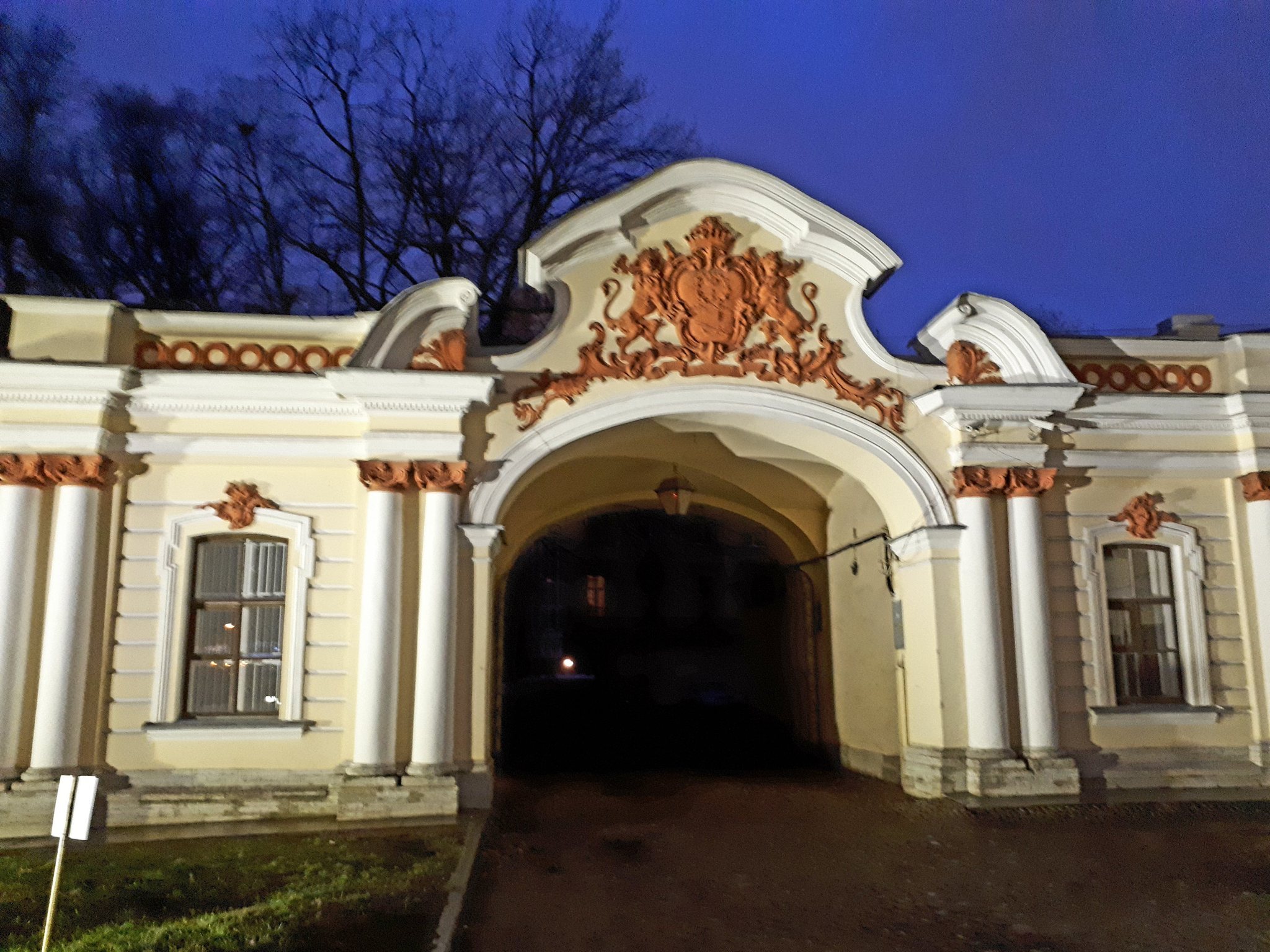
The boundary along the Fontanka consists of the cast-iron railing and gates designed by Ivan Corsini in 1838. Their decoration includes the Sheremetiev family arms. Two pavilions dating from 1821 to 1824 and the garden are also part of the surviving complex. The garden incorporates documented phases from the 1730s, the late eighteenth and early nineteenth centuries, and the 1930s.
Wings and associated buildings
Gallery and courtyard wings
The Gallery Wing incorporates work by Giacomo Quarenghi from 1803 and Ivan Corsini from 1839. The South Courtyard Wing dates from 1828 and is associated with Domenico Quadri. The Kitchen Wing was built in 1864 to a design by Nikolai Benois.
South Garden Wing
The South Garden Wing was built in 1845 and altered in 1911 and 1914. It is associated with Anna Akhmatova’s residence and forms part of the palace complex containing her memorial museum.
Office, Hospital, and Choir Wings
The former orangery site contains the Office Wing and Hospital Wing, built between 1811 and 1813. The three-storey Fountain Wing, constructed in 1821 with its principal facade facing the Fontanka, was joined to the Hospital Wing by the Choir Wing, built for singers of the Sheremetiev chapel.
Former estate features and collections
Former garden and performance structures
The estate formerly included a Summer House, carriage sheds, a Garden Pavilion, a riding hall, stables, an orangery, a grotto, an Hermitage, a Chinese gazebo, and garden gates. The riding hall and stables became a theatre hall in 1908. The orangery and several other garden structures were later demolished. The protected grounds also contain the foundations of an eighteenth-century fountain, which was filled in during the late eighteenth century.
Collections and memorials
The Sheremetiev family collection associated with the palace included paintings, sculpture, arms, decorative-arts objects, furniture, books, musical scores, manuscripts, church vessels, and icons from the household chapel. These holdings were later dispersed among several state institutions. The complex now contains the Anna Akhmatova Memorial Museum, while the 2015 memorial plaques commemorate Nikolai Punin and Genrikh Kaminsky by recording their names and fate.