Slot Teylingen: A Medieval Water Fortress and Hunting Castle in the Netherlands


Site at a Glance
- Rating
- 4.1
- Popularity
- Low
- Country
- Netherlands
- Primary era
- Medieval
- External website
- Open
- Eras represented
- Medieval
- Civilizations
- Unclassified
- Site type
- Military
- Remains
- Castle
On this page14 sections
History
Slot Teylingen is a medieval Dutch castle in the Netherlands, near Voorhout and the boundary with Sassenheim. It was probably the ancestral seat of the noble Van Teylingen family, from which the Van Brederode family directly descended. Established to protect the north-south route through the County of Holland, the castle developed during the thirteenth century from a water fortress into a fortified residence and later served the counts of Holland as a hunting and forestry centre.
Foundation and comital ownership
Willem van Teylingen is credited with building the original water fortress in the thirteenth century. A water fortress was protected partly by surrounding water, usually through a moat or a watery landscape. Dirk van Teylingen is said to have expanded and strengthened the site into a residential fortress around 1250. The castle first appears in writing in 1271, when Dirk held it as a hereditary fief from the count of Holland. The record refers to the place as “apud Teylinge.” A fief was property granted by a superior lord in return for service or allegiance.
Dirk died on 12 November 1283. His son Willem succeeded him but died a few weeks later without an heir, and the castle then reverted to the count of Holland. From 1283 the counts retained Teylingen rather than granting it as a fief. They used it for hunting, the administration of their forests, and the supply of game.
Count Floris V granted the castle and its associated estate to his mistress, Catherine of Durbuy, the widow of Albert of Voorne. After her remarriage in 1293, she was allowed to keep Teylingen until her death in 1328. Under William IV, Count of Holland, the castle became a centre for the counts’ forest administration. In 1329 William IV leased it to Simon of Bentheim, who became forest master. This office involved supervising hunting on the count’s estate and providing timber and game for the comital court. The connection between Teylingen and forestry continued until the end of the eighteenth century.
Foresters, castellans, and political conflict
Simon of Bentheim adopted the name Teylingen and repaired the castle in 1337 and 1338. He and William IV were killed at the Battle of Warns in 1345. The following year, Jan Boechorst became forest master, although the castle remained occupied by the widow of the previous holder and her new husband, Gerrit of Herlaer. In 1348 she surrendered Teylingen in return for compensation, and the property passed to Gerrit of Heemstede.
Gerrit of Heemstede supported the Hooks during the Hook and Cod Wars, a prolonged civil conflict in the County of Holland between rival political factions. When the Cod faction prevailed, Gerrit was removed from office and Teylingen passed to Jan of Herlaer. After Jan’s death, Willem of Wateringen received the property. He was appointed castellan, an official responsible for administering and defending a castle, for three years in 1353, but was dismissed in February 1355.
Willem opposed his dismissal partly because William of Bavaria, also known as Count William V of Holland, had previously killed Willem’s brother Gerrit of Wateringen during an apparently unprovoked fit of mental disturbance. In 1357 the count granted Willem “the house with all its appurtenances of Tylinge” as a fief. Willem supported Duke Albert, who became regent the following year, and lived at Teylingen with his wife until his death in 1365.
After Willem’s death, Teylingen briefly returned to Gerrit of Heemstede, who transferred it to the duke the following year. Following Count Albert’s death, his widow Margaret held the castle and used it as a hunting lodge and base for hunting parties and excursions. From 1376, the holders of the forestry office included Foycken Willemsz., Bartholomew Raephorst, and Willem Veldam. They did not live at the castle as foresters. Jan Boechorst, the castellan, directed a thorough renovation of the complex in 1383.
Jacoba of Bavaria and later decline
Jacoba of Bavaria was the best-known resident of Slot Teylingen. She withdrew there after the Hook and Cod Wars and died at the castle while married to her fourth husband, Frank of Borssele. He was a prominent nobleman and the first stadtholder of Holland after the comital period. Jacoba was a countess of Holland, Zeeland, and Hainaut whose succession and marriages made her a central figure in the conflict between the Hooks and the Cods.
The castle was severely damaged during the Eighty Years’ War around 1570. This conflict was the Dutch revolt against Spanish rule. Teylingen was partly restored afterward, but the donjon burned out around 1675. The complex then began to deteriorate, and other sections were gradually demolished.
Protection and conservation
The estate and ruins belonged to the territory of Holland until they were nationalized in 1795. The property was later sold on the condition that the ruins could not be demolished, making Teylingen an early example of monument protection in the Netherlands. Jhr. G. W. van Teylingen donated the ruins to the Dutch state in 1889. They later became part of the portfolio of the Rijksgebouwendienst, the Dutch government service responsible for government buildings and, historically, parts of the national architectural heritage.
During the late twentieth century, the ruins were restored and the partly filled moat was excavated and restored after the Slot Teylingen Foundation acquired additional land and donated it to the state. The castle and its surroundings are a Rijksmonument, a site protected under the Dutch national monument system. On 15 January 2016, the monument was transferred to the Monumentenbezit foundation, which owns and manages protected historic properties. The municipality of Teylingen, formed in 2006 through the merger of Sassenheim, Voorhout, and Warmond, takes part of its name from the castle.
Remains
Fortress layout
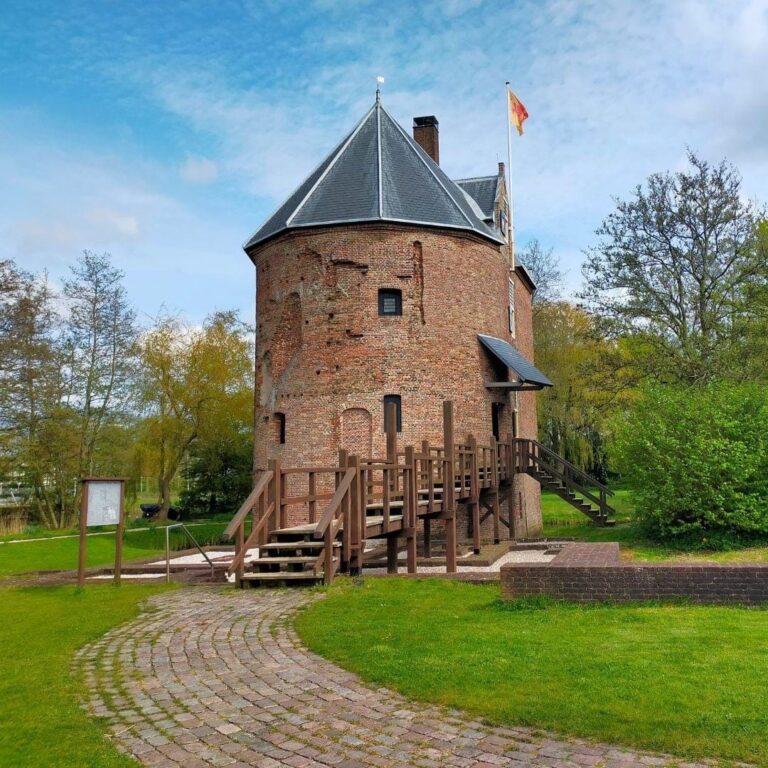
Slot Teylingen was a round water fortress approximately 37 metres in diameter. Its earliest form consisted of a ring wall dating from the beginning of the thirteenth century. The castle stood partly within water, and a moat formed part of its defensive setting. Although the moat was partly filled in over time, it was excavated and restored during the late twentieth-century conservation work.
Ring wall
The massive ring wall has buttresses on its inner side. These supported arches and a wall-walk, a passage running along the top of a defensive wall. The circular wall formed the principal enclosure of the early fortress and remains the main surviving element of the consolidated ruin.
Donjon
A donjon, the principal fortified tower and a major defensive and residential element, was added later in the thirteenth century. It formed part of the ring-wall circuit. The donjon burned out around 1675, and its surviving masonry now forms part of the ruin that remains at the centre of the castle’s interpretation as a fortified residence.
Outer wall and forecourt
The castle also included an outer wall and a forecourt. In the fourteenth century, a comfortable residential building was constructed against the outer wall. The early castle’s residential building dates from shortly after the ring wall, while the later fourteenth-century residence has not survived. The consolidated ruin principally consists of the ring wall and donjon and is also used as a museum.
Landscape and associated estate
Raised road to the hunting domain
A raised road ran westward from the strategic fortress through the marshy coastal plain to the counts’ hunting domain in the dunes of Noordwijkerhout. Part of this route retained the name Gravendam, meaning “the count’s dam.” The road reflects Teylingen’s connection with the comital hunting landscape and its role in administering the surrounding estate.
Keukenduin
The lands associated with Slot Teylingen were known as Keukenduin. Their wild game, livestock, herbs, and berries were intended for the castle household or kitchen. The later name Keukenhof derives from this association.
Jacoba jugs
Drinking jugs excavated around the castle and dredged from the moat are known as Jacobakannetjes, or “Jacoba jugs.” Their name links these objects with Jacoba of Bavaria, the castle’s best-known resident. They form part of the material evidence associated with the site and its later historical interpretation.