Real Monasterio de San Joaquín y Santa Ana: A Neoclassical Cistercian Monastery in Valladolid
Site at a Glance
- Rating
- 4.4
- Popularity
- Low
- Country
- Spain
- Primary era
- Early Modern
- External website
- Open
- Eras represented
- Early Modern
- Civilizations
- Spanish
- Site type
- Religious
- Remains
- Monastery
On this page11 sections
History
The Real Monasterio de San Joaquín y Santa Ana is a Cistercian nunnery in Valladolid, Spain, dedicated to Saint Joachim and Saint Anne, traditionally regarded in Christian belief as the parents of the Virgin Mary. The present monastery and church were built between 1780 and 1787 in a restrained Neoclassical style to designs by Francesco Sabatini, an Italian-born architect who served the Spanish Crown. The complex replaced a deteriorated sixteenth-century foundation and remains associated with the Cistercian Order of Saint Bernard, or of Castile.
Foundation and royal rebuilding
The original monastery was founded in 1596 for a community of Bernardine Recollect nuns, a Cistercian community. Its construction took place under Francisco de Praves. By 1777, however, the building had deteriorated so severely that it was threatened with collapse. Because the monastery had been established under royal patronage, the nuns appealed to Charles III, the Bourbon king of Spain, for protection and reconstruction.
Charles III commissioned Francesco Sabatini to prepare the design for a replacement monastery and church. Work began in 1780. Francisco Balzaina first directed the construction, while Francisco Álvarez Benavides served as contractor. M. Mariátegui later assumed direction of the works, which were completed in 1787. The rebuilding gave the community a new complex whose external restraint and ordered geometry reflected the architectural preferences of the late eighteenth-century Spanish Crown.
Religious and cultural use
The monastery continues to belong to the Cistercian tradition of Saint Bernard of Castile, whose female communities follow a disciplined communal and contemplative religious life. It is also the seat of the Brotherhood of the Holy Burial. Religious practices associated with the building have included exorcisms, adding another dimension to its continuing history as a sacred institution.
In 1978, the church was converted into a museum of sacred art. Its collection includes important examples of Spanish Baroque sculpture, including works by Gregorio Fernández and Pedro de Mena. On 1 September 2016, the church hosted the presentation and premiere of Per la ricuperata salute di Ofelia, a cantata by Wolfgang Amadeus Mozart and Antonio Salieri whose score had been lost for more than two centuries.
Protection and recognition
The monastery was declared a national historic-artistic monument and an Asset of Cultural Interest in 1956, through declarations dated 23 February and 23 March. These recognitions reflect the importance of the surviving royal foundation, its church, and its artistic contents within the historic fabric of Santa Ana Square in Valladolid.
Remains
Exterior and architectural composition
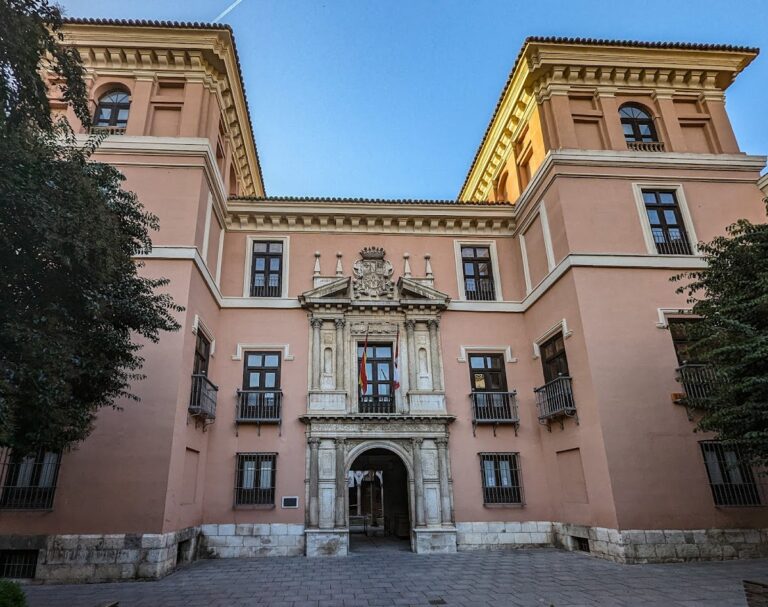
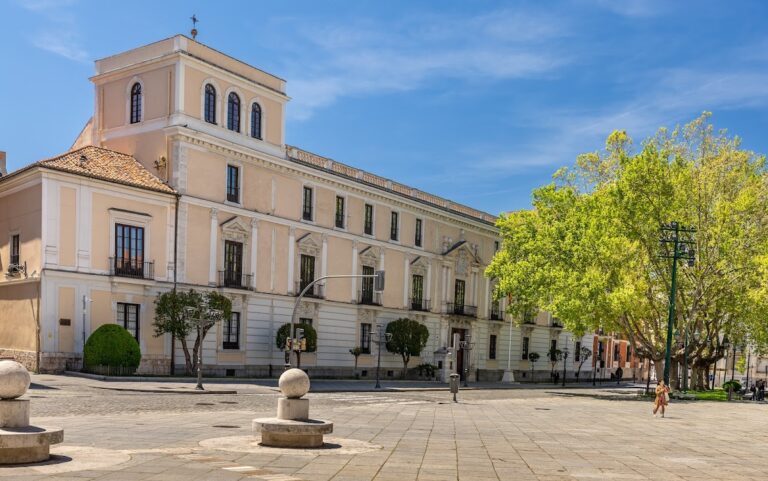
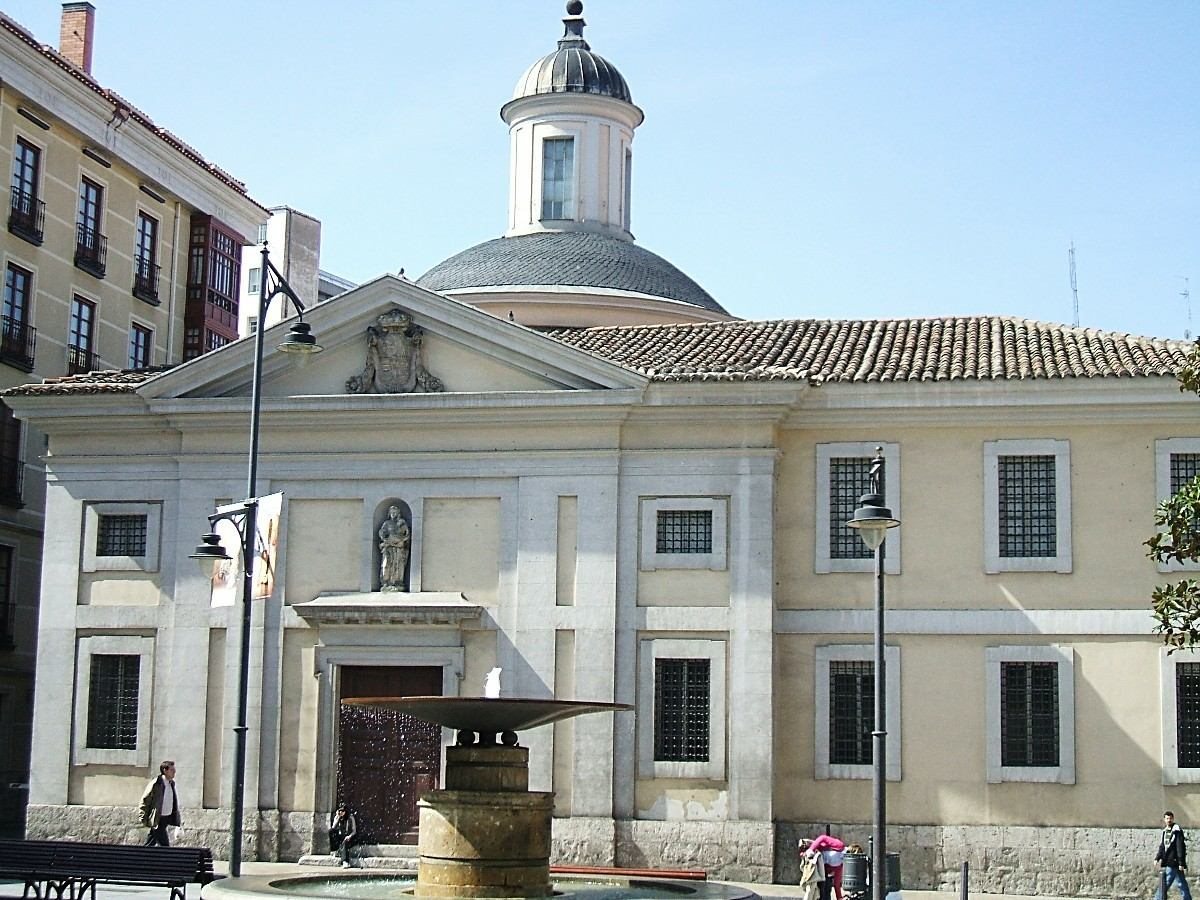
The present monastery and church form a strongly rectilinear complex with very limited exterior decoration. Smooth impost bands, which mark the springing point of an arch, and flat plate mouldings articulate the walls. The church facade receives richer moulding than the surrounding elevations, emphasizing its place within the monastic ensemble and controlling the building’s urban perspectives.
The facade belongs to the tradition of Herrerian architecture, a severe geometric style associated with Juan de Herrera and El Escorial that was revived by eighteenth-century architects such as Ventura Rodríguez. A sixteenth-century sculpture of Saint Anne occupies a niche above the doorway lintel and is believed to have come from the earlier monastery. The pediment above the facade contains the Royal Arms in its tympanum, the central field within a pediment.
Church interior
Elliptical church
The church has an elliptical plan and is covered by an elliptical dome pierced by round openings, or oculi. A narrow cylindrical lantern, a raised structure that admits light or ventilation at the top of a dome, crowns the composition. Flattened wall supports called pilasters organize the interior, while a large horizontal entablature runs above them and supports the rise of the dome.
Along the church’s major axis, three spaces are linked in sequence: a square entrance porch with a ceiling, the elliptical body of the church, and the square main chapel, which is also domed. The chapel opens onto the central space through a large arch rising above the entablature. This arrangement creates a dynamic and spatially complex interior associated with Borrominesque architecture, despite the building’s restrained Neoclassical decoration.
Side altarpieces and paintings
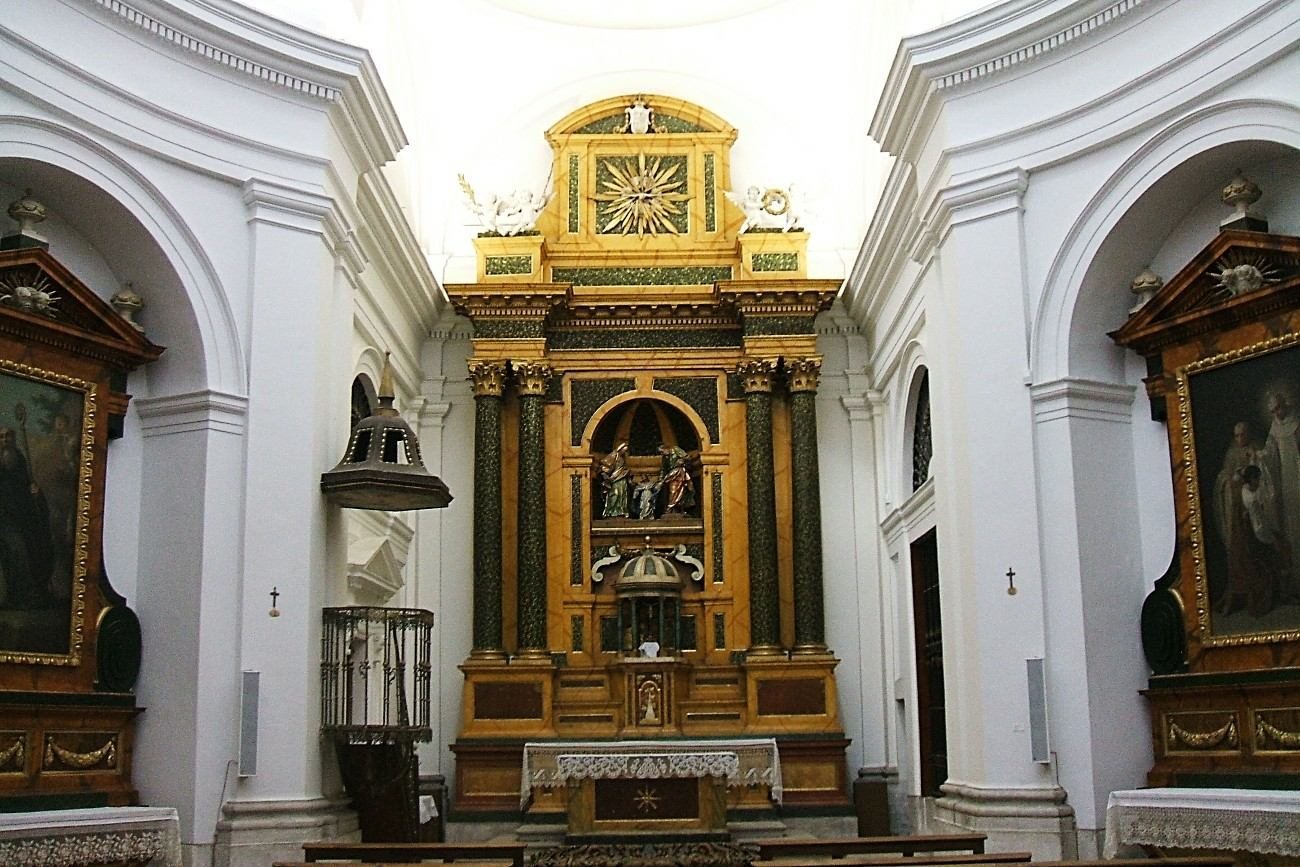
Six niches between the pilasters contain six large Neoclassical altarpieces, with three placed on each side of the major axis. Made of wood painted to imitate green marble, they are enriched with gold leaf, marble-effect cherubs, winged side elements, pilasters, and alternating triangular and curved pediments. Each altarpiece contains a painting made in 1787.
The three paintings on the Gospel side, the traditional left side of a church when viewed from the congregation toward the main altar, were painted by Ramón Bayeu. They depict Saint Scholastica, the Immaculate Conception with Saint Francis and Saint Anthony, and Saint Benedict, and are regarded as among Bayeu’s finest works. The three paintings on the Epistle side, the corresponding traditional right side, were painted by Francisco de Goya. They represent Saint Lutgarde, The Death of Saint Joseph, and Saints Bernard and Robert. Their austere religious manner recalls Zurbarán, the Spanish painter known for severe devotional compositions, and they are the only paintings by Goya preserved in Castile and León.
Main chapel and choir
The main chapel’s altarpiece consists of four Corinthian columns supporting a substantial entablature. Its central niche contains a late eighteenth-century sculptural group of Saint Anne, Saint Joachim, and the Virgin. The major axis of the church terminates at this altarpiece, while the monastic choir occupies the space beside the Epistle side of the chapel and contains Neoclassical choir stalls.
Sacred-art collection
The monastery’s sacred-art museum preserves Spanish Baroque sculpture alongside the church’s eighteenth-century paintings and architectural fittings. Among its works is a representation of the Dead Christ by Gregorio Fernández. The collection also includes works by Pedro de Mena, placing the museum within the artistic tradition of major Spanish sculptors of the Baroque period.