Shōrin-ji Temple: A Shingon Buddhist Temple in Sakurai, Japan


Site at a Glance
- Rating
- 4.4
- Popularity
- Low
- Country
- Japan
- Primary era
- Medieval
- External website
- Open
- Eras represented
- Medieval, Early Modern
- Civilizations
- Tokugawa, Yamato
- Site type
- Religious
- Remains
- Monastery
On this page9 sections
History
Shōrin-ji Temple is a Buddhist temple in Japan, located in Sakurai, Nara, whose traditional foundation dates to 712. It belongs to the Muro-ji branch of Shingon Buddhism, a Japanese tradition centered on ritual practice, mantras, mandalas, and major Buddhist figures. The temple is associated with the 76th station of the Northern Yamato Eighty-eight Sacred Places and the eighth station of the Yamato Jizo Ten Virtues Pilgrimage.
Foundation and Medieval Destruction
Temple tradition places the foundation of Shōrin-ji in 712, when Jōe, the eldest son of Fujiwara Kamatari, established it as Henjō-in. Fujiwara Kamatari was a seventh-century court leader traditionally regarded as the founder of the Fujiwara family, a powerful Japanese aristocratic lineage. Henjō-in functioned as an annex of Myorakuji at Tonomine, the institution now represented by Tanzan Shrine in the mountains south of Shōrin-ji.
Shōrin-ji’s earlier history remains uncertain in many respects. During a late-Heian conflict between Myorakuji and Kōfuku-ji, Kōfuku-ji attacked and burned the temple. Shōrin-ji was restored during the Kamakura period, preserving its institutional life after the destruction.
Early Modern Revival
During the Edo period, the monk Shōryō Genshin is said to have revived Shōrin-ji by transferring buildings from Miwayama Byōdō-ji, a Buddhist institution associated with Ōmiwa Shrine. The temple maintained close relations with Byōdō-ji thereafter. Although Shōrin-ji had begun as an annex of the Tendai institution Myorakuji, Tendai being a Buddhist school derived from the Chinese Tiantai tradition, it became a Shingon temple devoted to monastic observance.
During the Kyōhō era, approximately 1716 to 1736, a high-ranking Buddhist prelate of Myorakuji renamed the temple. In the same broad period, a monk spent four years and seven months traveling through the provinces to collect donations for the present principal image, an Edo-period seated stone Jizo made and enshrined for protection in childbirth and longevity.
Meiji-Era Transfers and Cultural Protection
During the Meiji government’s separation of Buddhism and Shinto, Buddhist institutions associated with shrines were dismantled or reorganized. The Eleven-Headed Kannon formerly enshrined at Daigorinji, a Buddhist institution connected with Ōmiwa Shrine, was transferred to Shōrin-ji. Daigorinji is now represented by Ōtataneko Shrine.
The Kannon is a National Treasure. Ernest Fenollosa praised the sculpture, and the philosopher and cultural historian Tetsurō Watsuji described it in Pilgrimage to Ancient Temples, published in 1919, as the supreme masterpiece of Tenpyō sculpture. Tenpyō was an eighth-century Nara-period cultural era known for major Buddhist sculpture. Art historian Kōichi Machida offered a different interpretation, regarding the statue as a formalized work from the end of the Tenpyō period.
Watsuji also preserved a tradition that the statue was discarded in grass during the suppression of Buddhism and discovered by the passing abbot of Shōrin-ji. Another interpretation holds that the abbot received it from Daigorinji and transported it to the temple on a handcart. Shōrin-ji’s grounds and associated cultural properties now receive national and municipal protection, including Sakurai municipal designation for the Pure Land of Mount Potalaka painting and an unadorned ritual stone chime.
Remains
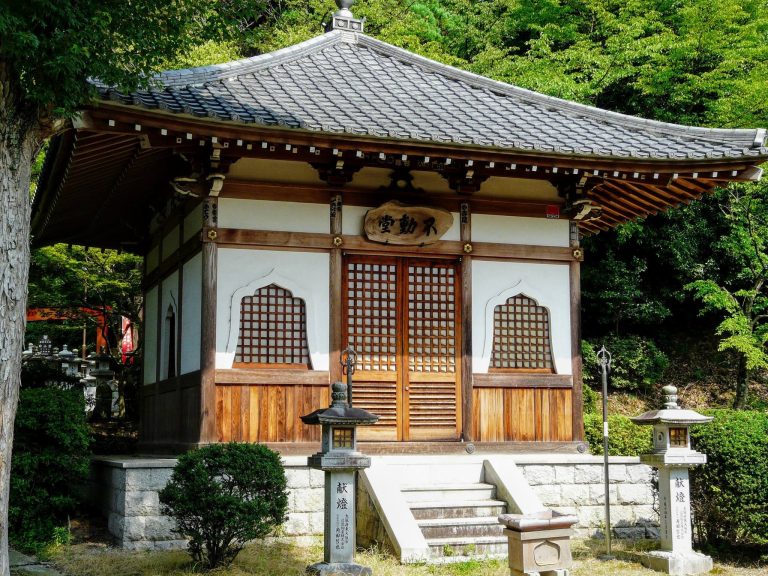
Shōrin-ji stands on a modest slope south of Sakurai’s urban area, with the Nara Basin visible to the north. Stone retaining walls support the sloping grounds, and the temple buildings rise above them. The surviving artistic remains include the National Treasure Eleven-Headed Kannon and the Edo-period stone Jizo that serves as the temple’s principal image.
Buddhist Sculptures
Eleven-Headed Kannon
The Eleven-Headed Kannon is 209.1 centimeters high and dates from the late Nara period. It is a wood-core dry-lacquer sculpture, a technique in which a wooden core is built up with lacquer mixed with powdered wood or a similar material. The basic form was carved from a single piece of wood and modeled with thick layers of dry lacquer, generally more than one centimeter thick. Detached elements, including the drapery, were shaped around iron-wire cores, and the completed surface received lacquer gilding.
Kannon, the Japanese name for Avalokiteshvara, is the bodhisattva of compassion. This image stands upright on a lotus pedestal. Its right arm hangs downward, with the third and fourth fingers slightly bent, while the left arm bends at the elbow to hold a water vessel at chest height. The head originally carried a Buddha face above the crown and surrounding faces consisting of three bodhisattva faces, three fanged faces, three wrathful faces, and one laughing face.
The sculpture is generally well preserved, with original elements in the head faces, drapery, attributes, and pedestal. Its original wooden-core dry-lacquer halo bears a hosoge floral ornament, a stylized design common in East Asian Buddhist art. The halo is severely damaged, and its surviving radiating section and part of the body halo are deposited with the Nara National Museum.
Lotus Pedestal
The pedestal combines a lotus seat, a lotus-pod-shaped support, an inverted-flower element, and a three-tiered framed base. Its inner lotus section is strongly bowl-shaped. The wooden petals curve sharply, carry raised central ridges, and end in angular cuts. Fifty-six petals are arranged like fish scales, with eight petals in each of seven courses. Thirty-nine are original, fourteen are medieval replacements, and the pedestal retains the strongly Nara-period character of its design. Two long tenons extend from the soles of the figure’s feet into the pedestal.
Jizo Image
The temple’s principal image is a seated stone Jizo made during the Edo period and finished with polychrome decoration. Jizo is a bodhisattva associated in Japan with protection, particularly of children and travelers. This image is known as the Jizo of safe childbirth and longevity and is venerated in connection with the granting of children.