Abe Monju-in Temple: A Historic Buddhist Temple in Sakurai, Japan


Site at a Glance
- Rating
- 4.3
- Popularity
- Medium
- Country
- Japan
- Primary era
- Early Modern
- External website
- Open
- Eras represented
- Medieval, Early Modern
- Civilizations
- Tokugawa
- Site type
- Religious
On this page13 sections
History
Abe Monju-in Temple is a Buddhist temple in Sakurai, Nara, Japan, traditionally founded in 645 during the Taika era. It belongs to the Kegon school, a Buddhist tradition emphasizing the interdependence of all phenomena. The temple’s formal name is Abezan Sōkyōji Monju-in, while its predecessor was known as Abe-dera. Its foundation is associated with Abe no Kurahashimaro, Minister of the Left during the Taika Reform, a series of seventh-century political and administrative changes that strengthened imperial government. With the patronage of Emperor Kotoku, Kurahashimaro established Sōkyōji as the Abe family’s clan temple.
The Abe-dera Foundation
The original temple stood approximately 300 metres southwest of the present site. Excavations there identified a seventh-century temple whose roof tiles support a foundation date in that period. The arrangement placed the Main Hall on the east and a pagoda on the west, following a plan associated with Horyuji. The Todaiji Yoroku names Abe no Kurahashimaro as the founder of Sōkyōji and gives Abe-dera as another name for the institution.
The original complex was destroyed by fire in the late Heian period, an era associated with aristocratic court rule, after an attack by warrior monks from Myorakuji on Mount Tonomine. That institution was the predecessor of present-day Tanzan Shrine. The former temple site is now known as the Abe-dera ruins, a nationally designated Historic Site developed as an archaeological park.
Revival and the Manjusri Cult
During the Kamakura period, when warrior government rose to prominence, the temple’s base moved to Manganji, a branch temple of Chisoku-in at the present location. The institution was revived there. Through the monk Chogen, who organized the restoration of Todaiji, the sculptor Kaikei created the principal image of Manjusri. Manjusri, called Monju in Japanese Buddhism, is a bodhisattva associated with transcendent wisdom and learning. Manganji consequently became known as Monju-do, and the complex flourished with 28 subsidiary temples as one of the Fifteen Great Temples of Yamato.
The temple’s Manjusri devotion grew during the late Heian period. In 834, the monk Shinga was said to have seen a vision of a golden Manjusri image emerging from a cave on the temple grounds, after which he dedicated the Monju-do. The monk Ninsho is also recorded as having regularly attended the temple during this period. The association with wisdom continues to draw students before examinations.
Fire, Reconstruction, and Later History
In 1563, the army of Matsunaga Hisahide burned the temple. Hisahide was a military commander and political lord of Japan’s Sengoku period, an era of prolonged warfare among regional powers. The principal image and several other Buddhist images survived, but almost all of the buildings were destroyed, and the temple declined afterward.
The former Abe-dera Manganji Main Hall, also called Monju-do, was rebuilt in 1665. The present Main Hall belongs to that reconstruction and has been rebuilt several times after fires. The temple survived the anti-Buddhist movement of the Meiji period and came to be known as Monju-in. In 1883, when Myorakuji was abolished and replaced by Tanzan Shrine, its former principal images, an Amida triad, were transferred to Monju-in. They were enshrined there as a Shaka triad and remain preserved at the temple.
Tradition also associates the temple with Abe no Seimei, a Heian-period practitioner of Onmyodo, a system combining calendrical calculation, cosmology, divination, and ritual practice. Seimeido was rebuilt in 2004, two centuries after its destruction. In 2010, Shinzo Abe, identified in the donation as the 90th Prime Minister, presented a stone lantern to the temple.
Abe Monju-in is regarded as one of Japan’s Three Great Monju temples. It is also the third temple on the Yamato Thirteen Buddhas pilgrimage, a Benzaiten site on the Yamato Seven Lucky Gods pilgrimage, site 82 on the 88-site Northern Yamato pilgrimage, a stop on the Yamato pilgrimage for the prevention of dementia, and site 34, or Nara site 21, on the Road of Pilgrimage to Shinto and Buddhist Sites. Its designated cultural properties include the principal Manjusri group as a National Treasure and Hakusan Jinja Honden as an Important Cultural Property. The Main Hall, the reidentified Shaka triad, and the seated Dainichi Nyorai are municipal cultural properties, while Monju-in Nishi Kofun is a Special Historic Site.
Remains
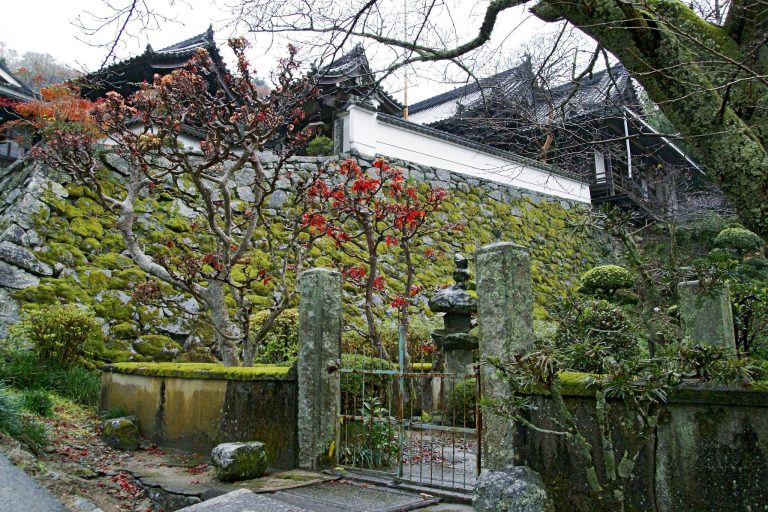
The present temple combines the rebuilt Main Hall, a shrine building, Buddhist images, and archaeological remains associated with the earlier Abe-dera. The former temple site preserves an east-west layout, while the temple grounds also contain a square-chambered kofun, a Japanese monumental burial mound associated with an ancient elite burial.
Temple Buildings and Images
Main Hall
The Hondō, or Main Hall, was rebuilt in 1665 and has an attached worship hall. It is the principal surviving building from the temple’s post-fire reconstruction. The hall houses the temple’s principal image, a wooden Manjusri seated on a lion, with attendant figures representing a young boy, an aged layman, a monk, and a groom. The approximately seven-metre-high sculptural group is attributed to Kaikei and is a National Treasure.
When the statues were dismantled for repairs in the 1930s, inscriptions were found inside the head of the Manjusri image. They include Kaikei’s signature, the year 1203, the phrase “Namu Amida Butsu,” and the phrase “master craftsman, An Amida Butsu.” The names of about 50 donors, including Kaikei and Chogen, were also written there.
Manjusri Sculptural Group
The National Treasure group includes an attached scroll bearing the Usnisa Vijaya Dharani, the Manjusri mantra, and the Manjusri seed syllable. Its reverse contains a record dated 1220 concerning the sick monk Ku Amida Butsu. An attached wooden standing image of Saisho the Elder was made by the sculptor Sōin and has an inscription identifying him as Sumiyoshi Daimyojin and dating it to 1607. The old-man attendant is an Edo-period addition and is classified separately from the principal group.
Hakusan Shrine
Hakusan Jinja Honden is a single-bay shrine building from the Sengoku period. It follows the nagare-zukuri style, in which a long, asymmetrically sloping roof extends over the front veranda, and it has a roof covered with thin overlapping wooden shingles. The building is an Important Cultural Property.
Transferred Buddhist Images
The wooden Shaka triad preserved at the temple was originally the Amida triad that served as Myorakuji’s principal image before its transfer in 1883. The temple also preserves a seated wooden Dainichi Nyorai that originally served as the principal image of Abe-dera. These images connect the present temple with both the former Abe-dera and the later history of Myorakuji.
Former Abe-dera and Burial Mound
Abe-dera Ruins
The former Abe-dera site lies approximately 300 metres southwest of the present temple. Excavation revealed a seventh-century temple layout with the Kondo, or Main Hall, to the east and a pagoda to the west. Ancient roof tiles and other remains indicate construction in the seventh century and preserve the arrangement of the early complex.
Monju-in Nishi Kofun
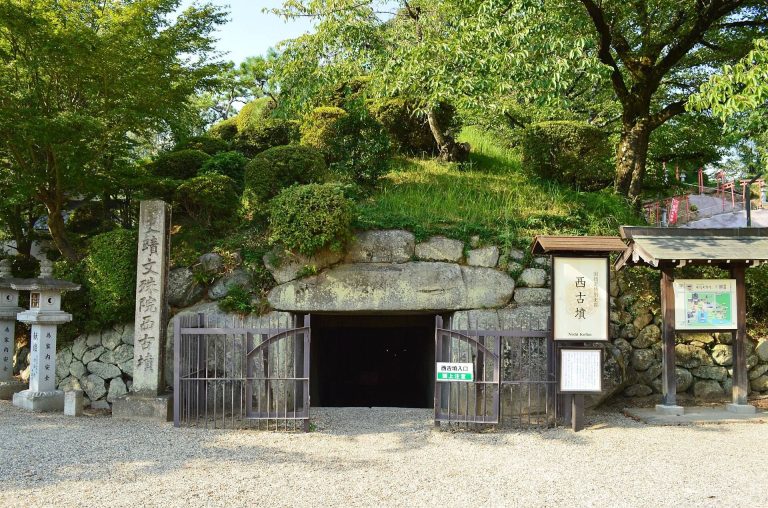
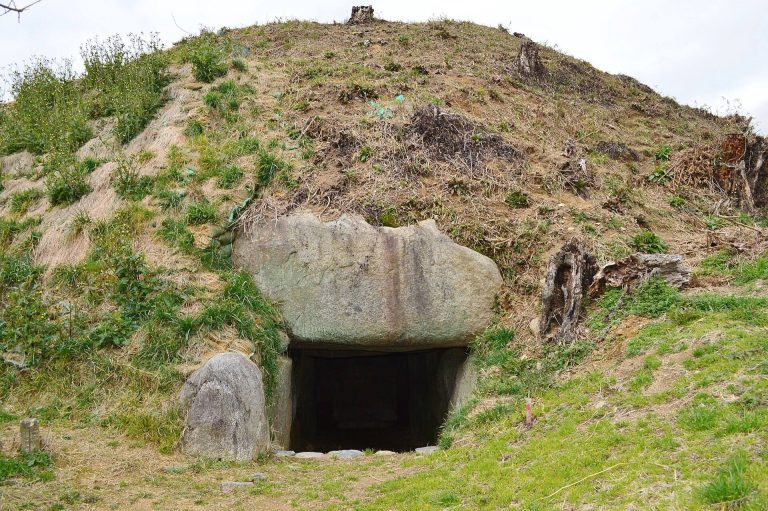
Monju-in Nishi Kofun lies within the temple grounds. Its square burial chamber is reached by a passage approximately 7.385 metres long, while the chamber itself is approximately 5.09 metres long. The surviving chamber is about 2.77 metres high, and the surviving passage is about 1.97 metres high. The mound has an overall length of approximately 12.48 metres.