Aoi Aso Shrine: A National Treasure Shinto Shrine in Hitoyoshi, Japan


Site at a Glance
- Rating
- 4.4
- Popularity
- Medium
- Country
- Japan
- Primary era
- Early Modern
- External website
- Open
- Eras represented
- Early Modern
- Civilizations
- Tokugawa
- Site type
- Religious
- Remains
- Sanctuary
On this page14 sections
History
Aoi Aso Shrine is a Shinto shrine in Hitoyoshi, Japan, traditionally founded in 806 and shaped by the religious traditions of the Aso region and the patronage of the Sagara family. Known locally as Aoi-san, it is now a Beppyo Shrine, a shrine recognized by the Association of Shinto Shrines for particular historical or institutional importance. Its surviving five-building complex is a National Treasure ensemble that combines local Hitoyoshi-Kuma traditions with the elaborate decoration of the Momoyama period.
Foundation and Sagara patronage
The shrine’s traditional foundation date is September 9, 806. Ogata Gonsuke Koremoto, chief priest of Aso Shrine, is said to have received a divine revelation and transferred the divided spirits of three Aso deities to Aoi-go in Kuma District. These were Takeiwatatsu-no-Mikoto, Asotsuhime-no-Mikoto, and Kunizo Hayamikatama-no-Mikoto, Shinto deities associated with the Aso religious tradition. The shrine was rebuilt in the mid-eleventh century and again in 1198, when the local lord Sagara Nagayori made it his family deity and donated an estate producing 216 koku of rice.
The Sagara family continued to support the shrine through repeated construction and repairs. Sagara Tamezugu began a major rebuilding in 1491. In 1558, the shrine also served as a setting for deliberations by local Sagara vassals before the enactment of seventeen laws, followed by a ritual oath. Aoi Aso Shrine therefore operated not only as a place of worship but also as an institution that helped sustain the Sagara clan’s authority over its retainers.
Early modern religious development
During the early modern period, the shrine was known as Aoi Daimyojin. Sagara Nagatsune, also called Yorifusa and the twentieth head of the family, prayed there for victory during the Japanese invasion of Korea. After returning in 1597, he designated Aoi Daimyojin the head shrine of more than 250 shrines in Kuma District. He donated approximately 4,000 tsubo of rice fields in Omura in 1601 and sponsored a large rebuilding as thanks for the prayer.
Although Aoi Aso Shrine began as a branch shrine of Aso Shrine, its connection with the main shrine weakened as the Aso and Sagara families repeatedly opposed each other during the Northern and Southern Courts conflict and the Warring States period. The shrine consequently developed an independent religious character. Until 1665, worship followed Ryobu Shinto, a form of Buddhist-Shinto syncretism that interpreted Shinto deities through Buddhist figures. Takeiwatatsu-no-Mikoto was associated with Eleven-Headed Kannon, Asotsuhime-no-Mikoto with Fudo Myoo, and Kunizo Hayamikatama-no-Mikoto with Bishamonten. In 1665, the shrine adopted a purely Shinto form of worship, although paintings showing the deities in Buddhist forms remain preserved there.
The seventeenth-century rebuilding
The present principal complex was commissioned by Sagara Nagatsune, the first lord of the Hitoyoshi Domain, and his chief retainer Sagara Seibei. The honden, corridor, and offering hall were completed in 1610, followed by the worship hall in 1611 and the Romon tower gate in 1613. Together, these buildings formed a unified ensemble whose regional architectural language and Momoyama-period decoration influenced early-modern shrine architecture in southern Kyushu.
The shrine’s hereditary chief priests came from the Aoi family, which traced its ancestry to Koremoto. During the Edo period, the family supervised Shinto priests across the surrounding region. The hereditary line ended in 1925, while the family residence and garden beside the shrine opened as a cultural garden in 2010. The shrine was classified as a village shrine in 1872 and promoted to prefectural-shrine status in 1935.
Rituals, festivals, and modern recognition
A summer purification rite is traditionally attributed to Sagara Maeyori, the seventh head of the Sagara family, in 1386. After an interruption, Sagara Yoshishige, the sixteenth head, is said to have revived it in 1533. The annual festival was formerly held on September 9, the traditional foundation date, but it moved to October 8 after the Meiji calendar reform. The wider sequence, known as the Okunchi Festival, runs from October 3 to 11 and includes fire prevention, lion-performer selection, chrysanthemum purification, the principal festival, a procession, and a thanksgiving rite.
On the evening of October 8, approximately three hours of Kuma Kagura, ritual music and dance performed for Shinto deities, takes place in the Kagura Hall. More than ten numbers are performed, and Kuma Kagura is designated a nationally selected intangible folk cultural property. The October 9 procession is led by a ringing Chirin flag and includes lions and portable shrines. It travels through Hitoyoshi before returning to the shrine, with local performing arts presented at the temporary festival site and elsewhere. Formerly, the procession circulated only around the lotus pond before the tower gate. Its route expanded through the town around the transition between the Taisho and Showa periods at residents’ request, partly as a prayer for Hitoyoshi’s prosperity.
The shrine’s five principal buildings were designated National Treasures under the prewar National Treasure Preservation Law in 1933, became Important Cultural Properties under the postwar cultural-property law of 1950, and were redesignated National Treasures on June 9, 2008. A National Treasure is Japan’s highest-level designation for important cultural properties. The five buildings received the first National Treasure designation for a thatched religious building and the first for an extant cultural property in Kumamoto Prefecture. A 1610 ridge tablet and five later inscription tablets found in the beams during dismantling and repair were added as appurtenant Important Cultural Properties in 1980. On April 24, 2015, Aoi Aso Shrine became a component cultural property of a Japan Heritage designation.
Because the shrine stands in the floodplain of the Kuma River, it has repeatedly been affected by flooding. Flood levels reached 2.1 meters in 1965 and 1.1 meters in 1971. In the 2020 Kyushu floods, water reached 4.3 meters at the site and flooded the National Treasure worship hall above floor level. Parts of the Misogi Bridge railing were lost, while the National Treasure buildings sustained no significant reported damage.
Remains
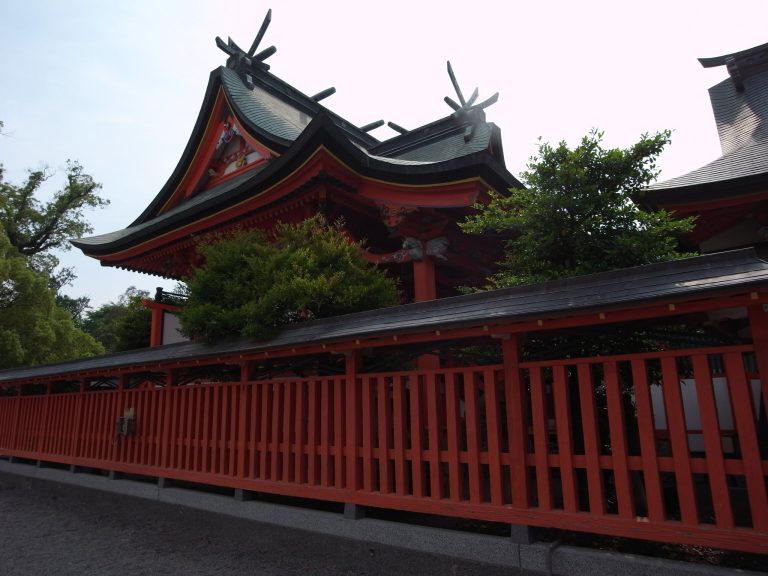
The principal shrine complex is arranged as five connected or closely related buildings, the honden, corridor, offering hall, worship hall, and Romon tower gate. Their steep thatched or copper-sheet roofs, lacquered structural members, gilded metal fittings, carved ornaments, and painted decoration unite regional medieval traditions with Momoyama-period techniques. Black lacquer is used below the eaves, while red lacquer covers brackets and chamfered structural surfaces.
The principal shrine buildings
Honden and corridor
The honden is a three-bay nagare-zukuri sanctuary, a shrine form whose roof extends forward to create a covered entrance. It has a copper-sheet roof, X-shaped patterns formed by the side and rear crosspieces, and small wall sections above the horizontal beams containing gōzama openings. These openings and other details are characteristic of religious architecture in the Kuma region.
The one-bay corridor linking the honden and offering hall has a gabled copper-sheet roof. Dragon carvings decorate the supporting brackets on both side pillars. These carvings are regarded as an influence on early-modern religious architecture in southern Kyushu.
Offering hall and worship hall
The offering hall is a three-bay-by-five-bay building with a hipped roof, meaning that the roof slopes on all four sides. Its entrance is placed in the gable end, and its roof is thatched. The building connects to the worship hall at the front and has elaborate decoration inside and out. Sculptural designs cross the intervening pillars instead of stopping within individual bays, while the metal fittings display advanced techniques of the period.
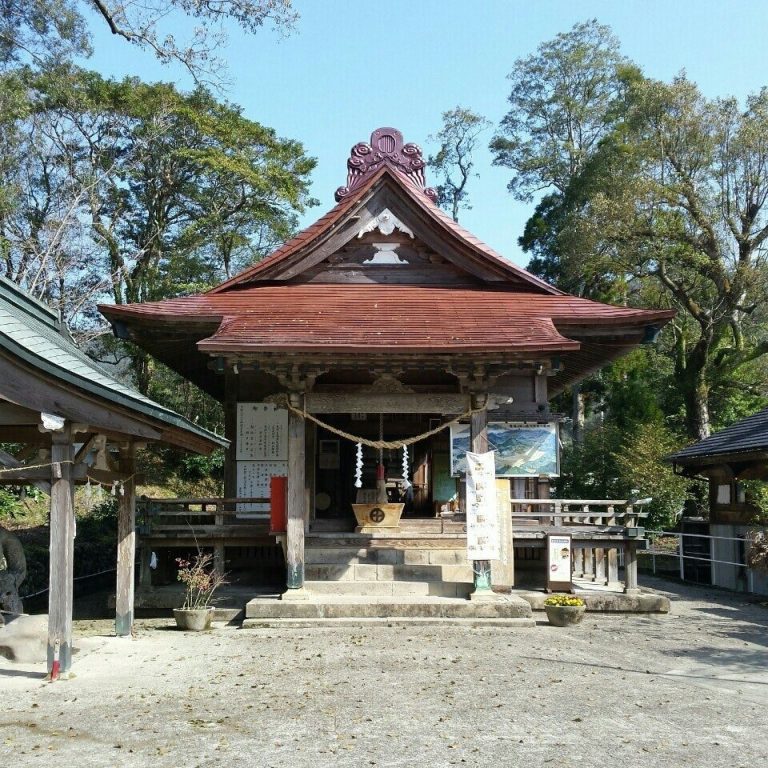
Completed in 1611, the worship hall is seven bays long and three bays deep. It has a thatched hipped roof and an entrance along its long side, with a one-bay projecting porch carrying a karahafu, or curved gable, beneath a copper-sheet roof. The front bay is open. The rear is divided among the worship hall, Kagura Hall, and a room for shrine offerings. The Kagura Hall retains distinctive local stage decoration and is used for the October 8 performance of Kuma Kagura.
Romon tower gate
Completed in 1613, the Romon is a three-bay, single-door tower gate supported by eight legs and covered by a hipped thatched roof. It combines Zen-style architectural forms with Momoyama features. Its brackets have two projecting stages on the lower level and three on the upper level. Ground sills and penetrating tie beams reinforce the bays, and plate beams run above the columns on both levels.
Paired male and female demon masks occupy the four corners beneath the Romon’s upper roof, an unusual arrangement regarded as characteristic of the local Hitoyoshi style. The lower-level panels carry sculptures of scenes from the Twenty-Four Filial Exemplars, a traditional East Asian collection of stories about exemplary devotion to parents. Paired male and female dragons are painted on the lower-level ceiling. The dedicatory plaque, presented in 1677 by Sagara Yorichika, the third lord of the Hitoyoshi Domain, bears calligraphy by the Tendai abbot-prince Gyojo and a reverse inscription by Hayashi Shunjo.
Precinct features
Daijingu and the camphor tree
Four subsidiary shrines stand within the precinct: Inari Shrine, Kogo Shrine, Miyajitake Shrine, and Daijingu Shrine. The precinct formerly contained more than ten subsidiary shrines. The Inner and Outer Shrines of Daijingu are designated buildings of Hitoyoshi City. Beside Daijingu stands a large camphor tree traditionally regarded as the place where the shrine’s spirit was first enshrined. It has a circumference of 18 meters, reaches 19 meters in height, and divides into two trunks one meter above the ground. The tree has been a Hitoyoshi City natural monument since 1958.
Bridge and lotus pond
The Misogi Bridge is a registered tangible cultural property, a category for physical cultural assets recognized through registration, and has held that status since 2017. The 2020 flood damaged parts of its railings. A lotus pond lies in front of the Romon. Local tradition says that the male and female dragons painted on the gate’s ceiling leave it each night and come to the pond to drink.
Sumo memorial
The precinct contains a tombstone honoring the Edo-period sumo wrestler Inosuke Kumagatake and a ring used for commemorative dedication bouts. Born Kuroki Matsujiro in 1807 in Itsuki Village, Kumagatake entered professional sumo at eighteen and competed in Kyoto and Edo before reaching the rank of ozeki. He retired in 1853, returned home as a Sagara retainer and sumo instructor, and died in 1855. The tombstone and ring were installed in October 2015.