Jindai-ji Temple: A Historic Buddhist Temple in Tokyo


Site at a Glance
- Rating
- 4.3
- Popularity
- Medium
- Country
- Japan
- Primary era
- Modern
- External website
- Open
- Eras represented
- Early Modern, Modern
- Civilizations
- Japanese, Tokugawa
- Site type
- Religious
- Remains
- Monastery
On this page16 sections
History
Jindai-ji Temple is a Buddhist temple in Japan, located in Chofu, Tokyo, whose foundation tradition dates to 733 during the Nara period. Its formal name is Fugakuzan Shōrakuin Jindai-ji, and it belongs to the Tendai school, a major Japanese Buddhist tradition introduced from China and formally established in Japan during the ninth century. The temple holds the status of a special head temple and is regarded as one of Tokyo’s oldest temples, traditionally ranking after Sensō-ji.
Foundation and religious affiliations
The traditional account attributes Jindai-ji’s foundation to Mankō Shōnin, a Buddhist priest who established it as a temple of the Hossō school, an earlier Japanese Buddhist school associated with East Asian Yogacara teachings. The temple’s name is linked to Jinja Daiō, a water deity believed in the temple tradition to have protected the Chinese monk Xuanzang on his journey to India.
A second foundation story centers on the daughter of the local headman Sato Osaukon and a man named Fukuman. When the headman’s opposition prevented their marriage, Fukuman is said to have prayed to Jinja Daiō. After the prayer overcame the opposition, the daughter reportedly founded Jindai-ji in gratitude and dedicated it to the water deity. The temple later joined the Tendai school during the Jōgan era, between 859 and 877.
Fires, rebuilding, and worship
Fire repeatedly altered the temple precincts. A blaze in 1646 and another in 1865 destroyed much of the complex’s buildings. The original main gate was lost in a separate fire in 1695 and later rebuilt. The main hall was reconstructed during the Taishō period in the early twentieth century, and its roof was renewed in 2003.
The principal object of worship is a crowned image of Amida Buddha, the Buddha associated with rebirth in the Western Pure Land. It is housed in the main hall. A hidden image of Gansan Daishi is also enshrined at Jindai-ji. Gansan Daishi is the posthumous name of Ryōgen, a tenth-century Tendai abbot and reformer who became an important protective figure in popular religion. Also known as the “Demon Master,” he is said to take demonic form to protect people from epidemics. During the temple’s Setsubun bean-throwing ceremony, participants therefore say “Fortune in” rather than “Demons out.”
Religious and local traditions
Jindai-ji is known for its Daruma Market, traditionally counted among Japan’s three major daruma markets. The temple is also an additional station on the Tamagawa Thirty-Four Kannon pilgrimage, a devotional circuit linking temples associated with Kannon, the bodhisattva of compassion. Through Bishamonten, a Buddhist guardian deity associated with protection and good fortune, it is connected with Chofu’s Seven Lucky Gods pilgrimage.
The temple grounds occupy a spring-rich area along the Kokubunji Cliff Line. Water from the springs supported fields, encouraged popular religious devotion, and helped develop local Jindai-ji soba production. The process included cultivation, noodle making, boiling, rinsing, and milling powered by water. Wasabi fields and other facilities also benefited from the valley-like terrain and abundant springs. Land now occupied by the adjacent Jindai Botanical Garden was formerly part of the temple estate.
Modern recognition
A bronze image of Shaka Buddha seated on a chair was found beneath the Gansan Daishi Hall in the early twentieth century. The sculpture is designated a National Treasure. The temple bell is an Important Cultural Property of Japan, while the spring-fed Fudō Waterfall is included among Tokyo’s 57 notable springs.
Remains
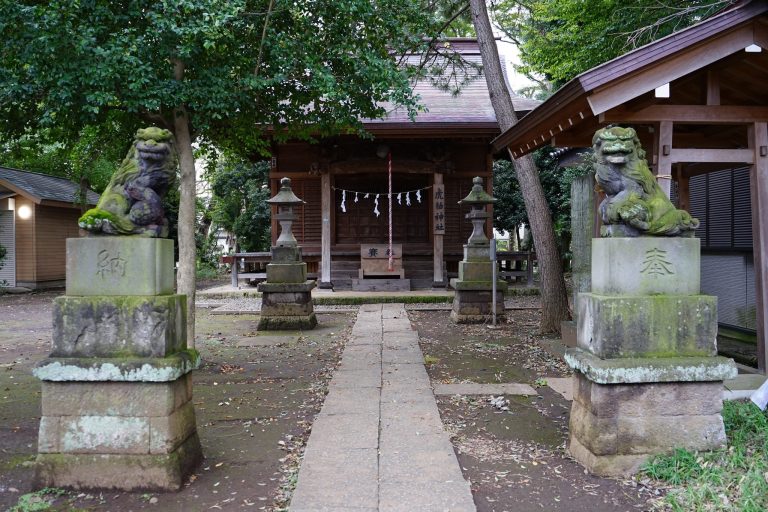
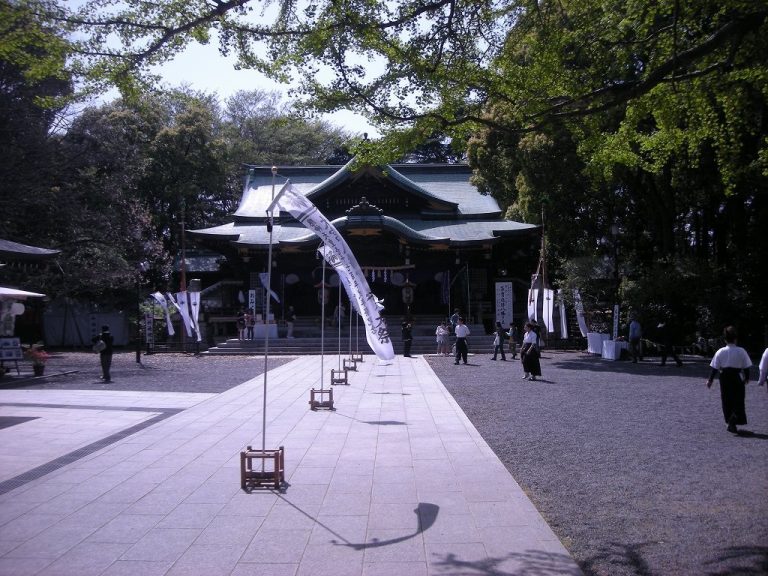
The precincts are bordered on the northeast by a hill that forms a semicircular enclosure. A staircase rises through the main gate, or Sammon, into the temple grounds. The bell tower stands to the right after the entrance, and the main hall faces the approach. The Gansan Daishi Hall is positioned to the left of the main hall and slightly farther back, while other buildings extend toward higher ground and the wooded rear of the site.
Entrance and principal halls
Main gate
The main gate was rebuilt in the Yakui style after the original was destroyed by fire in 1695. Its position at the foot of the staircase establishes the entrance into the enclosed precincts.
Main hall
The main hall, or Hondō, was rebuilt during the first half of the twentieth century after being lost in a major fire in the mid-nineteenth century. Its roof was renewed in 2003 with copper plates shaped to resemble roof tiles. Inside, the crowned Amida Buddha serves as the principal object of worship.
Gansan Daishi Hall
The Gansan Daishi Hall stands left of the main hall, set slightly farther back. During the Edo period it was a popular place for prayers for good fortune. A bronze image of Shaka Buddha, the historical Buddha Siddhartha Gautama, was discovered beneath this hall in the early twentieth century.
Shakadō
A separate Shakadō, or hall dedicated to Shaka Buddha, was constructed for the bronze image. The sculpture dates from the late Asuka, or Hakuhō, period of the seventh century, an art-historical period associated with early Japanese Buddhist sculpture. It measures 60.6 centimeters across the seated figure and 83.5 centimeters in total height. The hollow image includes an inner surface within the head.
The sculpture has a youthful face, a continuous line from the eyebrows to the nose, flowing parallel folds in the drapery, and moderately taut modeling. The folds on the lower legs, between the feet, and at the hem resemble those of the bronze standing Kannon at Hōryū-ji, commonly called the Yumechigai Kannon. Fire has affected the image, and much of its surface gilding has been lost. It is associated with the Three Hakuhō Buddhas, a seated Shaka accompanied by two attendant figures.
Bell tower and secondary buildings
Bell tower
The bell tower, or Shōrō, stands to the right of the main hall. Its original bronze bell was cast in 1376 by Yamashiro-no-kami Munemitsu, whose name appears in the inscription. The bell is 125.5 centimeters high and has a mouth diameter of 68.8 centimeters. It is regarded as the third-oldest temple bell in Tokyo. Cracking and related damage led to the casting of a replacement bell on August 15, 2001, while the original was placed in the Shakadō.
Monks’ quarters
The buildings to the right of the main hall include the monks’ quarters, the abbot’s residence, and a guesthouse known as “Accommodation for Sparrows.”
Kaisandō and Jinja Daiō Hall
The small Kaisandō, a hall dedicated to a temple founder, stands in the higher rear section and is dedicated to Mankō Shōnin. The cemetery lies farther uphill and to the west. A hall dedicated to Jinja Daiō stands somewhat higher than the Shakadō and is reached through a secondary exit beside that building.
Woodland and springs
Jindai-ji is set within woodland, with deep mixed woodland behind the temple. Several springs remain within the precincts, including the spring-fed Fudō Waterfall. Drainage channels and watercourses express the area’s abundant water supply and form part of the physical environment that supported the temple and its surrounding landscape.