Kōbōyama Kofun: An Early Third-Century Burial Mound in Japan
Site at a Glance
- Popularity
- Medium
- Country
- Japan
- Primary era
- Classical
- Eras represented
- Classical, Modern
- Civilizations
- Japanese
- Site type
- Burial
- Remains
- Burial Mound
On this page11 sections
History
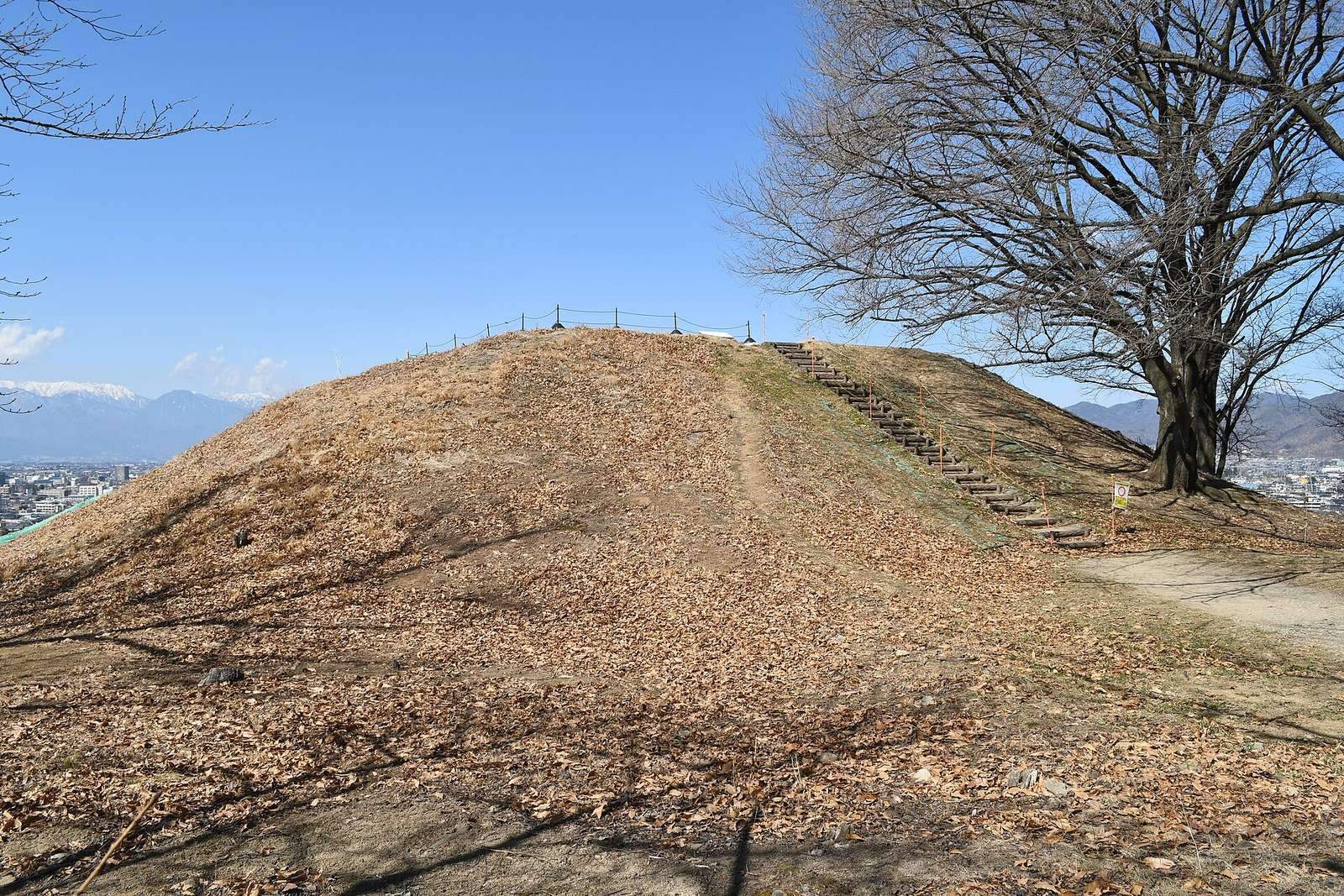
Kōbōyama Kofun is a third-century burial mound in Matsumoto, Japan, and one of the tombs in the Nakayama Kofun Group. Its construction is dated to the first half to middle of the third century. With square front and rear sections, it is important evidence for the emergence of a local political community in the Matsumoto Basin and the beginnings of Kofun-period culture in Nagano. The Kofun period is an era of ancient Japanese history named for its burial mounds.
Origins and regional context
Recent investigations placed the tomb earlier than the dating commonly used before them, which assigned it to the late third or early fourth century. Nakayama No. 36, another tomb in the sequence on the Nakayama Hills, is regarded as an early Kofun-period burial that followed it. Kōbōyama Kofun predates the large keyhole-shaped tombs built in the Zenkoji Plain from the fourth century onward, which drew on forms from the Kinai, the historic region around present-day Kyoto, Osaka, and Nara.
The buried person’s identity is unknown. One proposal identifies the occupant as a local ruler, possibly one of the Suwa kuni no miyatsuko, hereditary chiefs or officials associated with the Suwa region. The mound’s form has also been compared with burials of the late Yayoi period, the era preceding the Kofun period and associated with wet-rice agriculture and metalworking, in western Japan and the Nōbi Plain of central Japan.
The Chinese-made bronze mirror found in the grave belongs to a type that predates Chinese-style mirrors with triangular rims and images of deities and animals. One hypothesis proposes that a leader of Wa, a name used in Chinese records for peoples of the Japanese archipelago, obtained it on a tribute mission to Daifang, a Chinese commandery on the Korean Peninsula. The proposed mission would have taken place before Wei, a Chinese state, defeated the Gongsun ruling house in 238.
Rediscovery and preservation
During the final years of the Second World War, the mound was used for an anti-aircraft machine-gun position. A burial-mound map published in 1973 included the site, although it was then thought to have been destroyed. In 1974, Matsusho Gakuen acquired the hill for school development, prompting the first excavation. Archaeologist Tadashi Saito and the Matsumoto City Board of Education identified the tomb’s form and recovered burial goods.
The finds were re-examined in 1993, and further excavations took place during fiscal years 2020–2023 as part of renewed site-improvement work. Kōbōyama Kofun became a National Historic Site in 1976, and its finds were designated Nagano Prefectural Treasures in 1993. Site improvements followed in fiscal years 1981–1982, and about 5,000 cherry trees were planted during fiscal years 1984–1986. The site is now maintained as Kōbōyama Kofun Park.
Remains
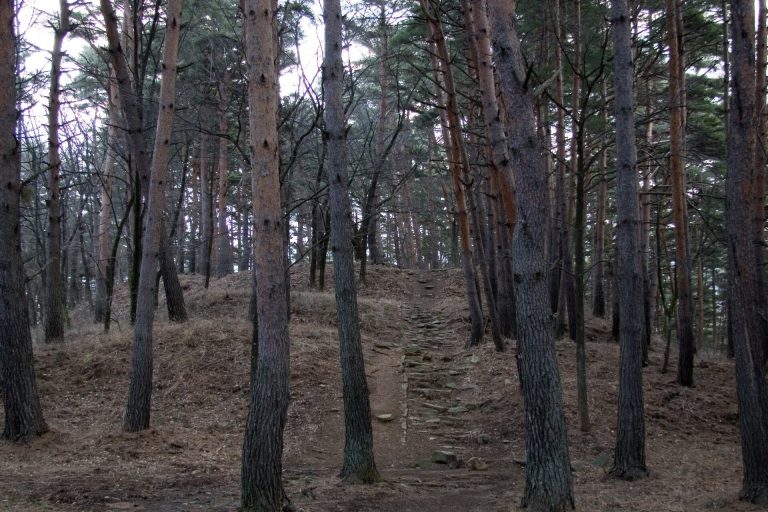
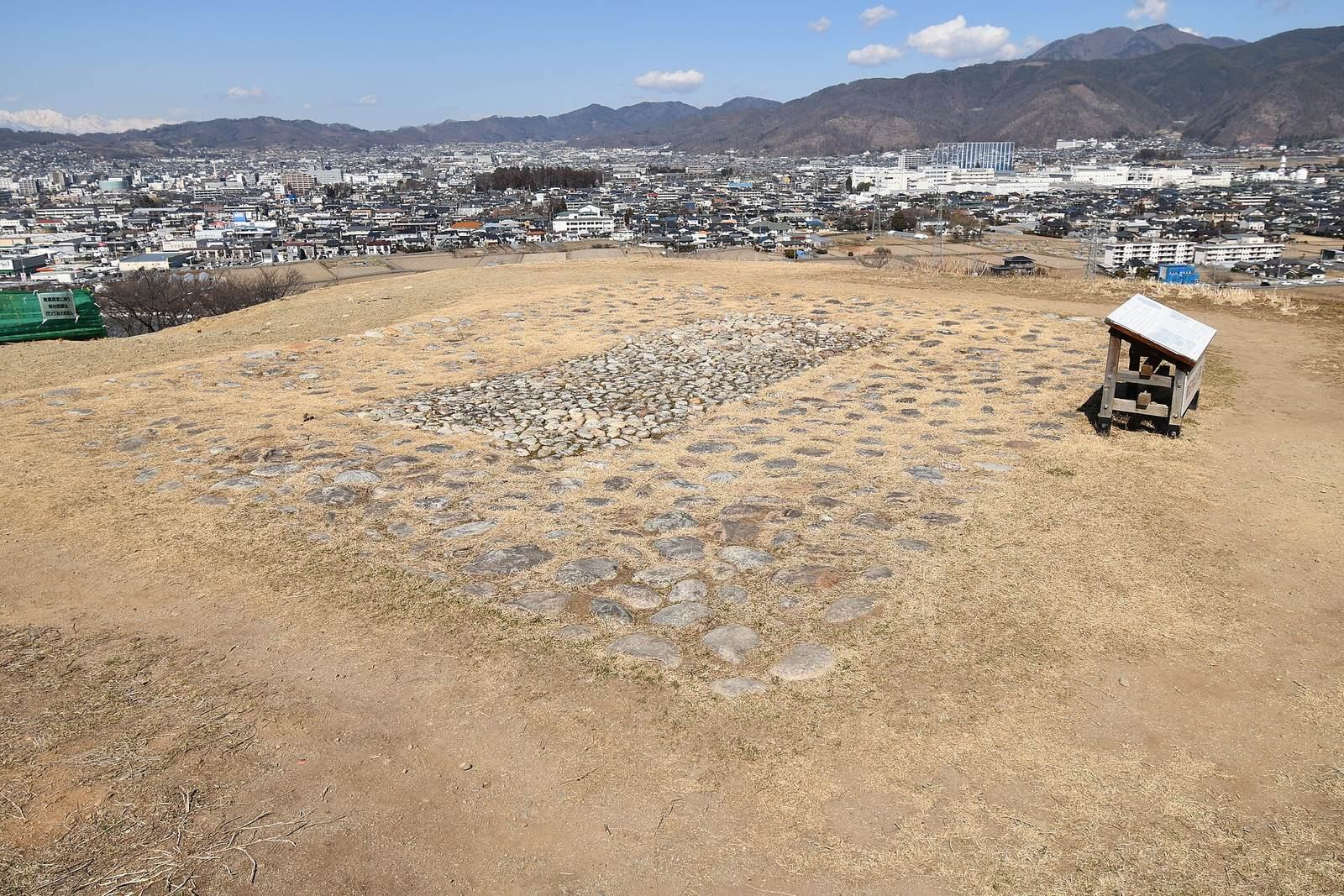
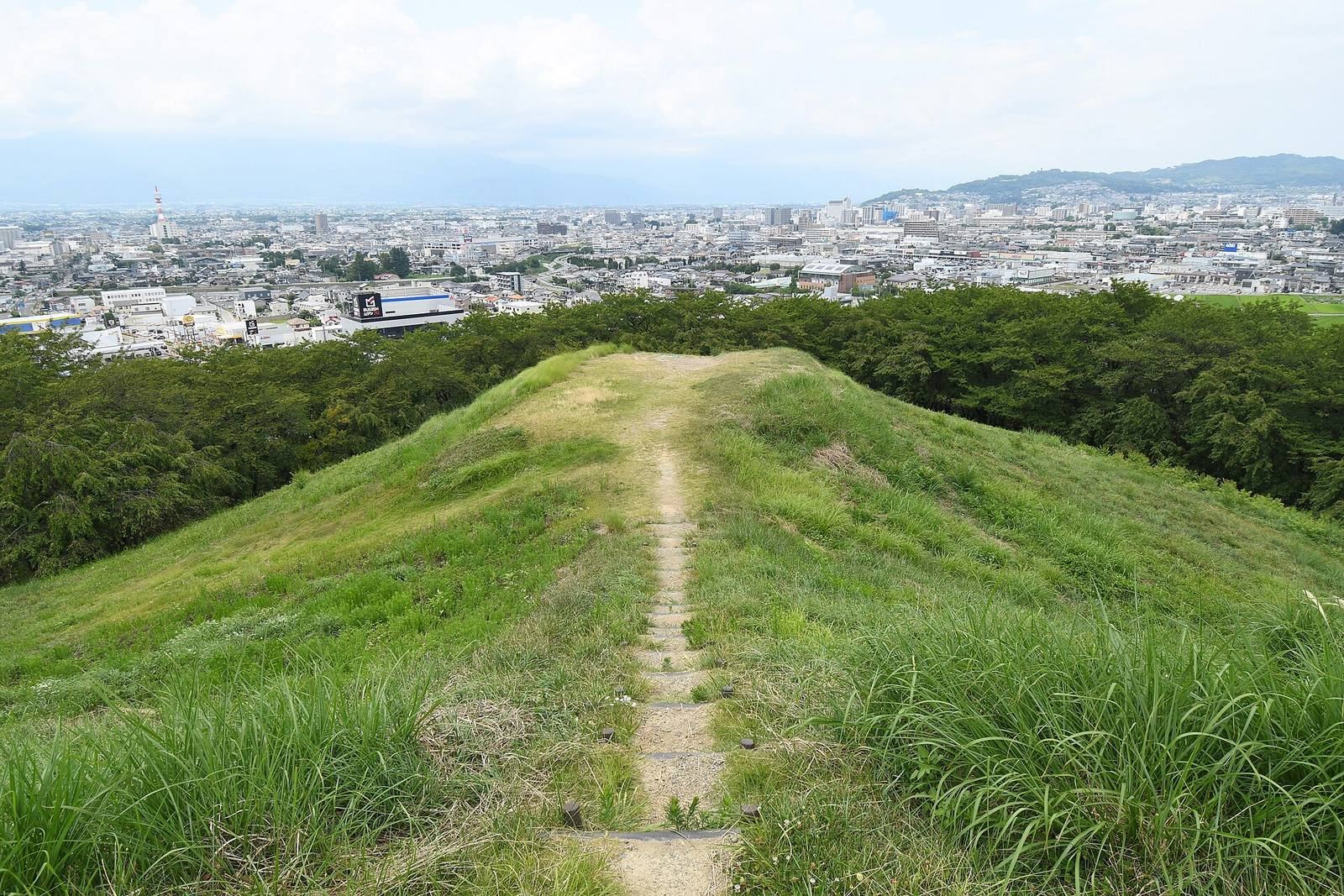
The mound occupies the summit at the northern end of Kōbōyama, on the eastern edge of the Matsumoto Basin. The hill reaches about 650 metres and stands roughly 60 metres above its surroundings; the mound overlooks the basin, with the Hida Mountains visible in the distance. Its square front and rear sections are joined together, with the front pointing northwest along the ridge. The mound was made by cutting into the natural ground and adding fill, particularly deep beneath the rear section, where it approaches four metres. The total length is about 61.5 metres, though an earlier measurement gave 66 metres.
The burial and its contents
Stone burial enclosure
A cobble-built burial enclosure lies at the centre of the rear section. Resembling a pit-style stone burial chamber, it runs northeast to southwest, almost perpendicular to the mound’s axis. Its interior measures 5.5 metres long, 1.32 metres wide, and 0.93 metres deep, with thick packing around the outside. River stones form the enclosure and may have been gathered from several rivers in the Matsumoto Basin. Compacted black soil filled its interior. The arrangement of the grave goods suggests that the deceased’s head lay toward the northeast, and cinnabar, a red mercury sulfide mineral, was found around the waist.
Objects from the grave
Grave goods include a Chinese-made bronze mirror, ornaments, weapons, and tools. Among the finds are three iron swords, 24 iron spearheads, a copper sheet, an iron cauldron, and 738 small glass beads. The objects also include magatama, curved beads used as ornaments and ritual objects, and a large jar with an S-shaped mouth. Many of the excavated items are displayed at the Matsumoto City Archaeological Museum.
Pottery above the enclosure
A large group of Haji ware, unglazed ancient Japanese pottery, was found above the burial enclosure. It comprises about 1,000 sherds and 25 identifiable vessels. These include eight jars, some with perforated bases, ten pedestal dishes, two vessel stands, two small vessels, two additional jars, and one vessel shaped like a hand warmer.
Other features and the surrounding landscape
Wartime gun emplacements
Three emplacements from the wartime anti-aircraft position were identified on the rear section of the mound. All lie outside the burial enclosure.
Fields and a possible settlement
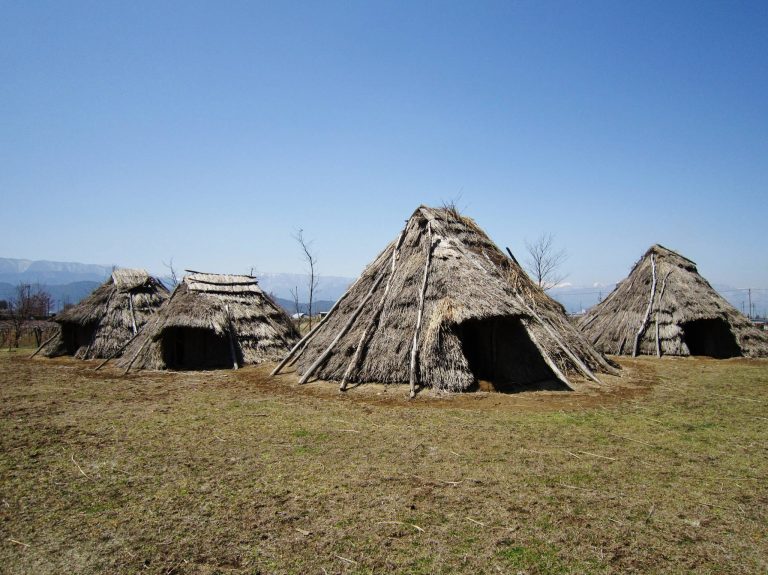
Remains of Kofun-period paddy fields extend across about 70 hectares to the north of the hill and 40 hectares to the east. A site 1.2 kilometres west of the mound has yielded similar pottery and may have been one of the burial occupant’s base settlements.