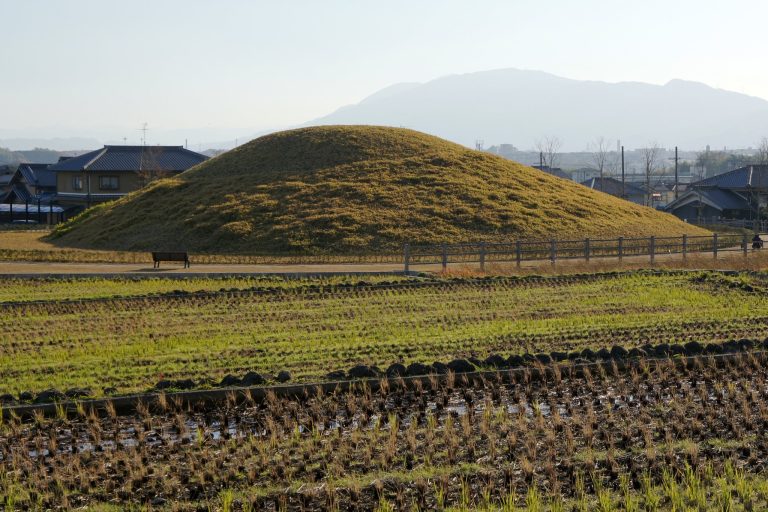
Shimanoyama Kofun: A Keyhole-Shaped Burial Mound in Nara


Site at a Glance
- Rating
- 3.6
- Popularity
- Very Low
- Country
- Japan
- Primary era
- Classical
- External website
- Open
- Eras represented
- Classical
- Civilizations
- Yamato
- Site type
- Burial
- Remains
- Burial Mound
On this page10 sections
History
Shimanoyama Kofun is a keyhole-shaped burial mound in Japan, near Kawanishi in Nara Prefecture, built from the end of the fourth century to the beginning of the fifth century during the Kofun period. This era, conventionally dated from approximately the third to the sixth centuries, was marked by the construction of large burial mounds whose size and grave goods can indicate the status of those buried within them. Shimanoyama’s scale and rich equipment suggest that it was the tomb of a powerful chief of the Nara Basin, although the person’s identity remains unknown.
Setting and regional relationships
The mound stands on a slight elevation on the left bank of the Teragawa, close to the convergence of rivers in the Nara Basin. The location formed a transportation crossroads, a feature also associated with the Otsukayama Kofun cluster. Shimanoyama belongs to the northern group of the Umami Kofun cluster at Tōin and, together with nearby tumuli, forms part of the Miyake Kofun cluster. It lies approximately one kilometre from the Otsukayama Kofun cluster.
Shimanoyama Kofun and Kawai Otsukayama Kofun share the same shape and dimensional standards, indicating a close relationship between the two tombs. The mound was also known as Shimane-yama Kofun, while its historical appearance was recorded by the Edo-period antiquarian Kiuchi Sekitei in Unkonshi. The “divine-age stone” described in that work was a hoe-shaped stone ornament excavated from Shimanoyama.
Investigation and protection
The rear burial chamber was robbed in the past, and many grave goods were removed. Some objects thought to have been dispersed through these robberies are now displayed in museums in the United States. A 1996 investigation excavated the principal clay-coffin burial in the rectangular front section. Further investigations in the circular mound from 1997 to 1999 established details of its terraces, stone revetment, and haniwa rows. The tenth investigation, in 2005, recovered a plant-fiber basket probably used in a ritual.
The excavated objects were collectively designated the “Excavated Items from Shimanoyama Kofun” as a National Important Cultural Property on June 30, 1998. They are held by the national government and stored at the affiliated museum of the Archaeological Institute of Kashihara, Nara Prefecture. The mound itself became a National Historic Site of Japan on September 20, 2002. It is ranked thirty-sixth nationwide in size among Japanese kofun.
Remains
Shimanoyama Kofun is a zenpō-kōen-fun, a keyhole-shaped tumulus formed by a circular rear mound joined to a rectangular front mound. The earthwork is approximately 190 to 200 metres long, with a rear section more than 105 metres in diameter and a front section more than 95 metres wide. Projections extend from both sides of the narrow waist between the two sections. A shield-shaped moat surrounds the mound, measuring approximately 40 metres wide. Including the moat, the earthwork measures about 265 metres in length and 175 metres in width. Water erosion along the moat indicates that the mound was probably originally more than 200 metres long.
Mound construction
The mound was built in terraces. Stones laid across its surface helped protect the earthen slopes from erosion, and rows of haniwa occupied the first and second terraces. These clay objects included morning-glory-shaped cylindrical pieces as well as representations shaped like houses, shields, and quivers. The surviving arrangement records both the stepped construction of the mound and the objects placed around its exterior.
Burial facilities
Rear stone chamber
A vertical stone burial chamber appears to have stood at the centre of the circular rear section. Its ceiling stones were removed, and the chamber was damaged during grave robbery. The chamber stones were made from Tatsuyama stone, quarried in Hyogo Prefecture.
Front clay-coffin burial
beneath the summit of the rectangular front section, excavators found a clay-coffin burial in 1996. The grave pit measures 10.5 metres from east to west and 3.4 metres from north to south. Within it was a split-bamboo-shaped wooden coffin, approximately 7.5 metres long and 1.7 to 2 metres wide, made from Japanese umbrella pine. Vermilion had been scattered over the area where the deceased was placed.
Approximately 2,500 objects lay outside the coffin. They included comma-shaped, small-round, and tubular talc ornaments, along with koto-pillar-shaped stone objects. Sealed in the clay above the coffin were 80 wheel stones, 21 hoe-shaped stone ornaments, 32 stone bracelets, and five iron knives. Inside the coffin were three jasper containers with lids, three bronze mirrors, five large tubular beads, eleven vertical combs, one necklace, and one hand-bead ornament. The hand-bead ornament suggests that the buried person may have been a woman.
Additional clay-coffin burial
A second large clay-coffin burial extended from the mound’s waist near the top toward the front section. Its position adds another burial facility to the complex arrangement of interments within the mound.
Ritual evidence
A plant-fiber basket was excavated from the western waist during the tenth investigation in 2005. Its form and location indicate that it was probably used in a ritual associated with the mound.