Karako-Kagi Site: A Yayoi-Period Moated Settlement in Japan


Site at a Glance
- Rating
- 4.3
- Popularity
- Low
- Country
- Japan
- Primary era
- Classical
- External website
- Open
- Eras represented
- Iron Age, Classical, Medieval
- Civilizations
- Yayoi
- Site type
- City
On this page17 sections
History
The Karako-Kagi site is a Yayoi-period moated settlement in Tawaramoto, Nara Prefecture, Japan, built by communities of the Yayoi culture from the early first millennium BCE into the Early Kofun period. The Yayoi period was an archaeological era associated with wet-rice agriculture, metallurgy, new pottery traditions, social differentiation, and expanding exchange across the Japanese archipelago. Located on an alluvial plain in the central Nara Basin, the settlement ultimately covered about 300,000 square metres at an elevation of approximately 48 metres above sea level. Its large buildings, specialized workshops, long-distance contacts, and probable bronze-bell manufacture indicate a powerful regional community, although its exact political identity remains uncertain.
Early Yayoi beginnings
The earliest settlement occupied slightly higher ground in the western and northern districts from the beginning through the first half of the Early Yayoi period. Streams surrounded this area, giving it an island-like setting. At this stage, the settlement probably supplied neighbouring communities with wooden tools and other products. Large pits were used to keep unfinished wooden objects submerged in water, a method that helped preserve timber while it was worked over an extended period.
During the later Early Yayoi period, occupation expanded into the southern district. A workshop producing rhyolite stone sickles operated in the western district, while a large ditch was dug between settlement zones near the end of the period. The ditch probably drained wetlands and filled soon after it was constructed. These changes show a settlement adapting its occupied area and managing the wet alluvial environment before the development of its larger moat system.
Expansion and prosperity
Karako-Kagi reached its greatest prosperity in the early Middle Yayoi period. A large moat was built around the settlement, accompanied by an outer belt of three to five smaller moats. The system probably carried flowing water and required substantial labour and time to construct. Entrances probably crossed the water on wooden bridges rather than earthen causeways. This enclosed arrangement made the settlement a clearly bounded place while also helping control drainage across the low-lying ground.
Wells appeared during the early Middle Yayoi period and served practical and ritual purposes. After a large well in the western district went out of use, it received divination bones, a jar containing charred miscellaneous grains, and animal bones. Divination bones were heated or scorched so that their cracks could be interpreted for ritual or predictive purposes. Other deposits point to ceremonies involving cooked grain and wild-boar mandibles, while large quantities of rice husks show that threshing took place at the settlement.
Production and exchange also became more differentiated. Stone sickles, wooden objects, pottery, and other goods were made or handled in distinct areas. Pottery from the Omi and Kii regions, along with sanukite and unfinished wooden objects, reflects connections extending beyond the settlement. A probable bronze-working workshop was established in the southern district from the end of the Middle Yayoi period into the beginning of the Late Yayoi period. The community therefore combined local manufacture with the movement of materials and vessels from distant regions.
Floods, rebuilding, and Late Yayoi transformation
Repeated floods affected Karako-Kagi from the latter part to the end of the Middle Yayoi period. The final Middle Yayoi flood probably swept across the entire settlement and formed part of a major regional disaster. Several other large settlements were abandoned, dismantled, or moved after similar disruption, but Karako-Kagi was rebuilt in the same location and expanded. Its recovery marks an important phase in the settlement’s long development.
The flood filled the moats, which were cut again and restored at the beginning of the Late Yayoi period. They were maintained during the first half of that period and then gradually filled with large quantities of pottery during its latter half. At the end of the Yayoi period, the final moat was filled, ending the settlement’s large surrounding moat system. Production and consumption probably continued without a major decline, and square-moated burials were established within the settlement, especially in the southern district.
Occupation probably continued from the end of the Yayoi period into the Early Kofun period after the large moat belt had disappeared. The Kofun period was associated with the emergence of powerful chiefly and political groups and with the construction of large burial mounds. Karako-Kagi’s pottery differed from that of the contemporary Makimuku site, a major archaeological site in the Nara Basin associated with the transition from the Yayoi period to the Kofun period. Pottery from the San’in region and the increasing number of Early Kofun remains indicate continuing exchange. Some earlier moats were recut, and a moated settlement probably revived during this period.
Later land use and historical recognition
From around the latter sixth century, approximately ten Late Kofun-period tombs were constructed at the site. A settlement of the same period occupied the eastern side, where ritual deposits including a horse skull suggest the presence of a powerful local chief.
In later centuries, the area was reorganized under the jori system, an ancient method of dividing land into planned units for taxation and administration. The Tanaka area was associated with Tanaka Estate, which was recorded at the end of the tenth century as the holding of Fujiwara no Nobutaka, a Heian-period court official. It later became an estate of Kofuku-ji, a major Buddhist temple in Nara historically connected with the Fujiwara family and the management of landed estates. Remains from the ancient and medieval periods indicate that an estate-management facility existed in the area.
Around the time of the Onin War, a fifteenth-century conflict that weakened established authorities and caused widespread upheaval, the area became part of holdings controlled by a warrior group led by the Hoki-ji clan. Medieval ditches and wells often contained Yayoi artefacts, and later activity probably damaged some earlier remains. In the early modern period, local warriors became farmers, settlements were consolidated at Karako-Minami, and the surrounding land remained predominantly rice-paddy country. Karako Pond was constructed in the late Edo period.
Kenji Takahashi first introduced the site in 1901 through his archaeological study Yamato Archaeological Miscellany, referring to remains at Kagi. Small excavations followed in 1917, and artefact collecting and publication in 1930 brought the site to the attention of archaeologists including Sueji Umehara and Rokuji Morimoto. An investigation in 1936, conducted in the bed of Karako Pond, demonstrated that the low, wet conditions had preserved wooden objects, seeds, and other organic materials. This preservation made Karako-Kagi an important source for reconstructing Yayoi culture.
Systematic investigation by the Nara Prefectural Archaeological Institute of Kashihara began with the third excavation in 1977 and established the settlement’s extent and duration. Tawaramoto Town Board of Education excavations began with the thirteenth investigation in 1982 and clarified the settlement’s great size. Farmland improvement and a primary-school project led to further excavations from 1988. Pottery fragments depicting a multistoried tower, found during the forty-seventh excavation, brought broad public attention, while the seventy-fourth revealed a large building. Investigations connected with designation began in 1996, and 112 excavations had taken place by 2012.
Karako-Kagi became a National Historic Site in 1999, with additions to the protected area in 2002, 2008, and 2010. Finds from the site are designated Important Cultural Properties. The Karako-Kagi Archaeological Museum opened in 2004 in the Tawaramoto Aogaki Lifelong Learning Centre, displaying excavated materials, and the surrounding area was developed as Karako-Kagi Historic Site Park in 2018.
Remains
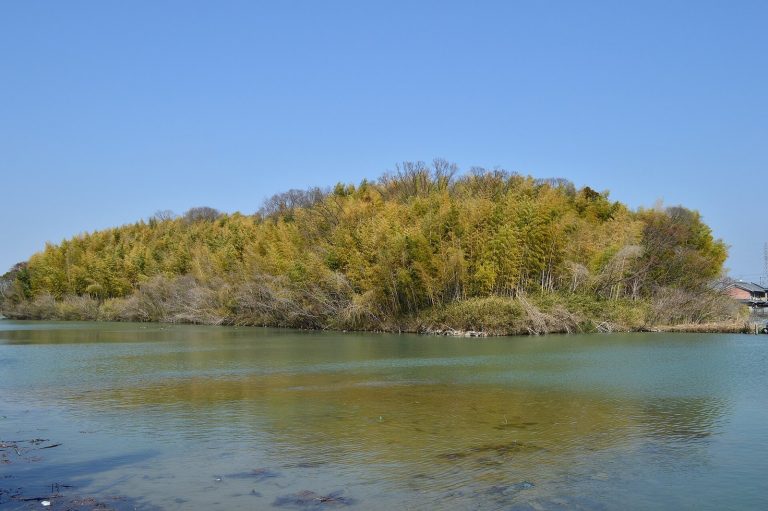
The archaeological area occupies alluvial ground at about 48 metres above sea level and is divided into northern, western, southern, and central districts. The main settlement eventually extended across roughly 300,000 square metres. Its physical organization changed over time from occupation around slightly elevated ground to a broad enclosed settlement with a principal moat, several outer ditches, large buildings, production areas, wells, and burial places. Waterlogged conditions preserved timber, seeds, and other organic materials, while later flooding and land use shaped the surviving evidence.
Settlement enclosure and buildings
Moats and entrances
The principal moat was approximately 7 metres wide and between 1.5 and 2 metres deep. Three to five smaller concentric moats extended beyond it, creating a broad belt around the settlement. The outermost circuit is estimated to have measured about 2 kilometres in length. A post approximately 30 centimetres in diameter found in the southeastern moat probably belonged to a bridge, supporting the interpretation that wooden bridges served as entrances. The moats were filled by flooding, recut and restored in the Late Yayoi period, and eventually filled with pottery at the end of the Yayoi period.
Large western-district buildings
A large central building in the western district had closely spaced posts, although its complete plan is not known. It measured at least 11.4 metres along the ridge direction and 7 metres across the beam direction, with two bays across and at least five bays lengthwise. The elongated structure ran north to south and had independent posts supporting the ridge. Three surviving posts were made of zelkova and one of Japanese mulberry. The zelkova posts measured about 60 centimetres in diameter. Radiocarbon results place the timber in approximately the fifth century BCE and the fourth to third centuries BCE, and the oldest post may have been reused from an earlier large building.
A second large building in the northern part of the western district probably dates from the beginning of the Middle Yayoi period. It was a closely posted structure approximately 13.2 metres long and 6 metres wide, with two bays across and six bays lengthwise. Its postholes indicate at least two rebuildings. Other large postholes around it point to an associated complex of buildings and facilities.
Workshops and craft production
Bronze-working area
The southern district contained furnaces, casting moulds, and other remains of a bronze-working workshop. The earliest probable casting evidence includes a Middle Yayoi stone mould for a bronze bell and discarded fragments interpreted as failed castings. The oldest securely dated casting-related object is a tuyere from the latter Middle Yayoi period. A tuyere is a tube that directs air into a furnace, raising the heat needed for metalworking. Large quantities of clay moulds belong especially to the end of the Middle Yayoi and the beginning of the Late Yayoi period. Their size is compatible with moulds for bronze bells, halberds, arrowheads, and mirrors.
Metal objects from the settlement include a slender bronze spear from the beginning of the Middle Yayoi period, probably brought from the Korean Peninsula or northern Kyushu. Other finds include a clay imitation of a bronze bell, Late Yayoi bronze arrowheads, bronze bracelets, comma-shaped bronze fittings, small imitation bronze mirrors, and perforated circular discs. Iron objects include a Late Yayoi iron axe and an Early Kofun-period yariganna, a narrow iron tool associated with woodworking. Cut marks on wooden and bone tools point to the use of iron implements in the settlement.
Stone and wooden manufacture
Stone-tool manufacture is represented by raw materials, unfinished pieces, and finished products. Rhyolite from Mount Miminashi was used for polished stone sickles in the Early Yayoi period, crystalline schist from the Kinokawa region for Middle Yayoi polished sickles, and sanukite from Mount Nijo for chipped stone swords, arrowheads, and chisels from the Early through Middle Yayoi periods. The distribution of unfinished pieces indicates regional specialization and exchange for some tools. Wooden-object production continued throughout the Yayoi period. Agricultural and woodworking tools, vessels, spinning equipment, weapons, hunting implements, and wooden ritual halberds were stored in water-filled pits, moats, dividing ditches, and wells while they were being worked.
Oak, Japanese mulberry, and zelkova were among the woods selected for different products. Numerous spinning implements and a fragment of finely woven cloth, probably from the beginning of the Middle Yayoi period, were also recovered. The cloth was a plain weave made from hemp and may reflect an introduction from the continent, alongside continuing local traditions of woven-mat production.
Burials, wells, and ritual evidence
Burial places
The earliest burials include a wooden-coffin burial at the northeastern edge of the northern district and a square-moated burial in the southeastern part of the southern district. One well-preserved coffin contained human bones, including a skull. The coffin dates to approximately 2,100 years ago, while the skeleton has unusually modern-looking characteristics and has been interpreted as possibly belonging to a person of immigrant origin. The relationship between the different burial forms may reflect chronology or distinct funerary practices. Later Middle Yayoi burial places at the settlement margins included simple earth-pit graves and children buried in reused pottery jars. Late Kofun-period tombs once had mounds, but later development levelled them, leaving their surrounding ditches.
Wells and offerings
Middle Yayoi wells commonly contained ritual pottery, including long-necked jars and ewer-shaped vessels. A large well in the western district held divination bones, a jar containing charred miscellaneous grains, and animal bones after it ceased to function. Another well contained a large deposit of rice husks. Forty-two examples of shoulder-blade divination used wild-boar or deer bones. The scorching method changed between the early Middle Yayoi and the Late Yayoi periods. Perforated wild-boar mandibles may have been hung on poles as ritual ornaments connected with good harvests or protection from evil.
Pottery, exchange, and symbolic objects
Pottery from Karako-Kagi spans the entire Yayoi period and forms the basis of the Yamato-style Yayoi pottery chronology, a standard framework for dating Yayoi pottery in the Kinki region. By 2012, more than half of the roughly 600 or more known painted Yayoi pottery pieces identified across Japan came from Karako-Kagi and its surrounding area. Painted vessels show multistoried towers, people, deer, fish, softshell turtles, and boats. Some scenes include figures in bird costumes, thought to be women, and warriors dancing with shields and halberds. The tower image helped establish that two-storey buildings existed in the Yayoi period.
Exchange connections changed through time. Pottery from Ise Bay and the Tokai region is especially common from the Early Yayoi period through the first half of the Middle Yayoi period. During the latter Middle Yayoi period, pottery from the Setouchi region, particularly Kibi, became more common. A large Kibi jar and a large Kibi pedestal, each represented by a single example, are interpreted as symbolic objects expressing interregional relationships rather than ordinary household vessels.
Seven pieces of jade from the Hime River area of Niigata Prefecture were found at the site. Two curved jade beads came from cavities in limonite. One measures 4.6 centimetres, among the largest of its period, while the other measures 3.6 centimetres and is made of exceptionally high-quality jade. Their exact depositional context is unclear, but they may have been chiefly or community-symbolic objects buried during the Late Yayoi period. Quartz beads, small glass beads, tooth pendants, unfinished large jasper tubular beads, and polishing stones show the use and production of ornaments.
Plant and animal remains
Carbonized rice and rice-ear bundles were recovered alongside beans, melons, bottle gourds, peaches, walnuts, and horse chestnuts. An Early Yayoi pit used to store acorns provides evidence for the continued use of gathered foods alongside rice. Animal remains include abundant wild boar, as well as deer, dogs, raccoons, foxes, rabbits, softshell turtles, waterfowl, freshwater fish, and marine species. Sardines, rays, pike congers, sea bream, veined rapa whelks, sharks, whales, and sea urchins indicate the consumption of marine foods, probably brought from the Izumi coast through the Yamato River. An octopus pot was also recovered. The site has additionally yielded evidence of chicken breeding.