Kakuan-ji Temple: A Shingon Ritsu Buddhist Temple in Japan


Site at a Glance
- Rating
- 4.2
- Popularity
- Very Low
- Country
- Japan
- Primary era
- Early Modern
- External website
- Open
- Eras represented
- Medieval, Early Modern
- Civilizations
- Kamakura shogunate, Tokugawa
- Site type
- Religious
- Remains
- Monastery
On this page13 sections
History
Kakuan-ji Temple is a Japanese Buddhist temple in Yamatokoriyama, Japan, traditionally founded in 621 and attributed to Prince Shotoku. Affiliated with Shingon Ritsu, a Japanese Buddhist tradition combining esoteric practice with monastic discipline, it was the clan temple of the Nukatabe family, a powerful local lineage based in the Nukata area of Heguri District in Yamato Province.
Origins and the Nara period
The traditional foundation story connects Kakuan-ji, also called Nukadadera, with Prince Shotoku, an early seventh-century imperial prince associated with the promotion of Buddhism and the establishment of Buddhist institutions. A record from 747 concerning Daian-ji, one of ancient Nara’s major monasteries, describes an earlier institution called the Kumagori Monastic Establishment in the Nukatabe area. It says that this foundation was later moved and renamed several times before becoming Daian-ji.
The identification of the Kumagori establishment with Kakuan-ji or Nukatadera is no longer generally accepted as historical fact. The historian Toshio Fukuyama also questioned whether the establishment existed, suggesting that the tradition may have been created later to connect Daian-ji’s origins with Prince Shotoku. He associated its development in part with the monk Doji, who helped move Daian-ji to Heijo-kyo and came from the Nukatabe family.
Kakuan-ji was already established by the middle of the eighth century. A plan probably produced between 757 and 765 records the temple’s buildings, surrounding estates, and institutional organization during the Nara period, the eighth-century era when Japan’s imperial capital stood at Heijo-kyo. The plan provides evidence for the temple’s place within the religious and landholding order of that period.
Medieval revival and destruction
The temple declined during the Heian period, which followed the Nara period, but it was revived in the late Kamakura period by Eison and Ninsho of Saidai-ji. These monks were associated with renewed religious discipline and charitable activity within the Ritsu tradition.
In December 1499, during the Sengoku period of political and military conflict, Kakuan-ji was burned in the campaign of Akazawa Tomotsune in Yamato. Akazawa served Hosokawa Masamoto. The destruction was followed by another period of decline.
Early modern changes
Oda Nobunaga’s land survey of 1580 confiscated the temple’s holdings, which were assessed at 180 koku, a historical unit used in land and rice assessments. Kakuan-ji was later revived after Toyotomi Hideyoshi granted it one cho of land, a traditional unit of land area, in return for transferring its five-story pagoda to Shitenno-ji. Toyotomi Hideyori carried out the agreed relocation in 1600.
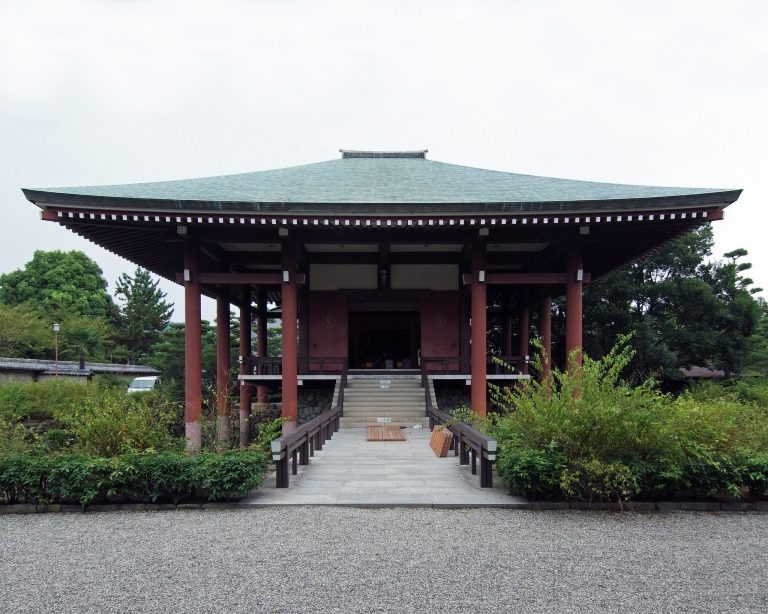
The present main hall dates from a rebuilding completed in 1606. During the Edo period, which lasted from the seventeenth through the nineteenth centuries, the temple was officially recognized as holding 12 koku of land. Its principal image is Eleven-faced Kannon, a form of Avalokiteshvara associated with compassion, whose eleven faces represent expanded spiritual perception and responsiveness to suffering.
Religious associations and protected heritage
Kakuan-ji remains associated with the pilgrimage circuit commemorating Prince Shotoku and with the Northern Yamato Eighty-eight Sacred Sites, where it is number 87. Its protected cultural properties include eight five-element stone towers, or gorinto, which are Buddhist funerary monuments formed of five sections symbolizing earth, water, fire, wind, and space. The tombs of Ninsho and the priest Zengan, also known as Jun’nin, are among these monuments. A hōkyōintō pagoda is designated a Nara Prefecture cultural property, while the main hall is designated by Yamatokoriyama City.
Remains
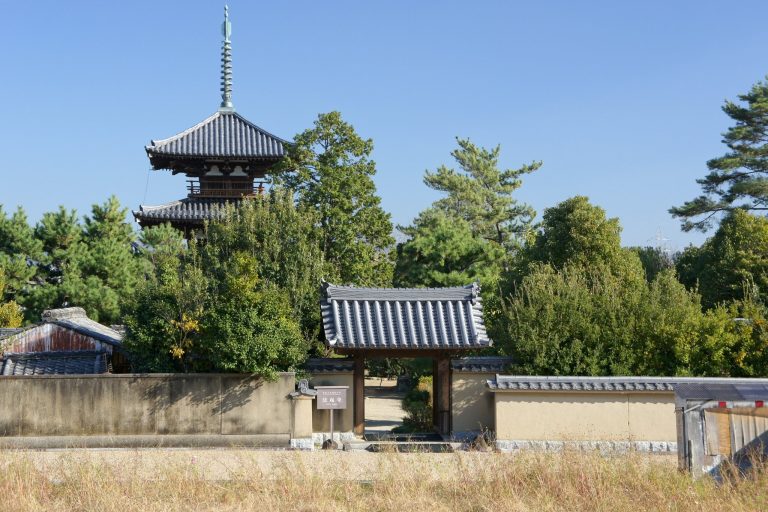
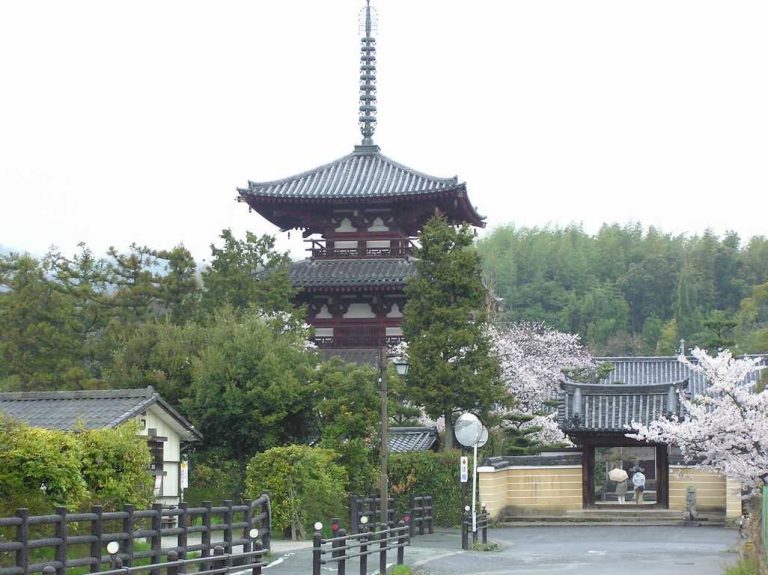
The surviving complex includes the main hall, a mountain gate, a priest’s living and service quarters, an ossuary hall, and a hōkyōintō pagoda. A cemetery lies north of the temple grounds. Together with the surviving monuments and archaeological material, these features represent the later temple and preserve evidence of its earlier development.
Nara-period layout and roof tiles
Former temple plan
The former Nara-period complex consisted of a south gate, middle gate, Golden Hall, three-story pagoda, lecture hall, monks’ quarters, and other buildings. Its arrangement and the surrounding temple estates appear in the former Kakuan-ji plan, a visual record now held off-site by the National Museum of Japanese History and designated a National Treasure. The plan preserves the organization of the buildings and lands that formed the temple during the eighth century.
Early roof tiles
Roof tiles regarded as belonging to the temple’s founding period include lotus-patterned round eave-end tiles with six single petals. They date to the second quarter of the seventh century. An individually carved eave-end tile with a honeysuckle arabesque, a stylized interlacing vegetal design, was excavated on the western side of the precinct. It is of the same type as tiles from the original Horyu-ji complex, known as the Wakakusa Complex, although the discovery of only one example has led to caution about claiming a direct connection between the temples.
Stone monuments and later buildings
Hōkyōintō pagoda
The hōkyōintō pagoda was made by a monk named Jishin to commemorate his mother. Its inscription is dated to 1260, and the monument is described as the third-oldest inscribed example of its type in Japan. It forms part of the temple’s surviving medieval stone heritage.
Five-element stone towers
Eight five-element stone towers stand in the cemetery north of the temple grounds. They include the tombs of Ninsho and Zengan, and two towers carry inscriptions dated to 1297. Their five-part form expresses the Buddhist elements of earth, water, fire, wind, and space.
Sculpture and inscriptions
The wooden Four Heavenly Kings formerly kept at Kakuan-ji were transferred to Nara University in 2005. These Buddhist guardian figures are associated with the four directions. During dismantling and repair work that began in 2014, ink inscriptions were found at seven locations on the Kōmoku-ten and Tamon-ten statues. Announced in 2019, the inscriptions identify the works with the Buddhist monk Gyoki and Sugawara Temple. Nara University stated that they supported the tradition that the statues had been moved from that temple, now called Kiko-ji.