Chūgū-ji Temple: A Buddhist Nunnery in Nara, Japan


Site at a Glance
- Rating
- 4.3
- Popularity
- Low
- Country
- Japan
- Primary era
- Classical
- External website
- Open
- Eras represented
- Classical, Early Modern, Modern
- Civilizations
- Japanese, Tokugawa, Yamato
- Site type
- Religious
- Remains
- Monastery
On this page12 sections
History
Chūgū-ji Temple is a Buddhist nunnery in Japan, founded during the first half of the seventh century in the Asuka period. It stands immediately beside the East Temple of Hōryū-ji in Ikaruga, Nara, and belongs today to the Shōtoku-shū, a Japanese Buddhist school centered on devotion to Prince Shōtoku and historically associated with Hōryū-ji. The temple is traditionally counted among the seven temples founded by Prince Shōtoku, although the precise circumstances of its foundation remain uncertain.
Foundation beside Hōryū-ji
Archaeological evidence places the foundation of Chūgū-ji approximately alongside that of Hōryū-ji. One tradition dates it to 607, but early records including the Nihon Shoki do not describe its establishment. Excavated roof tiles closely related to those from Mukohara-ji, also known as Sakurai Nunnery, support the view that Chūgū-ji was founded as a nunnery rather than being converted to that use later.
Temple tradition says that Prince Shōtoku transformed the palace of his mother, Princess Hashihito no Anahobe, into a temple after her death. Another tradition names Princess Hashihito herself as the founder. A medieval explanation connects the name Chūgū-ji with a supposed position among three palaces. These traditions preserve the temple’s close association with the imperial household, while its exact beginnings remain unresolved.
Decline and Kamakura revival
Chūgū-ji declined after the Heian period, but the nun Shinnyo revived it during the Kamakura period. In 1274, she is associated with the rediscovery of the Tenjukoku Shūchō, a textile connected with Prince Shōtoku, in Hōryū-ji’s storage facilities. During this period Chūgū-ji belonged to the Hossō school, a Buddhist tradition focused on consciousness and philosophical analysis. It later became affiliated with the Sen’nyūji branch of the Shingon school, an esoteric Buddhist tradition.
War, relocation, and imperial-princess leadership
The temple burned during the Sengoku period, an era of prolonged political and military conflict. It subsequently moved its institutional base to a subsidiary temple site belonging to Hōryū-ji, probably near the end of the sixteenth century, when Chūgū-ji became a monzeki temple. A monzeki temple was a high-ranking Buddhist institution traditionally headed by members of the imperial family or aristocracy.
In 1602, Jikaku-in-no-miya became Chūgū-ji’s first monzeki. From then onward, the temple was styled the Ikaruga Palace, or an imperial-princess nunnery, and imperial princesses and aristocratic women served successively as its chief priestesses. Chūgū-ji is one of three nunneries in Yamato associated with imperial-princess chief priestesses. After the Second World War, it joined the Shōtoku-shū, whose head temple is Hōryū-ji. The two institutions have continued close practical ties, including assistance from Hōryū-ji’s monks during ceremonies.
Archaeology and modern preservation
The original temple site lies about 500 meters east of the present grounds. It received National Historic Site status in 1990, and the protected area was expanded in 2001. The excavated remains were developed as the Chūgū-ji Ruins Historical Park, completed in May 2018. Chūgū-ji’s wooden seated bodhisattva and surviving fragments of the Tenjukoku Shūchō hold National Treasure status, while the late-Edo-period Omotegoten is a nationally registered tangible cultural property.
In 2021, the principal image and other treasures were lent to the Miyagi Museum of Art and the Kyushu National Museum during the exhibition National Treasures of Chūgū-ji, Nara, while repairs were carried out on the main hall. The present main hall dates from 1968 and was built at the initiative of Princess Takamatsu. It was designed by Isoya Yoshida in a modern Japanese style.
Remains
Original temple precinct
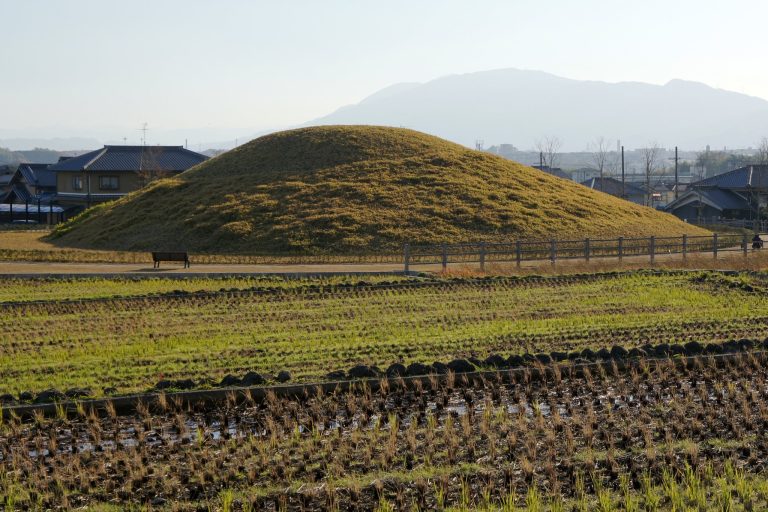
The founding-period complex stood within the area now occupied by the Chūgū-ji Ruins Historical Park. An earthen platform there is thought to preserve part of the original temple. Excavations begun in 1963 revealed the foundations of the Golden Hall and pagoda, arranged on a north-south axis with the Golden Hall to the north and the pagoda to the south. This plan resembles that of Shitennō-ji. The two principal buildings were placed unusually close together, probably with their eaves almost touching. The pagoda had a deeply sunk central foundation stone, a construction method also found at Shitennō-ji, Asuka-dera, and Hōryū-ji.
Further excavation exposed portions of the enclosure walls, the north and south gates, and an ancient north-south road running parallel to the western enclosure wall. The precinct measured approximately 130 meters from east to west and 165 meters from north to south. Its walls were about 2.1 meters wide at the base and bordered by an outer moat approximately 2.5 meters wide and 0.7 meters deep. Roof tiles from the Asuka through Muromachi periods reflect the long history of building activity at the original site. Founding-period round eaves tiles with single-petal lotus designs were made at the Imaike tile kiln and combine Baekje and Goguryeo characteristics. Other excavated tiles bear six-petal lotus, honeysuckle, and arabesque designs comparable to tiles from Hōryū-ji and related sites.
Present buildings
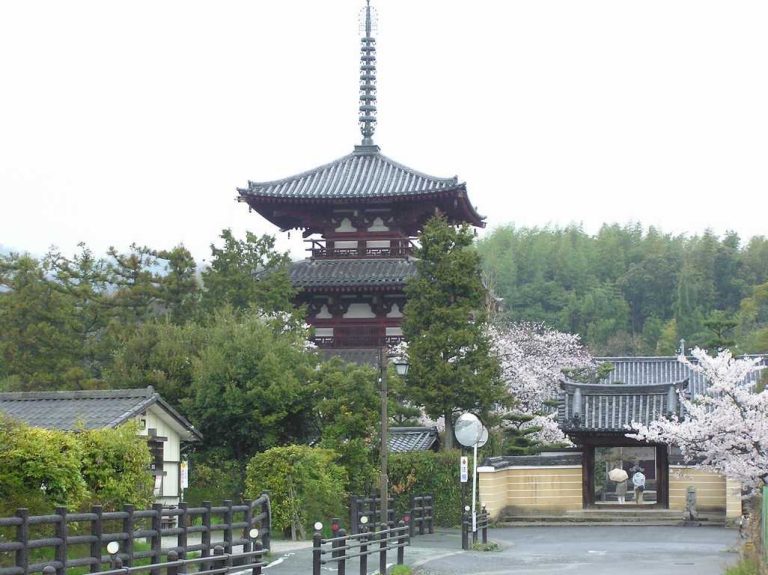
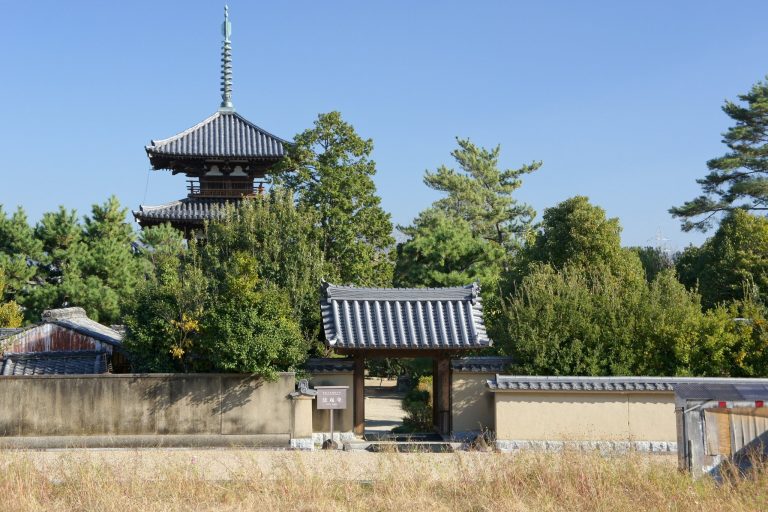
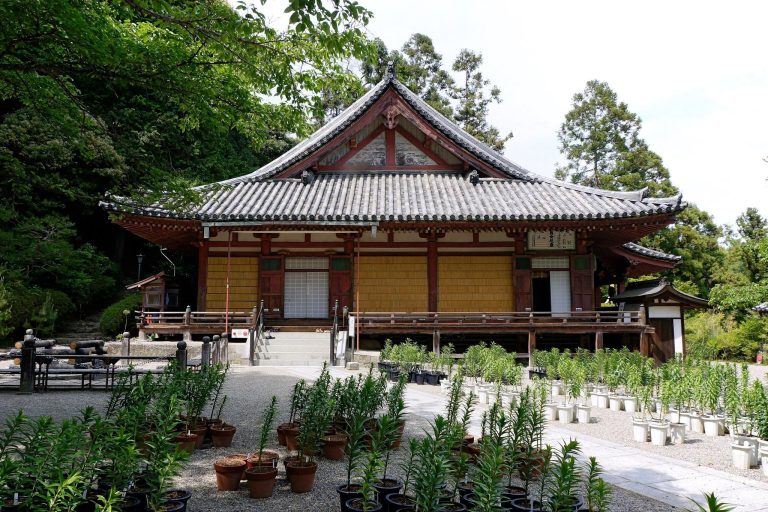
The present compound includes the 1968 main hall, the late-Edo-period Omotegoten, the Kuri, Hato-waden, and a temple gate. The Omotegoten follows shōin-zukuri, a formal Japanese residential and reception style characterized by a principal room, built-in writing or display features, and refined timber detailing. The main hall houses the temple’s principal image and a replica of the Tenjukoku Shūchō.
Sacred images and textiles
Seated bodhisattva
Chūgū-ji’s principal image is an Asuka-period wooden seated bodhisattva, a Buddhist figure, shown in a half-cross-legged posture with one leg raised across the other. The temple traditionally identifies it as Nyōirin Kannon, a form of Kannon associated with the wish-fulfilling jewel and the wheel of Buddhist law, while it is generally thought to have originally represented Miroku, the Japanese name for Maitreya, the future Buddha. The statue measures 132.0 centimeters in overall height and 87.0 centimeters when measured seated without the raised left leg.
Carved from camphor wood, the image uses an unusual multi-piece construction. The head consists of front and back sections, while the principal body is largely made from one piece. The legs, much of the pedestal, and smaller components were separately joined, with stepped cuts at the joints between the legs and pedestal. The right foot rests on the left knee, and the head is supported by the right hand. Traces on the soles show that the statue was once painted and equipped with separately made ornaments. Its surviving surface is darkened with a blackish sheen and was finished with lacquer. The first known documentary reference appears in a 1275 text by Jōen, which calls the principal image Kuse Kannon. Its earlier provenance is unknown.
Tenjukoku Shūchō
The Tenjukoku Shūchō is an Asuka-period embroidered mandala, an image representing a Buddhist realm, that depicts the heavenly realm and eternal life. It includes one hundred tortoises and accompanying text. Prince Shōtoku’s consort, Tachibana no Oiratsume, commissioned the original pair of hanging textiles to mourn his death in 622 and that of Princess Hashihito. The surviving fragments are deposited at the Nara National Museum. A replica made in 1982 is enshrined in Chūgū-ji’s present main hall, while the textile itself was restored in the Edo period by combining surviving pieces with sections of a Kamakura-period replica.
Other artworks and manuscripts
A Kamakura-period standing image of Manjusri was made by layering glued paper over a core formed from a sutra scroll. Documents placed inside the statue date it to 1269, and one is thought to refer to Shinnyo. The image is deposited at the Tokyo National Museum. Chūgū-ji also holds a two-volume Nara-period manuscript of the Yogācārabhūmi, written in ink on paper, together with paintings by Kaihō Yūshō, Hanabusa Itchō, and Yokoyama Taikan.