Atagozuka Kofun: A Late Kofun-Period Burial Mound in Japan


Site at a Glance
- Rating
- 4.3
- Popularity
- Very Low
- Country
- Japan
- Primary era
- Medieval
- External website
- Open
- Eras represented
- Medieval
- Civilizations
- Yamato
- Site type
- Burial
- Remains
- Burial Mound
On this page7 sections
History
Atagozuka Kofun is a Japanese burial mound in Yao, Osaka, constructed during the late Kofun period, probably around the sixth century. The Kofun period was an era when monumental burial mounds were built for members of the elite. Atagozuka served as a grave in the late sixth century and received additional burials before becoming a sacred place for approximately 200 years.
Late Kofun-period burial
The tomb belongs to a landscape in northern Yao where more than 500 late-period clustered burial mounds were once distributed. More than 100 of those mounds survive. Atagozuka Kofun is described as the largest mound in this group, although its archaeological affiliation remains disputed. Earlier references placed it within the Takayasu Kofun Group, while recent classifications by Yao municipal archaeologists treat it as an independent tomb. It was also formerly included in the Rakujinji-Otake Kofun Group, but is no longer classified there.
Later use and medieval burials
The tomb was reused after its original burial phase. Excavated pottery dates from the early Heian period through the middle and later Heian and Kamakura periods. The Heian period was centered on court rule, while the Kamakura period was associated with the Kamakura shogunate. A five-ring pagoda, a Buddhist memorial structure made of five stacked elements representing the traditional cosmic elements, and human bones indicate further burials during the Muromachi period, when later medieval military governments held power.
Investigation and heritage protection
Investigation in 1967 revealed numerous artifacts from the mound. The precinct became an Osaka Prefecture Historic Site on March 31, 1992. Its excavated artifacts were designated Osaka Prefecture Tangible Cultural Properties on December 13, 1995. Osaka Prefecture owns the artifacts, which are deposited at the Yao Municipal Museum of History and Folklore.
Remains
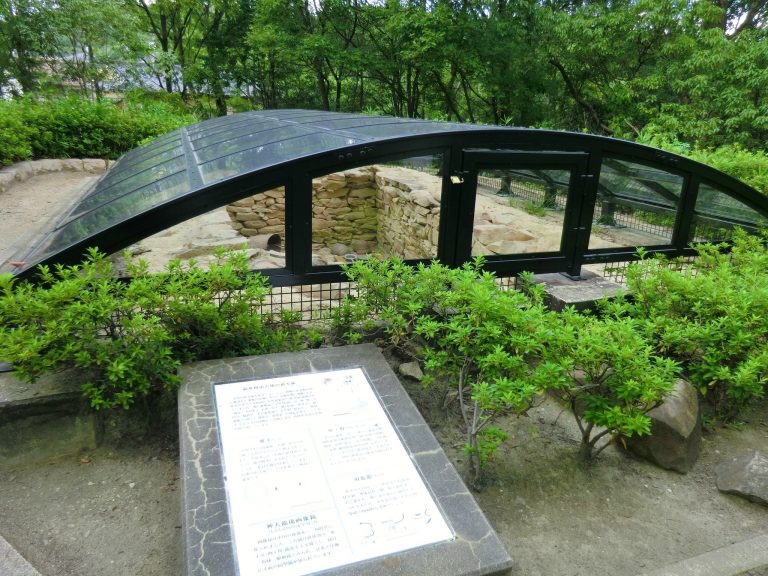
Atagozuka Kofun is a circular mound 22.5 meters in diameter and 9 meters high. It stands on an alluvial fan in northern Yao, in eastern Osaka. Beneath the mound is a south-facing passage-type stone chamber, a burial chamber reached through an entrance passage, with extensions on both sides of the chamber entrance. This double-winged arrangement is associated with many late Kofun-period passage chambers.
Stone chamber
The main chamber is 7 meters long, 2.5 to 3.1 meters wide, and 3.9 to 4.2 meters high. Its passage measures 8.7 meters in length, 1.95 to 2.15 meters in width, and 2.2 meters in height. The chamber and passage were built mainly with two tiers of stone masonry. The chamber is among the largest of its type in Osaka Prefecture and is described as the largest stone chamber in the Takayasu Kofun Group. Two assembled stone coffins are thought to have stood in the main chamber, but they have since been destroyed.
The chamber’s form resembles a seventh-century style, yet most of the excavated Sue ware dates from the first half to the end of the sixth century, with especially many pieces from the latter half of that century. Sue ware is a high-fired, usually gray Japanese ceramic associated with the Kofun period. Comparisons with nearby tombs also produce a chronological discrepancy, which remains an archaeological issue.
Weapons, horse fittings, and pottery
Grave goods from the stone chamber include part of a twisted-ring-pommel sword and a gilt-bronze-plated horse fitting shaped like a sword lozenge, with attached subsidiary elements. The sword’s silver-inlaid scabbard fitting bears two dragons and a bracken-scroll design. Its pommel was made from an iron rod twisted into a spiral and covered with silver foil. Dragon-pattern silver-inlaid swords occur in several regions, while twisted-ring-pommel swords are concentrated around the Kinai, the historical region around the political centers of Nara and Kyoto, broadly corresponding to present-day Osaka and Nara. Their combination at Atagozuka is therefore regarded as evidence of connections between the Kinai and other regions.
Some horse fittings have pendant plates whose designs correspond to motifs found on gilt-bronze objects associated with crowns from the Korean Peninsula. The pottery assemblage includes both Sue ware and Haji ware, a lower-fired earthenware tradition. Material from the tomb’s later reuse includes early Heian Sue ware, black pottery, unglazed pottery, Hagi plates, and winged cooking vessels. The five-ring pagoda and human bones associated with the Muromachi-period burials add further evidence of the mound’s continuing funerary use.
Nearby sites