Chosho-ji Temple: A Cliff-Hanging Buddhist Temple in Sammu, Japan


Site at a Glance
- Rating
- 3.9
- Popularity
- Low
- Country
- Japan
- Primary era
- Early Modern
- External website
- Open
- Eras represented
- Early Modern, Modern
- Civilizations
- Japanese, Tokugawa
- Site type
- Religious
- Remains
- Temple
On this page6 sections
History
Chosho-ji Temple is a Buddhist temple in Sammu, Japan, traditionally founded in 736 and associated with the Chizan School of Shingon Buddhism, a branch of esoteric Buddhism centered on ritual practice, sacred imagery, and teachings transmitted through initiation. Formally known as Narutoyama Fudo-in Chosho-ji, it was originally a subsidiary temple of Entsu-ji in Shimoyokochi.
Traditional foundation and maritime protection
According to tradition, the Buddhist monk Gyoki established the temple while traveling through eastern Japan. He carved an image of Fudo Myoo, a protective Buddhist deity associated with immovable resolve, and prayed for protection from maritime disasters. This connection gave the temple its long-standing name, Namikiri Fudo-in, meaning “Wave-Cutting Fudo Temple.”
During the early Heian period, Kukai, also known as Kobo Daishi and recognized as the founder of Japan’s Shingon school, is said to have moved the temple to its present location and rebuilt it while spreading Buddhist teachings in the Kanto region. Tradition also associates him with a major fire ritual performed at the temple for the relief of the local population and the advancement of public welfare.
The coastline has since receded, so the temple can no longer be seen from the sea. A local tale nevertheless recalls that the light of its all-night lamp once guided a ship in danger of wrecking. The story reflects the temple’s enduring association with protection from the sea.
From the Edo period to the present
The exact date of construction of the main hall is unknown. A ridge tag found during repairs is said to carry the date 1618, placing the existing hall at least in the early Edo period, the era of Tokugawa rule from 1603 to 1868.
The Meiji Restoration, the political transformation that began in 1868 and replaced the Tokugawa shogunate with a centralized imperial government, brought institutional changes affecting Buddhist temples. After this period, Chosho-ji’s role in maritime protection ended, and it continued as a cultural heritage site. The temple received later repairs in 1912 and 1955, while work on the stone foundation was completed in 1974 to preserve its construction against the cliff.
Chosho-ji is the thirty-second pilgrimage site on the New Thirty-Three Kannon Pilgrimage of Kazusa. Kannon is a bodhisattva associated with compassion, and Kannon pilgrimages form religious circuits linking temples connected with this figure. Ishizuka Forest, the mountain on which the temple stands, is designated a natural monument by Chiba Prefecture, while the main hall is a cultural property designated by Sanmu City.
Remains
Main hall and cliff setting
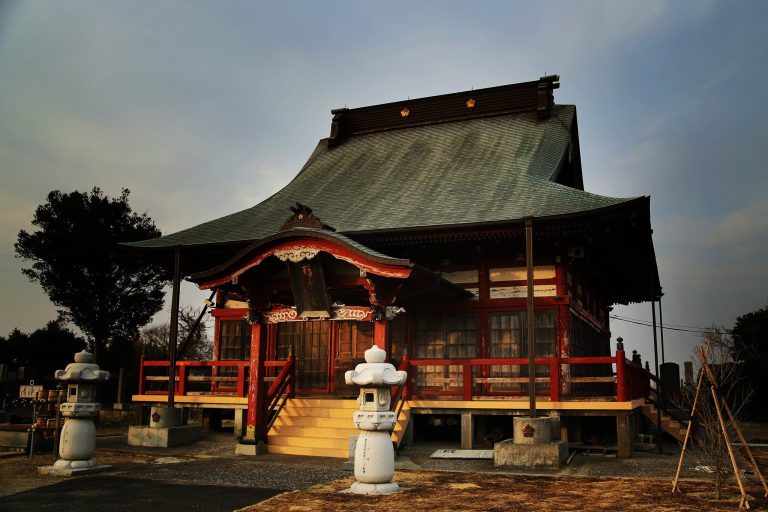
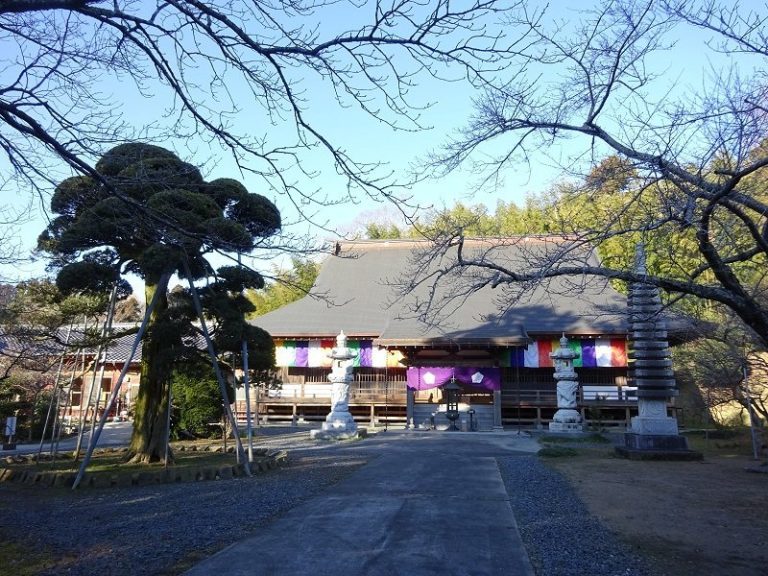
The main hall stands on rock halfway up the approximately 30-metre-high Ishizuka Mountain, also called Ishizuka Forest. Its red-painted cliff-hanging construction projects from the steep rock face on a raised timber framework. A stone-built platform supports the structure, which is held by 26 columns, including two through-posts extending continuously to the inner sanctuary.
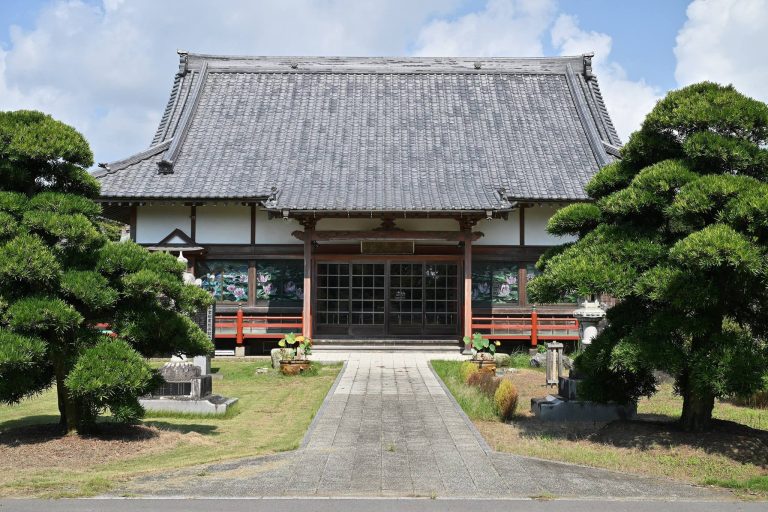
The hall has an irimoya-style roof, combining hipped and gabled forms, and the tiled roof is surrounded by a balustrade and veranda. The plan measures three bays across the front and four bays in depth. Inside is an image of Fudo Myoo with his traditional attendants, Kongara and Seitaka.
Mineral-spring remains
Immediately below the temple are the remains of a mineral-spring inn that opened in 1901 and closed around 1930. The surviving features include a monument to the mineral spring and the remains of a mineral-spring well, preserving evidence of the later use of the area beneath the temple.