Shaolin Monastery: A Mahayana Buddhist and Chan Institution in China
Site at a Glance
- Rating
- 4.5
- Popularity
- Medium
- Country
- China
- Primary era
- Early Modern
- External website
- Open
- Eras represented
- Medieval, Early Modern, Modern
- Civilizations
- Ming, Qing, Yuan
- Site type
- Religious
- Remains
- Monastery
On this page32 sections
History
Shaolin Monastery is a Mahayana Buddhist institution at the foot of Wuru Peak in Dengfeng, Henan, China, founded in AD 495 during the Northern Wei dynasty under Emperor Xiaowen for the Indian monk Buddhabhadra, also known as Batuo. Batuo became its first abbot, establishing the monastery as a place for studying, translating, and preaching Buddhist scriptures. It later became closely associated with Chan Buddhism, the Chinese meditation-centered tradition known in Japan as Zen, and with the martial art known as Shaolin kung fu.
Foundation and early Buddhist learning
Batuo’s disciples included Sengchou and Huiguang. In AD 506, the Indian monks Ratnamati and Bodhiruci established a scripture-translation hall at Shaolin. Working with Huiguang, they translated Vasubandhu’s commentary on the Ten Stages Sutra. Huiguang also promoted the Four-Part Vinaya, the body of Buddhist monastic rules governing discipline and communal life. This teaching later provided the basis for the Luzong school.
Bodhidharma is traditionally said to have arrived from India in AD 527 and to have introduced or established the Chan tradition at Shaolin. East Asian Buddhists later honored him as the first patriarch of Chinese Chan. The tradition that he created Shaolin martial arts is much less certain. Martial arts existed in China before Buddhism, and the specific connection between Bodhidharma and boxing became widespread only in modern popular literature.
Tradition also places Bodhidharma in a cave on Mount Song, where he meditated facing a wall for nine years. Stories connecting him with Shaolin developed gradually through later biographies, inscriptions, legends, and religious traditions. The association remains central to the monastery’s religious identity, while his role in creating Chinese martial arts remains historically disputed.
Persecution, restoration, and the Sui period
During the persecution of Buddhism and Daoism under Emperor Wu of the Northern Zhou, the monk Huike was forced to leave the monastery. In AD 580, Emperor Jing restored the institution and renamed it Zhi’ao Temple. Emperor Wen of the Sui later restored the original name and granted Shaolin approximately 100 hectares of land. The monastery then developed into an important Chan center with extensive agricultural and monastic properties.
Tang and Song expansion
At the beginning of the Tang dynasty, thirteen Shaolin monks assisted Li Shimin, the future Emperor Taizong, in his campaign against Wang Shichong. In AD 626, Li Shimin sent the monastery a letter of thanks. A later stele records the monks’ assistance and an imperial grant of land and a water mill. The frequently repeated claim that the monks were permitted to consume meat and alcohol is not supported by that inscription.
Shaolin became prosperous during the Tang and Song dynasties. Eminent monks, emperors, and officials visited or supported the institution, which established branch foundations and developed ties with local and imperial military organizations. Around AD 1093, the Chan master Bao’en promoted the Caodong school, a major Chan lineage known in Japan as Soto Zen. Shaolin thereby became formally associated with Chan Buddhism after an earlier emphasis on the Vinaya tradition, although it had also maintained a Chan hall.
Yuan revival and destruction in the fourteenth century
During the early Yuan dynasty, Emperor Shizu appointed Xueting Fuyu abbot and placed him in charge of temples in the Mount Song region. Fuyu directed important construction, introduced a seventy-character generational lineage poem for Shaolin disciples, and helped revive the monastery. He was honored as a Buddhist master in 1260 and received the posthumous title Duke of Jin in 1312.
During the Red Turban Rebellion in the fourteenth century, rebels ransacked Shaolin, destroyed much of the complex, and drove away the monks. The monastery was probably abandoned from approximately 1351 or 1356 until government troops recovered Henan in at least 1359. Restoration followed under the Ming dynasty.
Ming military service and renewed destruction
During the Ming dynasty, Shaolin monks were repeatedly recruited for military campaigns. They became especially associated with staff fighting and took part in campaigns against Japanese pirates, including operations organized by the generals Qi Jiguang and Yu Dayou. Their military service helped shape the monastery’s later national reputation for kung fu.
In 1641, rebel forces led by Li Zicheng sacked Shaolin because of its support for the Ming dynasty and the possible threat posed by its armed monks. The monastery’s fighting force was effectively destroyed, and the institution declined until restoration during the Qing period.
Qing patronage and later traditions
Qing emperors supported the monastery. The Kangxi Emperor provided a tablet bearing the monastery’s name in 1704. The Yongzheng court financed major reconstruction in 1735, and the Qianlong Emperor visited in 1750, stayed in the abbot’s room, and wrote poems and inscriptions.
Stories that the Qing government destroyed Shaolin for anti-Qing activities, causing five fugitive monks to disperse and spread Shaolin martial arts, belong to later martial-arts and popular traditions. Their dates and locations vary, and these accounts are regarded as legendary rather than securely documented history.
War, fire, and twentieth-century disruption
In 1912, the monk Yunsong Henglin organized a Shaolin militia to protect local communities from bandits. During the warlord conflicts of the late 1920s, the monastery became associated with General Fan Zhongxiu, who had studied martial arts there.
On 15 March 1928, troops under Shi Yousan set fire to Shaolin Monastery. The blaze destroyed or damaged numerous halls and towers, including the Dharma Hall, Heavenly King Hall, Great Hall, Bell Tower, Drum Tower, Sixth Ancestor Hall, and Chan Hall. Several monks died, while approximately 5,480 volumes of Buddhist scriptures and many cultural relics were destroyed.
During the Cultural Revolution, monks were forced into secular life, temple property was invaded, and Buddhist images were destroyed. After the period ended, Shaolin was repaired and rebuilt. The Great Hall and the stone associated with Bodhidharma’s wall meditation were reconstructed, while some training grounds, pagodas, and stone carvings survived.
Restoration and modern administration
Beginning in the 1980s, the monastery was restored and reactivated as a Buddhist and cultural institution. Because records had been destroyed, architects interviewed elders who had known the pre-1928 complex. By 1998, fourteen architectural elements had been reconstructed or restored. The work required choices among several historical layouts rather than reproduction of one definitive configuration.
In 1994, the monastery registered “Shaolin” as a trademark. From the late 2000s, its leaders authorized overseas branches and cultural centers, helping spread Shaolin culture, Chan meditation, martial arts, and related practices internationally. Modern administration has combined monastic leadership with government and commercial management. This arrangement supported restoration, cultural exchange, and overseas expansion, while also prompting criticism that the institution had become excessively commercialized.
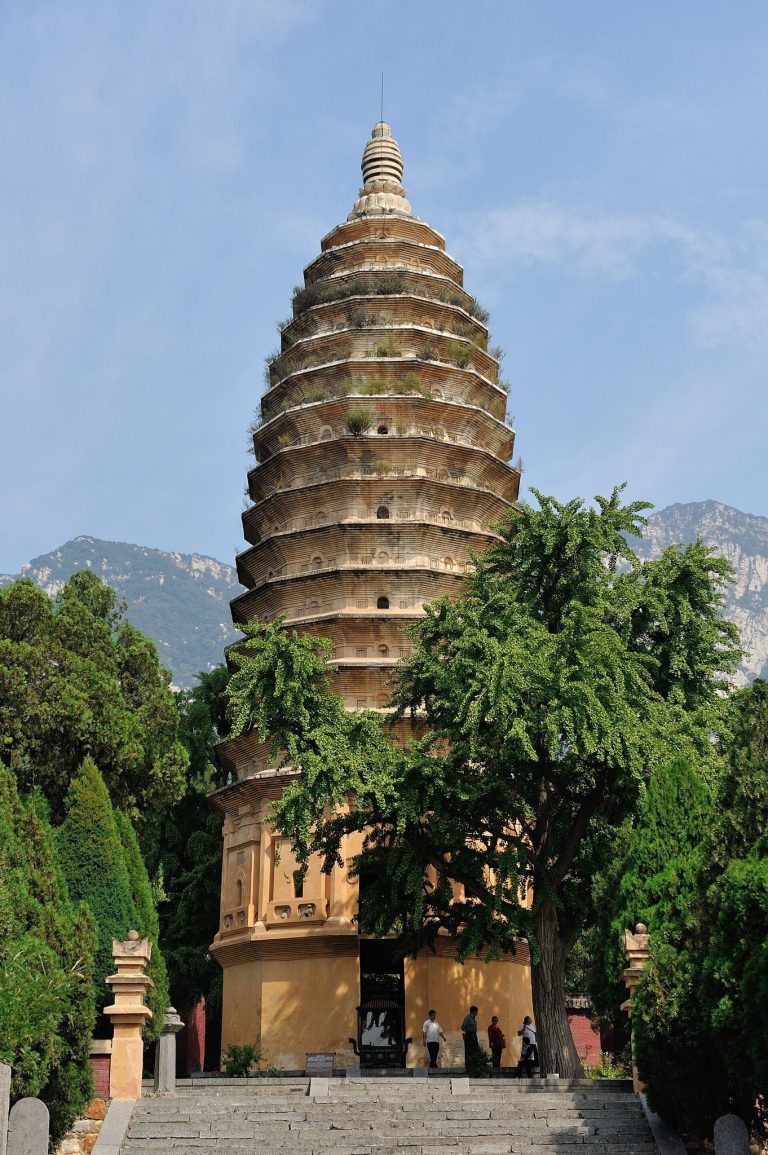
The Shaolin Temple compound, Pagoda Forest, and Chuzu Temple form components of the Historic Monuments of Dengfeng in “The Centre of Heaven and Earth,” inscribed on the UNESCO World Heritage List on 1 August 2010. Shaolin and the Pagoda Forest are also national key cultural relic protection units. Shi Yongxin served as abbot from 1999 to 2025, after which Shi Yinle became abbot. Government officials have also participated in the monastery’s management and financial administration.
Remains
Shaolin Monastery stands in the wooded setting of Mount Shaoshi, part of the Mount Song range. Its name means “Temple of the Shaoshi Mountain Woods.” The historic compound measures approximately 160 by 360 metres, or about 57,600 square metres. Buildings are arranged in three longitudinal strips, with seven principal halls on the central axis, seven additional halls, and several courtyards.
Entrance axis and courtyards
Mountain Gate
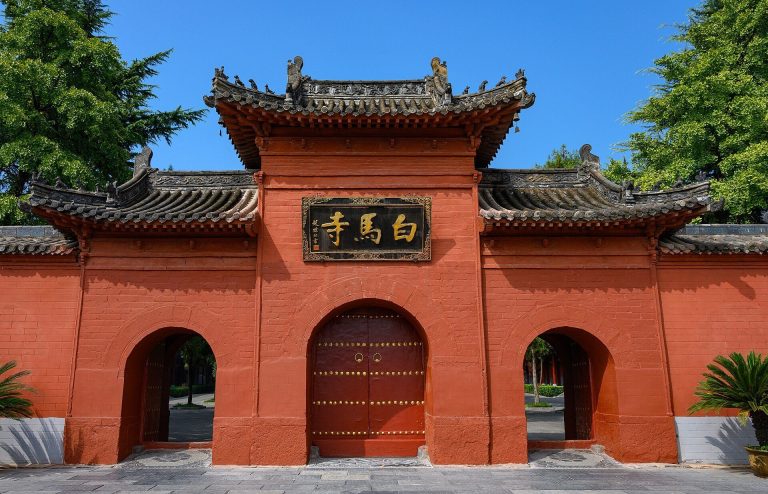
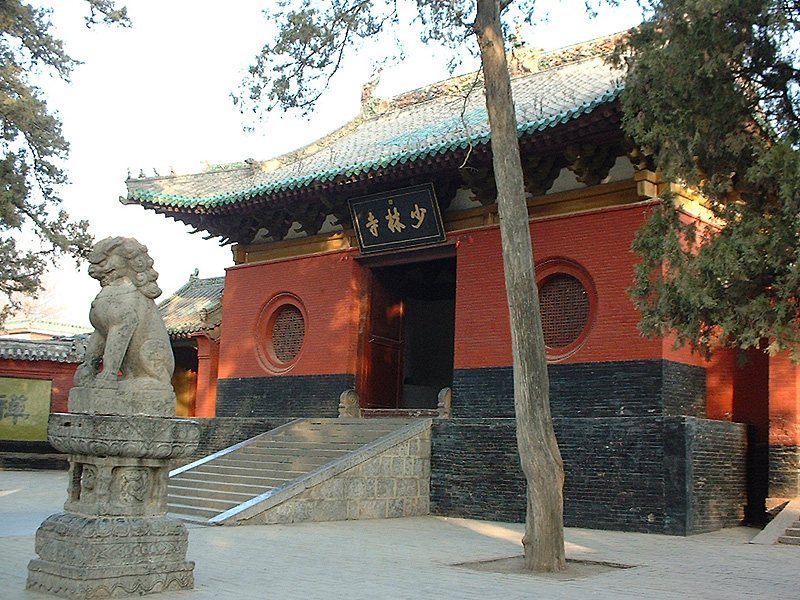
The principal entrance is the Shanmen, or Mountain Gate, built in 1735 during the Qing dynasty. Its black tablet with golden characters reading “Shaolin Temple” bears the inscription written by the Kangxi Emperor in 1704. A statue of Maitreya is enshrined inside the gate.
Hall of the Four Heavenly Kings
The Yuan-period Hall of the Four Heavenly Kings originally served as the monastery’s main gate and housed the Maitreya image. After the Mountain Gate was built, the structure became the Hall of the Four Heavenly Kings. Guardian figures stand beside its entrance, while the Four Heavenly Kings are enshrined within. The central route from the Mountain Gate to this hall is bounded on the east and west by the Chuipu Hall and the Hall of Compassionate Clouds.
Chuipu Hall and Hall of Compassionate Clouds
Chuipu Hall occupies a courtyard of approximately 870 square metres in the southwestern part of the compound. Low buildings around it contain wooden sculptures depicting the origins of Shaolin martial arts and battles involving monks. A building added to the courtyard in 2005 houses a statue of Bodhidharma.
The Hall of Compassionate Clouds occupies a corresponding courtyard in the southeastern part of the compound. A modern building at its center houses an image of Avalokiteshvara with a thousand hands and eyes.
Bell, drum, and inscription monuments
Bell Tower and Drum Tower
The Bell Tower was first built in 1345 and reconstructed in 1994. Its bell dates to 1204. The Drum Tower was built between 1297 and 1300 and reconstructed in 1996. The present bell and drum traditions use the bell in the morning and the drums in the evening.
Li Shimin Stele
Near the Bell Tower stands the Li Shimin Stele, erected in AD 728. This inscribed stone monument commemorates Emperor Taizong’s commendation of the Shaolin monks and records the account of thirteen staff-wielding monks who assisted him during the fall of the Sui dynasty. Its reverse records the imperial grant of Baigu Village to the monastery.
Stele Corridor
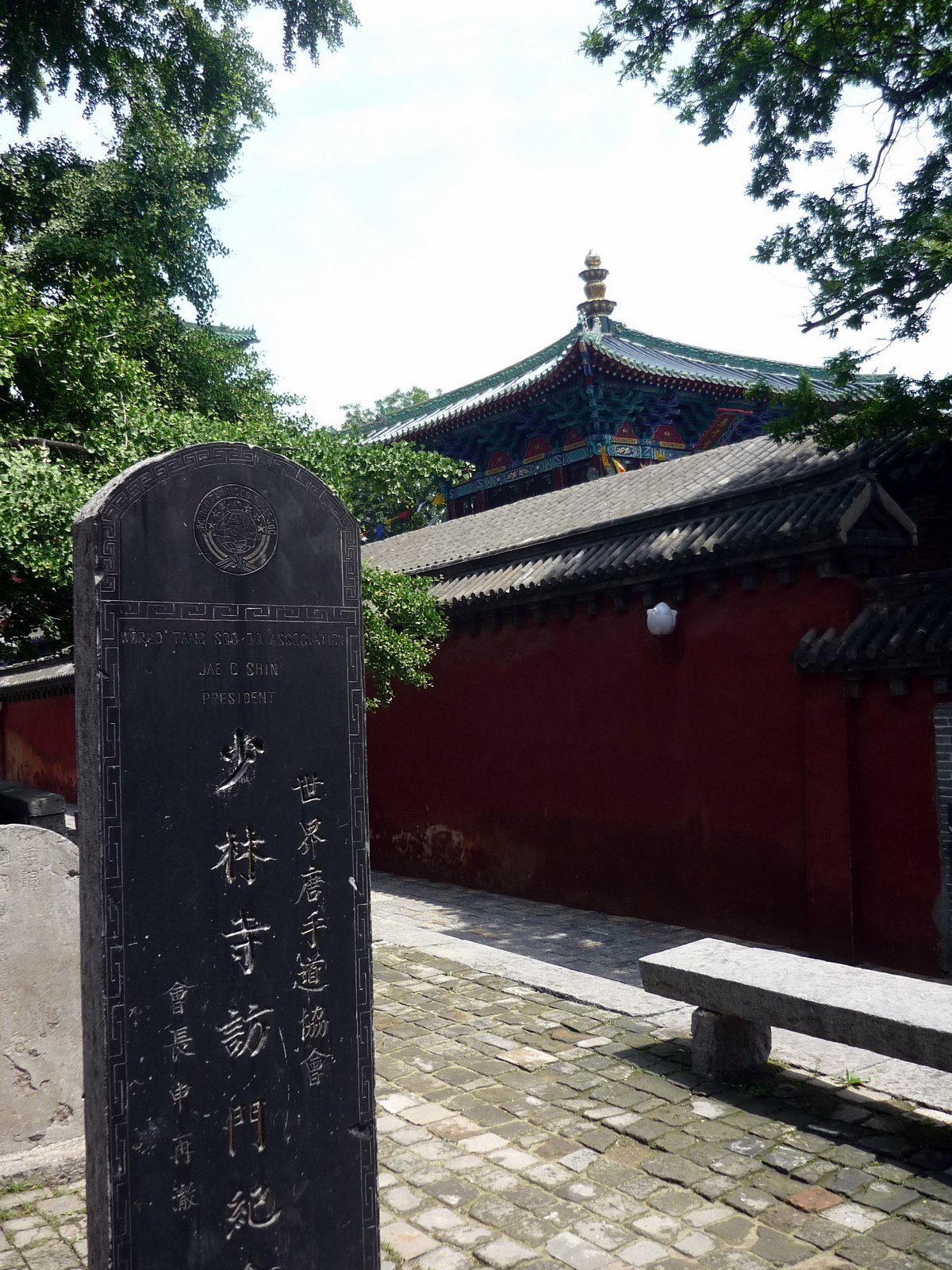
The Hall of Compassionate Clouds includes a Stele Corridor containing 124 stone tablets from several dynasties, beginning with the Northern Qi period. The hall was built in 1686, altered in 1735, and reconstructed in 1984.
Worship and teaching halls
Hall of the Kinnara and Sixth Patriarch Hall
The Hall of the Kinnara was reconstructed in 1982. The Sixth Patriarch Hall contains images of the first six Chan patriarchs and bodhisattvas including Avalokiteshvara, Manjushri, Samantabhadra, and Ksitigarbha. A large iron bell cast during the Ming Wanli period, weighing approximately 650 kilograms, stands in the corridor outside.
Great Hall
The Great Hall, also called the Daxiongbao Hall or Mahavira Hall, was built around 1169 and reconstructed in 1985. It enshrines the Buddhas of the Three Directions, Shakyamuni, Amitabha, and the Medicine Buddha, together with Avalokiteshvara and the Eighteen Arhats. A four-character calligraphic work by the Kangxi Emperor hangs inside.
Thousand Buddha Hall
The Thousand Buddha Hall was built in 1588 and repaired in 1639 and 1776. Its murals include “Thirteen Staff-Wielding Monks Save the Tang King” and “Five Hundred Arhats and Vairocana.” The hall also contains a bronze statue of Vairocana and a white-jade statue of Shakyamuni.
Dharma Hall and Chan Hall
The Dharma Hall, also called the Sutra Pavilion, was reconstructed in 1993. It is associated with Buddhist teaching and the preservation of scriptures. More than 5,000 volumes of Buddhist scriptures, together with traditional musical instruments, were destroyed in the 1928 fire, and the collections were later replenished. The Chan Hall, a space dedicated to meditation, was reconstructed in 1981.
Other central buildings include the Dining Hall, Sutra Room, Guest Reception Hall, guest rooms, monks’ quarters, the Abbot’s Room, the Ordination Platform, and the Shaolin Pharmacy Bureau. A white-jade reclining Buddha donated in 1997 by a lay Buddhist from Myanmar weighs approximately 16.5 tonnes, measures about 7 metres in length, and stands on the altar in the Sutra Pavilion.
Patriarchal and commemorative buildings
Abbot’s Room
The Abbot’s Room was first built during the early Ming dynasty. It served as temporary accommodation for the Qianlong Emperor during his 1750 visit. Its interior contains mural art, statues of Maitreya and Bodhidharma, and a Shaolin lineage chart.
Lixue Pavilion
The Lixue Pavilion, also called the Hall of Bodhidharma or Hall of the First Patriarch, was reconstructed in 1983. It is associated with the tradition of Bodhidharma’s meditation at Shaolin and is surrounded by halls dedicated to major Mahayana bodhisattvas.
Hall of Manjushri
The Hall of Manjushri was reconstructed in 1983 after its destruction in 1928. It contains the stone traditionally said to preserve Bodhidharma’s shadow during his meditation. That interpretation belongs to legend rather than established historical evidence.
Hall of Avalokiteshvara
The Hall of Avalokiteshvara, also called the Hall of the White Robe, was built during the Qing dynasty in the nineteenth century. Its name also refers to wall paintings from that period, including scenes of Qing officials inspecting the monastery and monks practicing unarmed and armed combat.
Associated sites and outdoor features
Chuzu Temple and Bodhidharma’s Cave
Chuzu Temple, or the Hermitage of the First Patriarch, was first built during the Song dynasty and forms one of the protected components of the Shaolin architectural complex. Damodong, or the Cave of Bodhidharma, is traditionally identified as the place where Bodhidharma meditated facing a wall for nine years.
Pagoda Forest
The Shaolin Pagoda Forest is the monastery’s cemetery. It contains approximately 240 pagodas of different sizes dating from the Tang, Song, Jin, Yuan, Ming, and Qing dynasties. These pagodas commemorate deceased abbots and monks, and their forms vary according to the period and the status of the person commemorated.
Training areas and surviving artwork
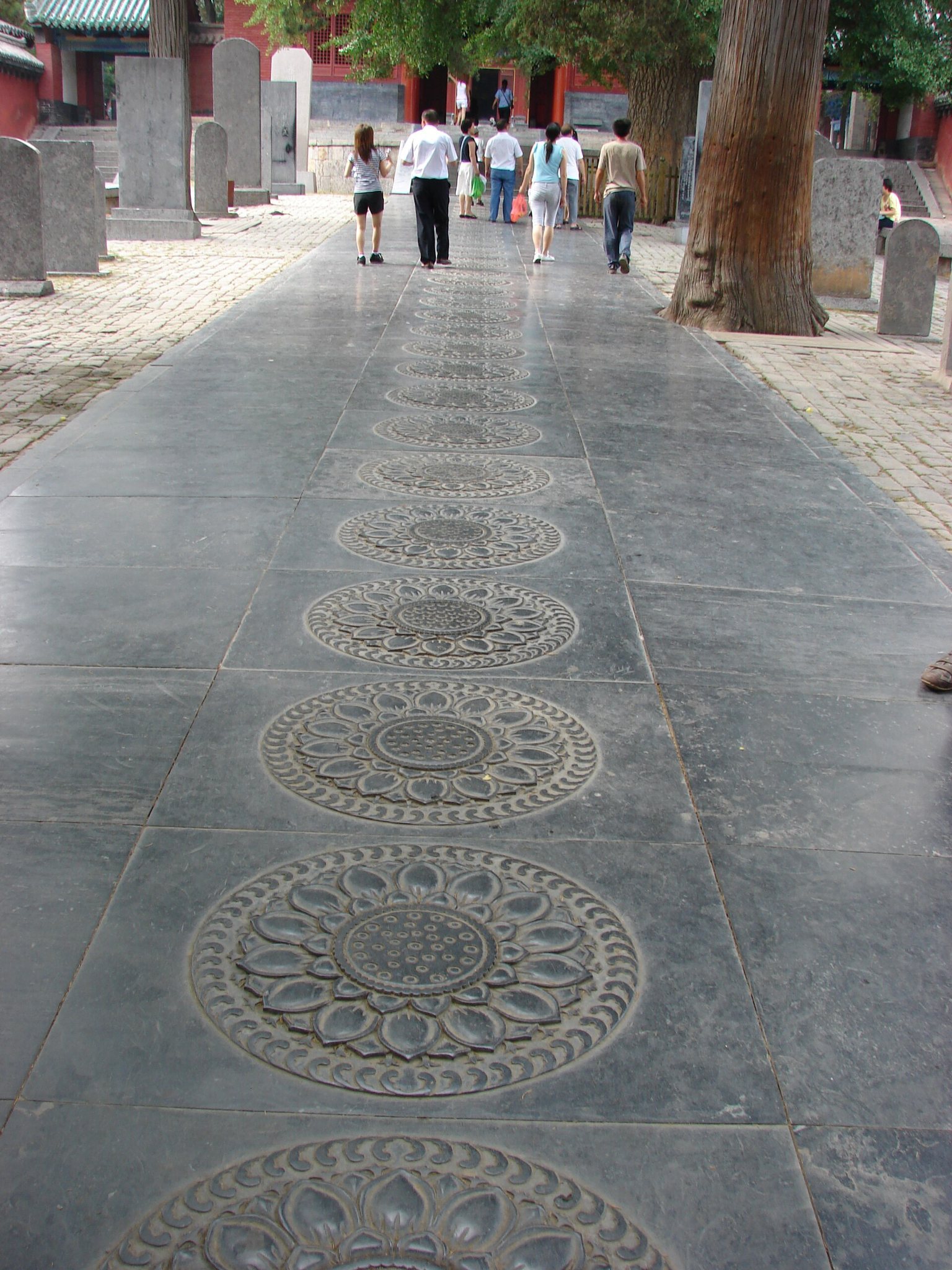
The complex includes a martial-arts training ground and a martial-arts hall. Open areas around the compound have historically been used for martial-arts practice. Ancient ginkgo trees, memorials, monuments, stone carvings, inscriptions, murals, Buddhist images, and other religious and artistic features are distributed among the halls and courtyards.