Zhengzhou Shang City Site: A Bronze Age Shang Urban Center
Site at a Glance
- Rating
- 4.1
- Popularity
- Very Low
- Country
- China
- Primary era
- Bronze Age
- Eras represented
- Stone Age, Bronze Age
- Civilizations
- Unclassified
- Site type
- City
On this page9 sections
History
Zhengzhou Shang City Site is a Bronze Age archaeological settlement in Zhengzhou, China, associated with the early Shang dynasty and the Erligang culture. Most of the city was built during, or shortly before, the Erligang period, broadly between about 1640 and 1500 BC. It was probably a Shang capital, although its identification as Bo, the capital traditionally attributed to Shang founder Tang, or Ao, associated with the eleventh Shang king Zhong Ding, remains disputed.
Before and during the Erligang period
The earliest excavated cultural layer at the site belongs to the late Neolithic Longshan culture, a period before the widespread use of bronze. It contains pottery but no metal objects. Remains linked to the later Luodamiao culture also occur within the walled area. These earlier occupations preceded the construction of most of the urban settlement.
The city was established during the early Erligang sequence, although its precise foundation date is uncertain. Radiocarbon and stratigraphic studies place construction broadly between about 1640 and 1500 BC, while the site is also divided into four phases extending from about 1630 to 1400 BC. A corrected radiocarbon determination from charcoal in the eastern wall gives 3570 ± 135 years before present, with an approximate upper date around 1620 BC. The inner wall and palace area may have preceded the lower Erligang phase or may have been built early within it.
The lower Erligang phase included the outer wall, residential areas, bronze workshops, and a palace district in the northeast. Many tombs beyond the inner wall belong to the upper Erligang phase. The scale of the settlement and its concentration of palatial, industrial, residential, and ritual remains are consistent with a major Shang political center. Its population at the height of its prosperity has been estimated at about 100,000.
Bo, Ao, and the ancient capital debate
The proposed identification with Bo is supported by ceramic discoveries bearing the inscriptions “Bo” and “Bo district.” The alternative identification with Ao rests on proposed connections between the site’s chronology, the Luodamiao culture, and historical records concerning Zhong Ding’s capital. Neither interpretation has resolved the question of the city’s ancient name.
Discovery and archaeological investigation
Han Weizhou discovered the site at Erligang near Zhengzhou in 1950. Archaeologists investigated it in 1951, and formal excavations began in October and November 1952 under Guo Baojun. The work involved cultural-administration authorities, the Institute of Archaeology of the Chinese Academy of Sciences, and a Peking University archaeological training class.
Excavations over the next two years revealed extensive Shang remains, a later cemetery from the Warring States period, and a rammed-earth wall initially identified as an outer wall. Archaeologists identified the inner city wall in 1955. Excavation was interrupted by the Cultural Revolution from 1966 to 1971 and resumed afterward. The palace area was revealed in 1973, followed by the discovery in 1974 of a large square bronze vessel decorated with an animal face and bosses.
Investigation remains difficult because the ancient settlement lies beneath the densely built modern city of Zhengzhou. The site was designated a National Key Cultural Relic under state protection in 1961. In 2004, Zhengzhou joined the Chinese Association of Ancient Capital Studies as its eighth member, reflecting the proposed ancient-capital status of the city while the identification and interpretation of the settlement continued to be debated. During the 2021 Zhengzhou rainstorm, portions of later protective soil covering the rammed-earth walls collapsed. Examination found that the original wall remains had not been damaged.
Remains
Inner city walls
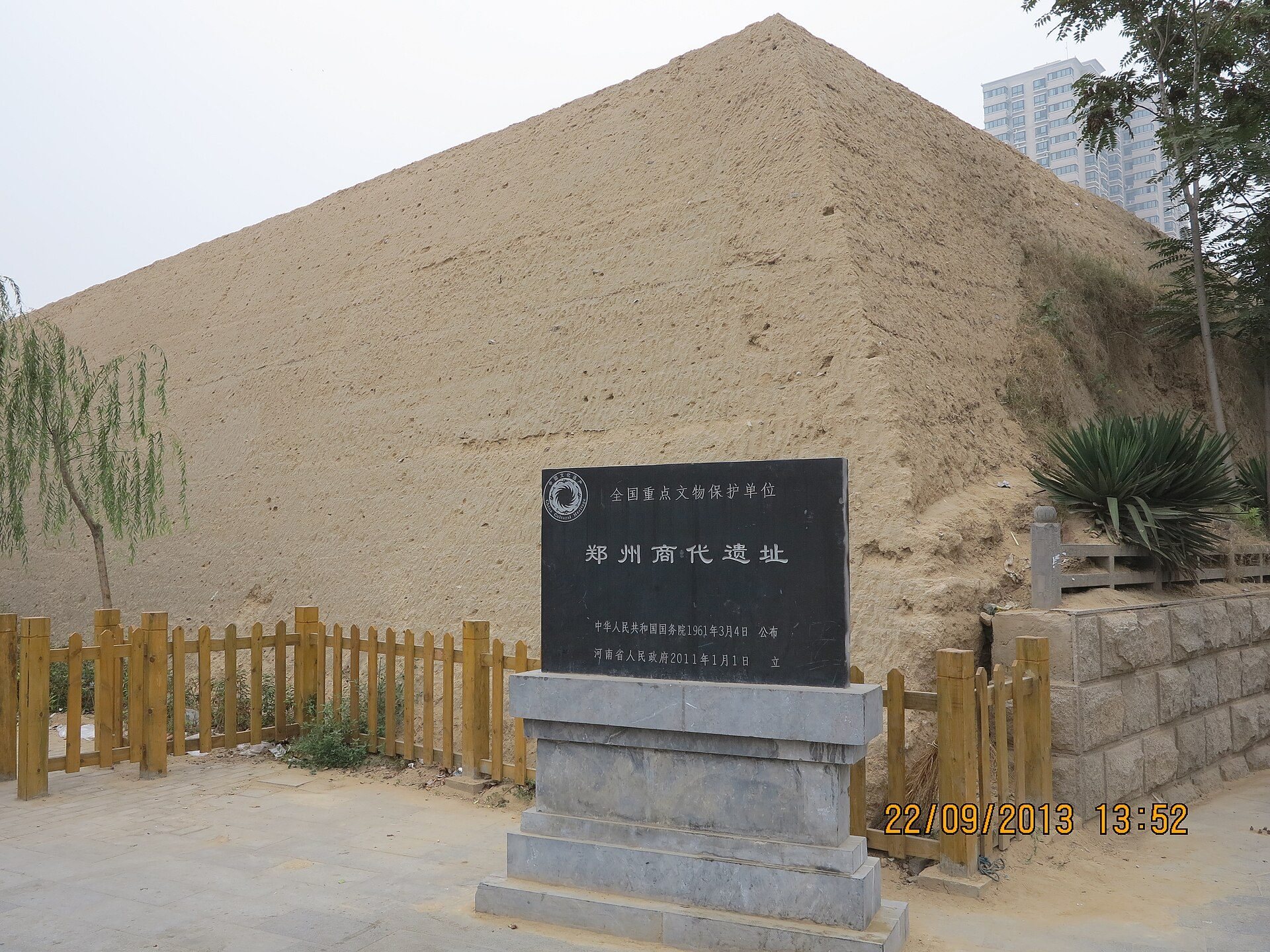
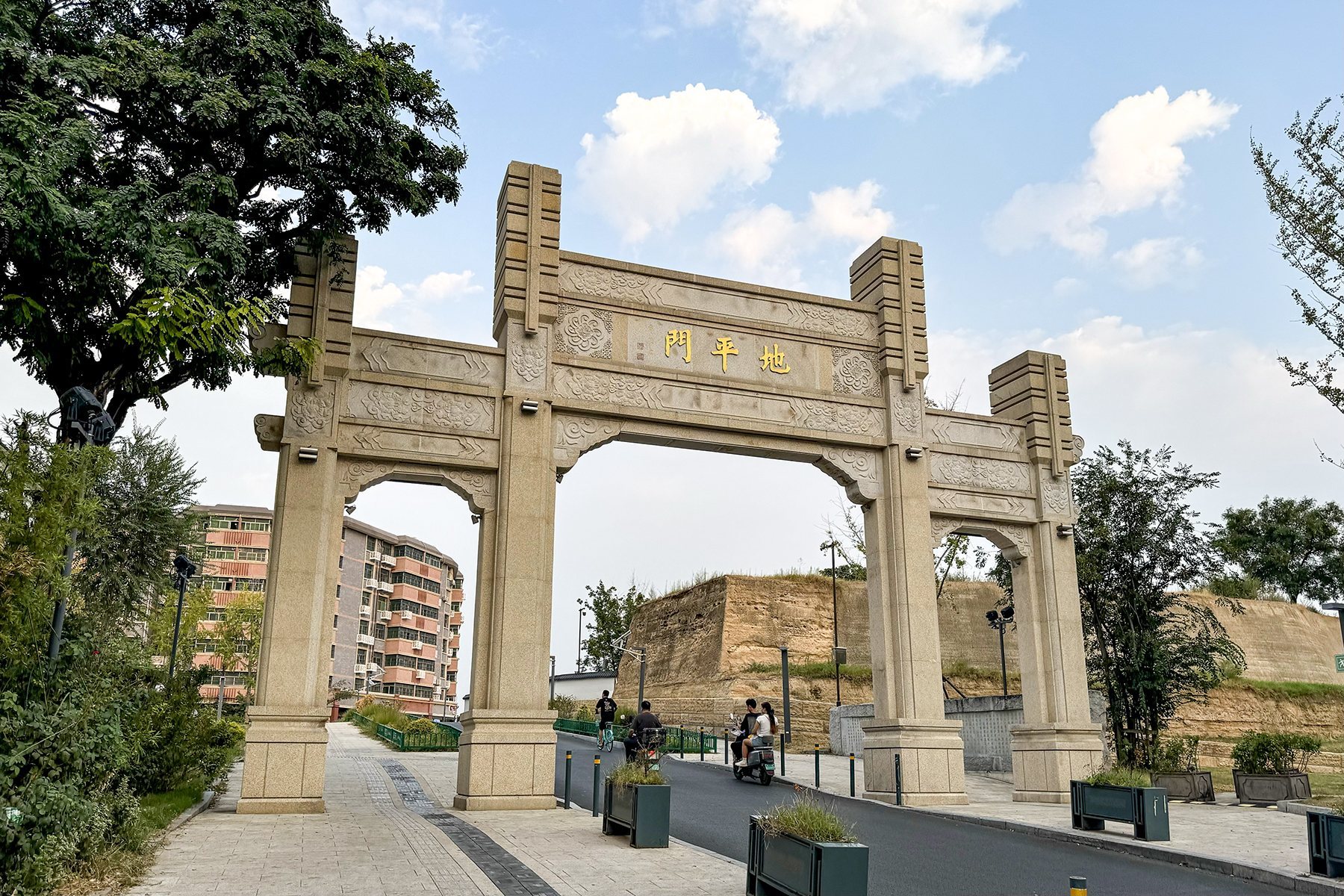
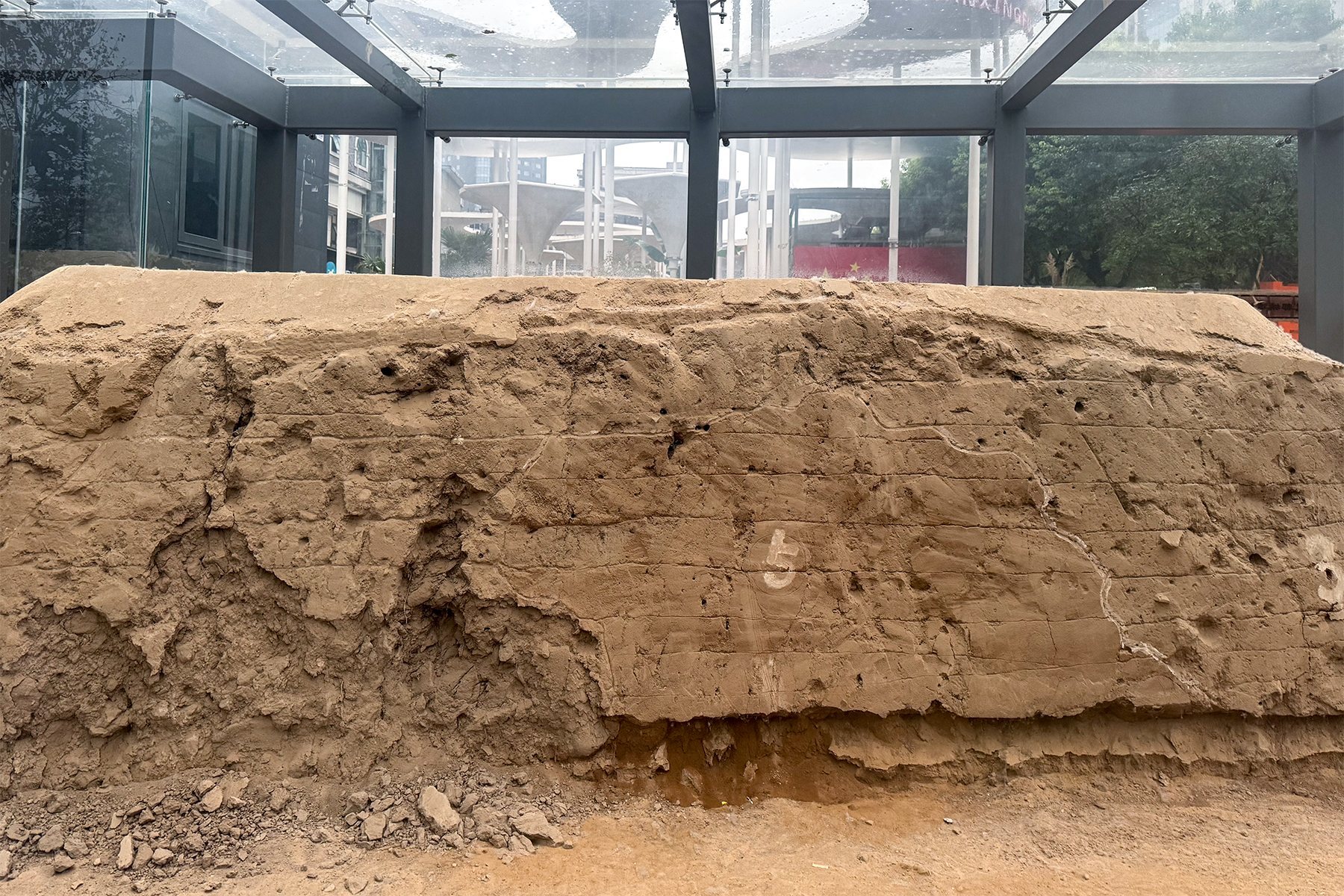
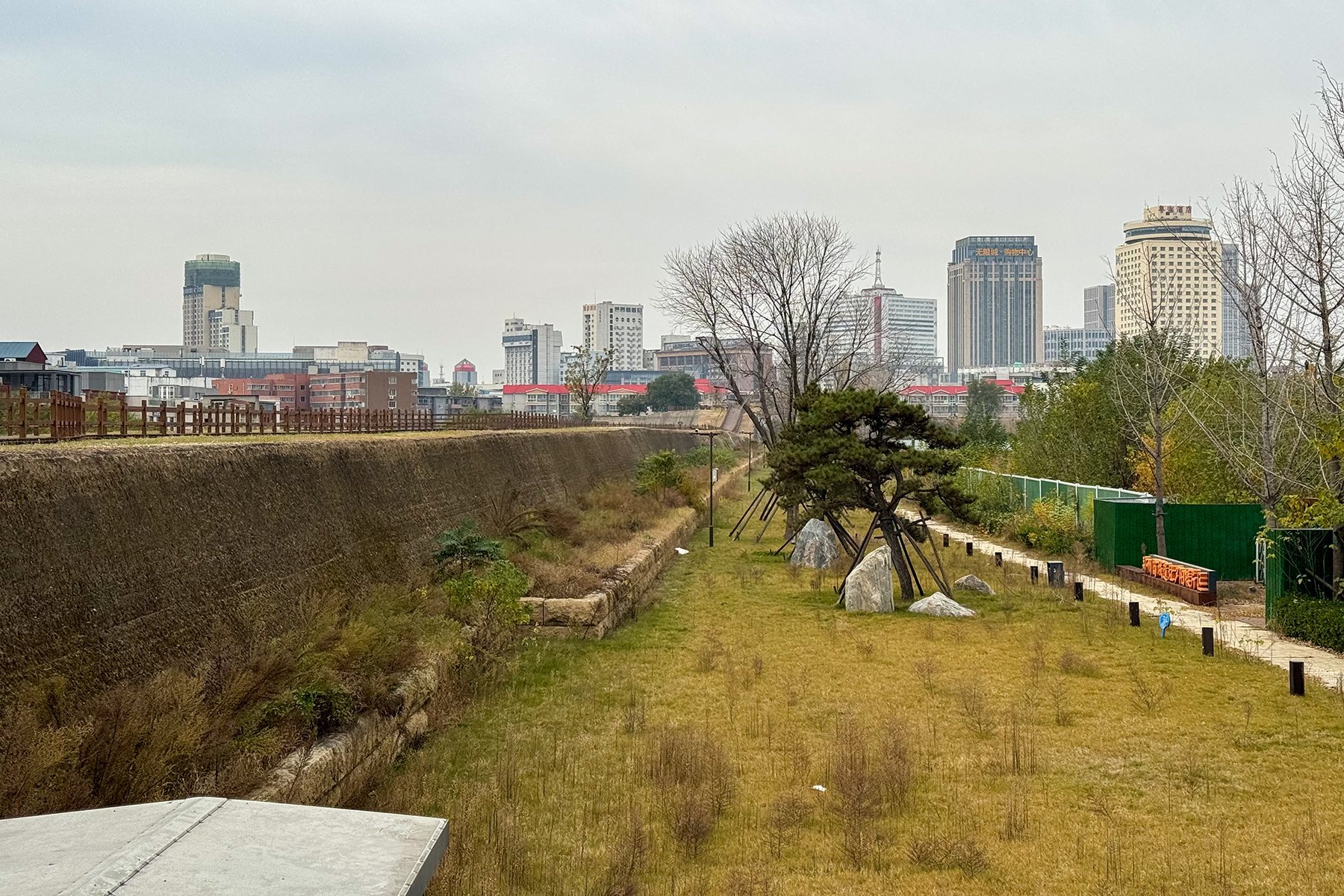
The inner city forms a roughly rectangular enclosure built with hangtu, a technique in which layers of earth are placed and compacted to create strong walls. Its perimeter measures about 6,960 metres. The north side is approximately 1,690 metres long, the east and south sides about 1,700 metres each, and the west side about 1,870 metres.
The wall reaches a maximum stated height of about 9.1 metres. Its base has been described as approximately 36 metres thick, while archaeological structural measurements give a foundation width of about 20 metres. The cross-section was trapezoidal, consisting of the principal wall and an outer protective slope. Builders first cut a foundation trench, then compacted the earth in distinct layers, generally 8 to 10 centimetres thick, with recorded layers ranging from 3 to 20 centimetres. Eleven openings of different sizes were identified around the enclosure, and some may have served as city gates. The massive wall probably helped defend the city and protect it from flooding associated with the nearby Yellow River.
Palace district
The inner city was principally a ceremonial and palatial zone. Its northeastern sector contained a palace district covering nearly 400,000 square metres, with dozens of rammed-earth platforms. The larger platforms exceeded 2,000 square metres, while smaller ones measured more than 100 square metres. At least three large foundations are interpreted as palace structures.
Foundation C8G15 measures more than 65 metres from east to west and 13.6 metres from north to south. Two rows of post sockets were exposed, including 27 in the northern row and 10 surviving at the eastern end of the southern row. One or two foundation stones generally occupied the bottom of each socket, and some sockets preserved traces of round wooden posts. The building may have carried a nine-eaved roof and surrounding corridors.
A water-storage installation in the northeastern part of the palace district measures about 100 metres long and 20 metres wide. Calcareous stone material lined its bottom and walls, while relatively regular blue-grey stone slabs covered the floor. Additional stones reinforced the sides. The installation is interpreted as a water facility serving the palace district.
Smaller foundations and wells also lay within the inner city. Some of the smaller buildings have been interpreted as living quarters for lower-status inhabitants, although the identities of their occupants are uncertain. Copper and jade hairpins, together with fragments of other jade objects from the palace district, are interpreted as elite personal possessions.
Outer city and production areas
An outer wall surrounded at least the southern part of the settlement about one kilometre beyond the inner wall and may have enclosed the entire city. At least 2,900 metres of this wall have been identified. Additional rammed-earth foundations outside the southern and western sides of the inner wall may represent further sections. The area within the outer wall may have covered as much as 1,500 hectares.
Areas beyond the inner wall contained residential quarters, tombs, and craft zones. Buildings were generally round, while the structures used by bronze workers were rectangular. Bronze-casting workshops stood north of Zijing Mountain and in the southern area near Nanguan. A bone-working workshop lay north of Zijing Mountain, and pottery workshops occupied the Minggong Road area west of the city.
The bronze objects produced at Zhengzhou were heavier and technically more advanced than those made at Erlitou, and bronze tools were more common. These workshops formed part of an urban economy that combined craft production with palatial, residential, and funerary areas.
Tombs, ritual objects, and other finds
Small and medium-sized graves were distributed outside the inner wall. Small graves mainly contained pottery, while medium-sized graves included bronze ritual vessels, jade and stone objects, ivory, early porcelain, and furniture. One grave contained a sacrificed attendant. The burial furnishings also included cast bronze objects and other ivory items.
Two bronze hoards contained the Duling square and round ding vessels, a handled you, and a zun decorated with a bovine head. A ding was a bronze vessel used for cooking and ritual purposes, a you was a covered ritual wine container, and a zun was a ritual wine vessel. These objects are considered Shang ritual vessels belonging to King Xuan.
The site has also yielded an approximately 3,000-year-old gold funerary mask from a royal tomb. Its similarities to finds from Sanxingdui, a major Bronze Age culture and site in Sichuan, have been used to support connections between the Shang dynasty and Sanxingdui. Early porcelain and inscribed divination bones were also found. Such oracle bones, made from animal bones or turtle shells, carried written questions, predictions, or records and belong to the early history of Chinese writing.