Imperial Mausoleums of the Northern Song Dynasty: The Royal Cemetery at Gongyi
Site at a Glance
- Popularity
- High
- Country
- China
- Primary era
- Medieval
- Eras represented
- Medieval, Early Modern, Modern
- Civilizations
- Ming, Qing
- Site type
- Burial
- Remains
- Necropolis
On this page24 sections
History
Foundation and imperial burials
The Imperial Mausoleums of the Northern Song Dynasty form a royal burial complex at Gongyi, Henan, China. Construction began in 963 under Emperor Taizu, who established the cemetery for his father Zhao Hongyin. The site lay at the northern foot of the Songshan range, between the Northern Song capital of Kaifeng and Luoyang, about 120 to 130 km from Kaifeng.
Kaifeng stood on flat land with a high water table, which was considered unsuitable for large tombs. The royal family also followed geomantic principles, choosing and arranging burial places according to perceived auspicious relationships between terrain, direction, and natural forces. They favored Gongyi’s rising ground to the southeast and water to the northwest.
Taizu moved Zhao Hongyin’s remains to Gongyi and established Anling. Zhao had been honored after death as Emperor Xuanzu. He was buried there with Empress Dowager Du, whose death in 961 had led to their initial joint burial near Kaifeng. After Taizu died in October 976, he was buried at Yongchang in April 977.
Six more imperial mausoleums followed. Taizong was buried at Yongxi in October 997, the year he died. Zhenzong died in February 1022 and was buried at Yongding that October. Renzong, who died in March 1063, was buried at Yongzhao in October. Yingzong died in January 1067 and was buried at Yonghou in August. Shenzong died in March 1085 and was buried at Yongyu that October, while Zhezong, who died in January 1100, was buried at Yongtai in August. These seven imperial tombs and Zhao Hongyin’s Anling are known collectively as the Eight Mausoleums of the Seven Emperors.
Song burial practice shaped the cemetery’s form. Emperors’ tombs were built after their deaths rather than during their lifetimes, and burial generally took place in the seventh month after death. The short period available for construction resulted in mausoleums smaller than those of the Tang dynasty. Geomantic principles also guided the orientation of tombs and the positions of empresses’ burials, satellite graves, lower palaces, and monasteries.
The district was administered by Yong’an County, established in 1007 to manage the mausoleums. In 1113, the county was raised to the status of a military prefecture.
Conquest, damage, and later protection
The cemetery did not include the tombs of the last two Northern Song emperors. After the Jin conquest of the capital in 1127, Huizong died in Jin custody in 1135 and was first buried at Wuguocheng. Following a peace agreement, his coffin was returned to the Southern Song. Emperor Gaozong then buried him at the Southern Song imperial cemetery in Shaoxing, giving the tomb the name Yongyou.
Qinzong was also captured in 1127 and died in Jin custody in 1161. Gaozong held funeral rites for him and assigned his tomb the distant title Yongxian. About a decade later, the Jin buried him near the southern plain of Huiguo town, using the rites reserved for a first-rank official. His tomb was described as a round mound without carved figures along its ceremonial approach.
After the Northern Song fell, Jin forces and the succeeding puppet state of Qi looted the mausoleums extensively. In 1139, Song official Zheng Gangzhong described damaged corner towers at Yongzhao and its lower palace reduced to foundations; he also reported that fire had destroyed Yonghou’s lower palace. During an embassy to Jin in 1148, Song court ritual official Fang Ting-shuo found that the tombs had been plundered and Zhezong’s remains exposed. He wrapped the remains in his clothing, while Yongzhao remained intact. The complex sustained further damage under the Yuan dynasty and became a field of ruins.
During the Ming and Qing dynasties, the court protected the cemetery, sent officials to make offerings, and erected commemorative steles. The land was treated as government property, and cultivation was forbidden. After the Republic of China was established, more of the land passed into private ownership and was leveled for farming. Some sculptures on lower ground to the north were buried and later uncovered.
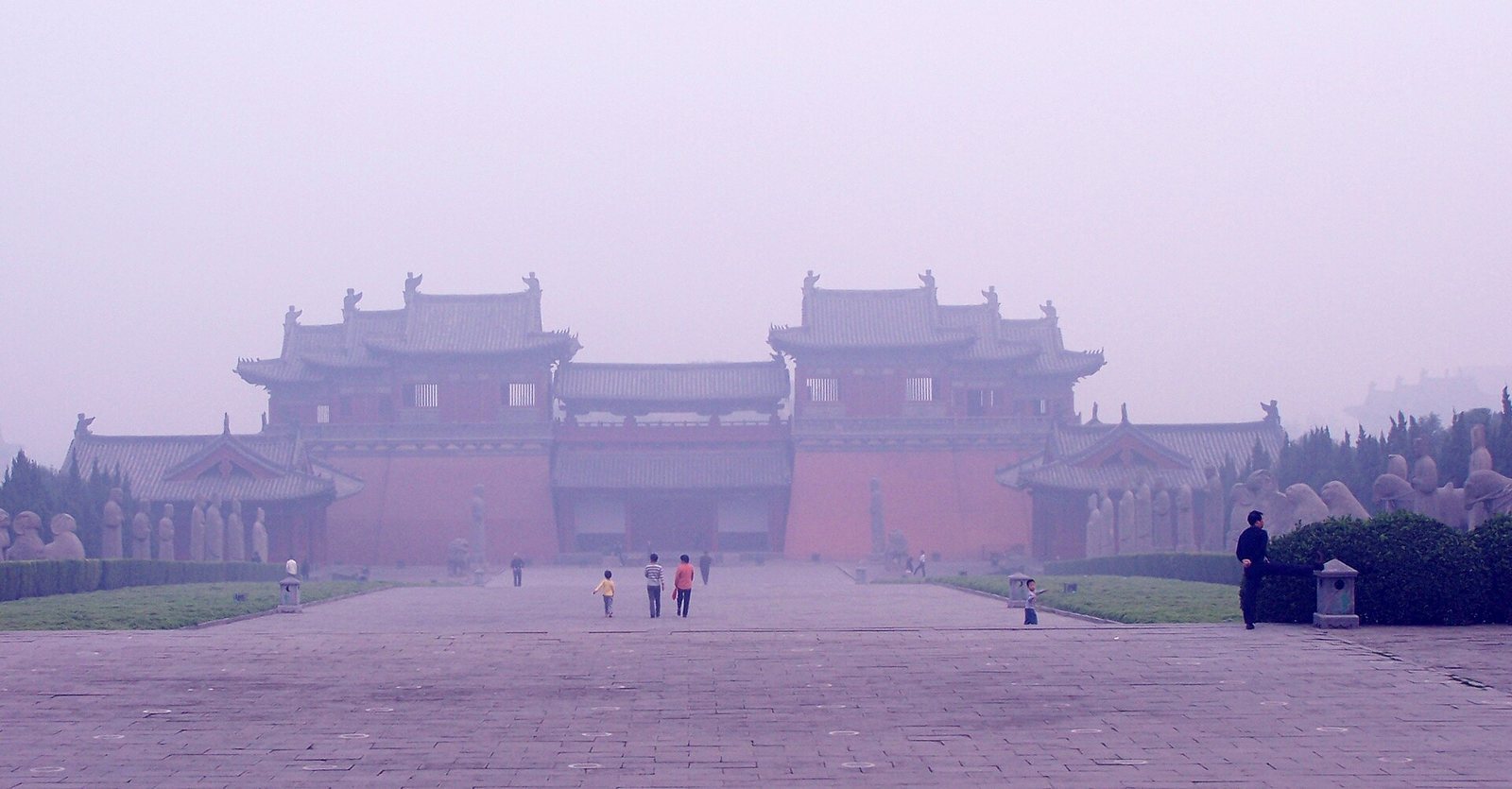
The mausoleums became a Henan provincial cultural heritage site in 1963 and a National Key Cultural Heritage Site in 1982. A rescue and protection project at Yongzhao began in 1995 and reconstructed its upper precinct according to the original plan. Yongzhao is the only mausoleum in the complex whose upper precinct was rebuilt in this way.
Remains
Landscape and overall layout
Four burial districts
The cemetery occupies the western outskirts of Gongyi along the northern base of the Songshan range. It extends about 15 km from north to south and 10 km from east to west, across four districts called Xicun, Caizhuang, Xiaoyi, and Baling. Their settings vary: Xicun lies below the northern foothills of Jinniu Mountain and east of Qinglong Mountain, while Caizhuang occupies a ridge north of its village. Xiaoyi, the northernmost district, sits on the north-facing slope of a low ridge south of central Gongyi. Baling lies between Baiyun Mountain to the south and the Yiluo River to the north.
Shared arrangement
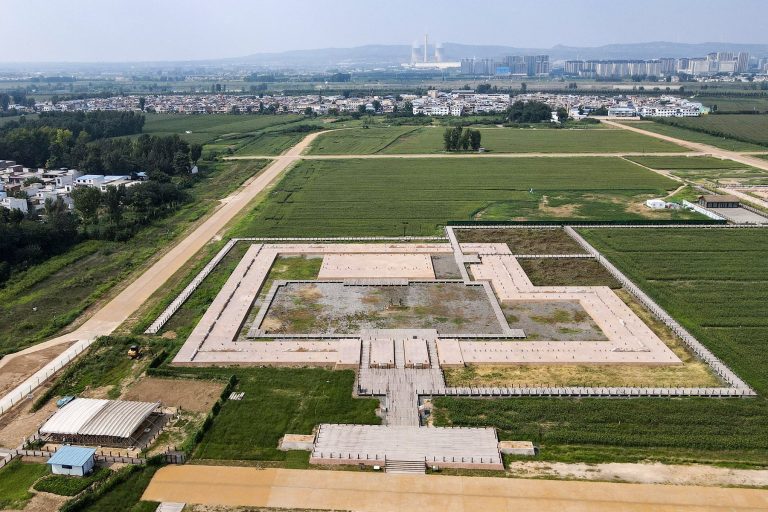
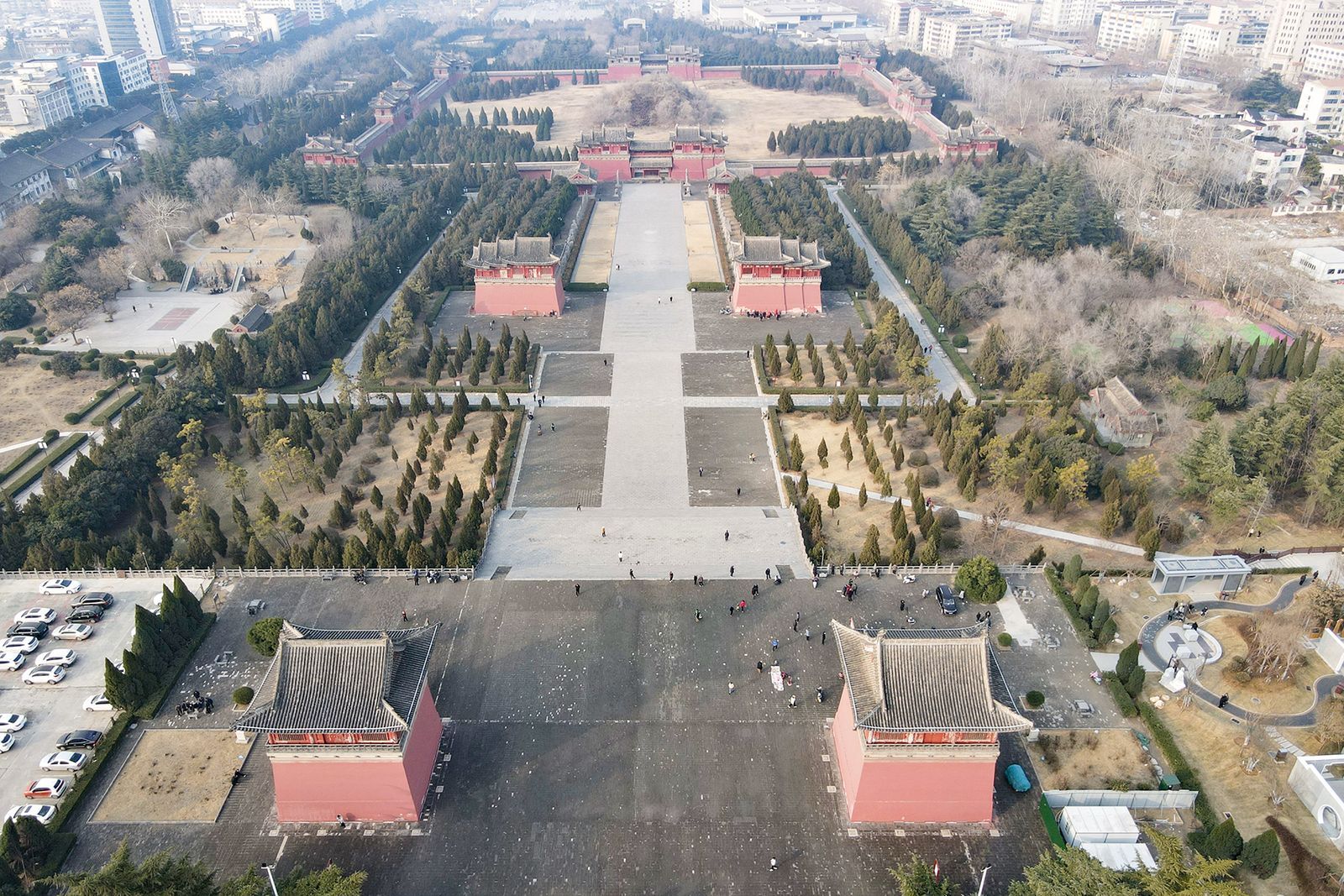
The principal elements of the mausoleums include an upper precinct, a lower palace, empresses’ tombs, and satellite graves. The upper precinct was the main area for ritual offerings. In general, it was square, faced south, and enclosed an earthen mound over the burial chamber. A wall surrounded the mound, with a tower at each corner and a gate centered in each side. A pair of stone lions stood outside each gate.
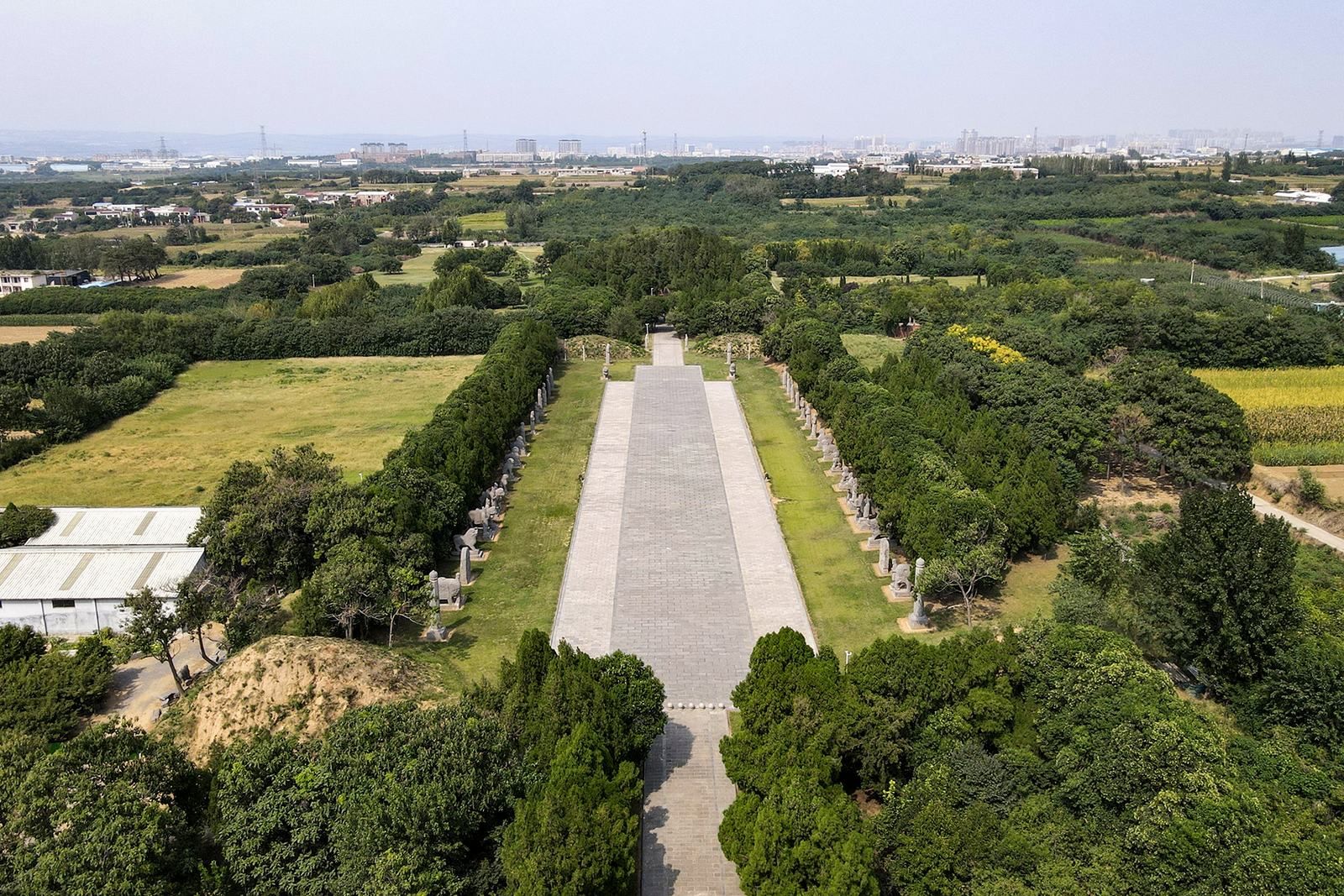
The southern gate opened toward a ceremonial approach, or spirit way, lined with paired stone figures. Paired inner platforms stood at its southern end, with another pair of outer platforms marking the precinct’s southern boundary. From those outer platforms, the ground descended northward past the inner platforms to the enclosure. The burial mound lay in the precinct’s lowest area, reversing the rising sequence typical of traditional Chinese architecture.
Imperial and empresses’ precincts
Imperial enclosures and measurements
At Anling, the enclosure measured about 230 m from east to west and 227 m from north to south. The mound was 22.5 m wide at its base, 8.5 m across its upper edge, and 6.4 m high. The distance from its south gate to the inner platforms was 151 m; the inner-to-outer platform interval measured 141 m.
Stone processions
Except at Anling, imperial precincts had 60 stone figures, arranged in matching pairs along the spirit way. The procession included pillars, elephants with handlers, auspicious birds and mythical beasts, horses with handlers, tigers, sheep, foreign envoys, military and civil officials, lions, warriors, mounting stones, and palace attendants. Elephants and their handlers were a new feature of the Song mausoleums, placed near the southern end of the procession beyond the pillars.
From south to north, the imperial procession began with pillars and elephants, followed by auspicious birds and mythical beasts. Horse pairs and their handlers came next, then pairs of tigers and sheep, three pairs of foreign envoys, and pairs of military and civil officials. Walking lions flanked the south gate; warriors, mounting stones, and palace attendants stood farther along the approach or near the mound. Seated lions guarded the east, west, and north gates.
Empresses’ tombs
Empresses’ precincts followed the imperial plan on a smaller scale, with a mound inside an enclosure, gates, corner towers, platforms, and a south-facing spirit way. Each gate had seated lions. The procession included pillars, horses and handlers, pairs of tigers and sheep, and pairs of military officials, civil officials, and palace attendants. These precincts generally had half as many stone figures as imperial ones.
Most empresses’ tombs had no individual formal title and were grouped under the term garden mausoleums. Tombs of empresses who had served as regents were called mountain mausoleums. This category applied to the tombs of Empress Dowagers Liu, Cao, Gao, and Xiang. Enclosure sizes varied: those of Empress Guo and Empress Yang at Xicun were about 80 m on each side, while many others at Anling, Yongchang, Yongxi, and Yongding measured 100 to 110 m per side. The precincts of the mountain mausoleums of Cao, Gao, and Xiang exceeded 115 m per side after an order to enlarge them. Later tombs at Yongyu and Yongtai returned to dimensions of about 100 to 110 m per side. Empress Dowager Liu’s burial chamber was deeper than those in earlier empresses’ tombs, while the structures above ground remained similar in size.
Burial districts
Xicun
Xicun contains Anling, the joint tomb of Zhao Hongyin and Empress Dowager Du. Four empresses’ tombs were attached to its precinct: those of Taizu’s empresses Wang and He, and Taizong’s empresses Fu and Yin. Aboveground remains survive at the tombs of He and Yin.
Taizu’s Yongchang lies about 450 m west and slightly north of Anling. Both of its associated empresses’ tombs, those of Empress Song and Empress Pan, retain aboveground remains. Taizong’s Yongxi is about 1 km northwest of Yongchang. Aboveground remains also survive at the tombs of Empress Li, another Empress Li, and Empress Guo.
Caizhuang
Zhenzong’s Yongding occupies the Caizhuang district. Three empresses’ tombs lie northwest of its upper precinct. Empress Liu’s tomb is adjacent to the precinct, with the tombs of Empress Li and Empress Yang farther to the northwest.
Two satellite graves lie near Yongding. The grave immediately west of Empress Yang’s tomb has paired stone tigers and sheep and is thought to be an imperial-family burial. A second grave, about 230 m north of her tomb, is identified by a Qing-period stele as the tomb of Song chancellor Bao and is also associated with Bao Zheng. A stone pillar, two tigers, and one sheep remain there. About 3 km northwest of Yongding, four statues, a tiger, two sheep, and a military official, are traditionally attributed to the tomb of statesman Kou Zhun.
Xiaoyi
Renzong’s Yongzhao and Yingzong’s Yonghou lie about 300 m apart, with Yongzhao to the southeast. Empress Dowager Cao’s tomb occupies the northwest corner of Yongzhao, while Empress Dowager Gao’s is associated with Yonghou. Three cleared satellite graves in Yonghou’s northwest area belong to Zhao Yun, Prince of Wei; Zhao Hao, Prince of Yan; and Zhao Jun, Prince of Yan.
Baling
Shenzong’s Yongyu lies southeast of Zhezong’s Yongtai, which is about 500 m to its northwest. Four empresses’ tombs are associated with Yongyu. Empress Dowager Xiang’s lies northwest of the upper precinct; the tombs of Empresses Chen and Zhu are to its west, and Empress Wang’s tomb lies north of theirs. Huizong’s empresses Mingda and Mingjie were buried with Empress Wang, though their tombs have no visible aboveground remains. Empress Liu’s tomb lies northwest of Yongtai.
Four satellite graves lie northwest of Yongyu’s lower palace. One is the tomb of Huizong’s daughter Kangshu, Princess of Shang, and retains a stele commemorating her posthumous title as well as stone figures. The other three have surviving mounds, but their occupants are unidentified. Steles recording the posthumous titles of Huizong’s daughters Huishu, Princess of Deng, and Anshu, Princess of Shu, place their tombs in this area. The tomb of Zhezong’s fourth daughter, Princess of Yang, is presumed to have stood northwest of Yongtai, where her tomb inscription was found.
A separate group of Northern Song royal-family graves lies about 1.5 km northwest of Yongtai’s lower palace, near the southern ridge of Qingxi village. Nine loose stone figures recovered there are now kept together within Yongding’s precinct. Across the burial area, counts include eight imperial mausoleums, 21 empresses’ tombs, 144 graves of imperial-family members, nine graves of senior officials and noted generals, and nearly 1,000 graves of other imperial relatives. Aboveground remains survive at 18 empresses’ tombs, and more than 1,000 stone sculptures remain above ground across the cemetery.
Lower palaces and monasteries
Lower palaces
The lower palace, also called the sleeping palace, stood northwest of the upper precinct in a separate courtyard entered past a pair of stone lions. Yonghou’s lower palace included a main hall, an image hall, a fasting hall, and quarters for tomb guards. The halls held imperial clothing and portraits. A record of Yonghou describes a bier and imperial seat in the main hall, an imperial portrait in the image hall, and sacred silk and imperial clothing in an eastern tent. The wider complex also included a washing court, kitchen, and offices for mausoleum staff.
Monasteries
Four Chan monasteries, Buddhist monasteries associated with the Chan tradition, served the burial districts and held prayers for the deceased. The Eternal Prosperity monastery served Anling, Yongchang, and Yongxi; the Eternal Stability monastery was built for Yongding; the Illustrious Filial Piety monastery served Yongzhao and Yonghou; and the Spirit-Pacifying monastery served Yongyu and Yongtai.
The remains of the Eternal Stability monastery lie about 1 km southeast of Yongding’s upper precinct. The Illustrious Filial Piety monastery stood on the north bank of the Yiluo River. Completed in 1072, it was later renamed the Temple of Longevity during Huizong’s reign. The Spirit-Pacifying monastery stood west of Balings village. Its gate, main hall, and side halls survived into the Republican period before being destroyed during the Cultural Revolution. The location of the Eternal Prosperity monastery is no longer known.
Quarry, kiln, embankment, and Huisheng Palace
Stone quarry
The quarry associated with the mausoleums lies about 25 km east of the burial district, in a valley on the southern slope of Nan Hengling. The valley runs roughly east to west for about 1 km. Cut rock faces and quarry pits mark its slopes, while unfinished sculptures and discarded stone lie at the bottom. Workers roughed out sculptures at the quarry and completed them after transporting them to the tombs. Discontinuous cart tracks on the southern slope have wheel ruts about 105 cm apart. Seven inscriptions connected with quarry work were cut into cliff faces, although most are now indistinct.
Official brick-and-tile kiln
A Song-period kiln complex was found in 1994 on a terrace north of the Wuluo River, about 1 km east of the former Yong’an County seat. Thirteen kilns and large quantities of bricks and roof tiles were identified. Marked tile fragments, animal-face roof tiles, and heads of Buddhist celestial figures match objects from Yongding’s upper precinct and the Eternal Stability monastery, linking the kilns to the production of building materials for the mausoleums.
Flood-control embankment
A Song-period embankment lies beneath Baiyun Mountain, between the north side of Zhangzuizhai village and Duidong village, about 2 km northwest of Yongyu. Built from dressed red stone and mixed river cobbles, it runs approximately east to west in three north-to-south sections. It diverted floodwater from the mountain’s northern slope in both directions, protecting Yongyu from mountain floods.
Palace of Huisheng
The Palace of Huisheng stood on the southern slope of Fengtai Mountain, along the route between the two Song capitals and within Yong’an County. Built in the style of an ancestral temple from the Han dynasty, its construction began in 1030 and finished in 1031. Images of Taizu, Taizong, and Zhenzong were installed at its completion; images of Renzong and Yingzong were added during Shenzong’s reign.
The palace site is at present-day Sigou village, about 4 km south of the former county seat and across the Yiluo River. The cultivated area measures about 260 m from north to south and 180 m from east to west, with cliffs along its eastern, western, and southern sides. A 9.2 m stele from 1034 survives at the site. Titled Inscription on the Newly Built Palace of Huisheng in Yong’an County of the Western Capital, it was written by the scholar Shi Zhongli and describes the palace’s construction, location, buildings, installation rites for the imperial images, and ceremonies attended by officials and commoners. About 100 m northwest of the stele stands an octagonal pillar of blue-gray stone. Four of its faces have raised triangular carvings at the top and bottom; a double circular cap and oval ornament crown the pillar, which rests on a plain, inverted-basin-shaped square base.