Imakumano Shrine: A Kumano Guardian Shrine in Kyoto


Site at a Glance
- Rating
- 4.1
- Popularity
- Low
- Country
- Japan
- Primary era
- Early Modern
- External website
- Open
- Eras represented
- Early Modern
- Civilizations
- Tokugawa
- Site type
- Religious
- Remains
- Sanctuary
On this page9 sections
History
Imakumano Shrine in Kyoto, Japan, is a Japanese imperial-period shrine founded in 1160 in the rare Kumano-zukuri architectural style. Retired Emperor Go-Shirakawa ordered its establishment as the guardian shrine of his Hojuji-dono residence, a major imperial residential and administrative complex. Kumano Gongen, understood in the medieval Buddhist and Shinto tradition as manifestations of the Kumano deities, was invited from the Kumano Three Mountains in Kii Province. Taira no Kiyomori then established the site as the New Shrine and Separate Shrine of the Kumano Three Mountains.
Foundation as a Kyoto Kumano shrine
Go-Shirakawa had a deep devotion to Kumano worship and made 34 pilgrimages to the Kumano Three Mountains, the three principal sacred shrines of the Kumano region. Because Kii Province was distant from Kyoto, he created a nearby place for worship beside his residence. Imakumano Shrine consequently became a major center of Kumano devotion in the capital. Its principal deity, Kumano Musumi-no-Mikoto, is identified with Izanami, a major creation deity in Japanese mythology, and has Senju Kannon, the thousand-armed form of Avalokiteshvara, as a Buddhist counterpart.
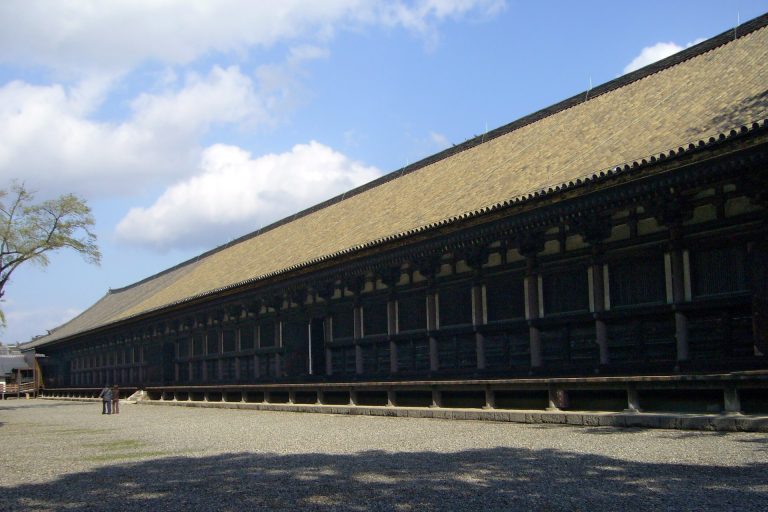
The religious complex around Hojuji-dono expanded during the same period. New Hiyoshi Shrine was founded in 1160, while Rengeo-in, now known as Sanjusangen-do, was established in 1165 as the complex’s guardian temple. Imakumano Shrine is one of Kyoto’s Three Kumano Shrines. It corresponds to Kumano Hongu Taisha, while Kumano Shrine represents Kumano Hayatama Taisha and Kumano Nyakuoji Shrine represents Kumano Nachi Taisha.
Warfare, revival, and rebuilding
The shrine declined during the Muromachi period, when warfare including the Onin War damaged Kyoto’s religious institutions. Imakumano was at one point almost abandoned. It was revived during the Edo period through the patronage of Tofukumon’in, empress consort of Emperor Go-Mizunoo and a major supporter of religious institutions. The main sanctuary was rebuilt in 1673 by Prince Dōkan of Shogoin, a son of the retired emperor.
Noh tradition and modern status
In 1375, the performers Kan’ami and Zeami presented sarugaku noh before Ashikaga Yoshimitsu, the third shogun of the Muromachi shogunate. Sarugaku was a medieval performance tradition that developed into noh theater, and this performance led to Imakumano Shrine being regarded as the birthplace of noh.
The shrine formerly held the legal rank of a village shrine. Around 2015, it left Jinja Honkyo, the umbrella organization with which it had been affiliated, and became independent. Kyoto City designates the main sanctuary as a tangible cultural property and the great camphor tree as a natural monument.
Remains
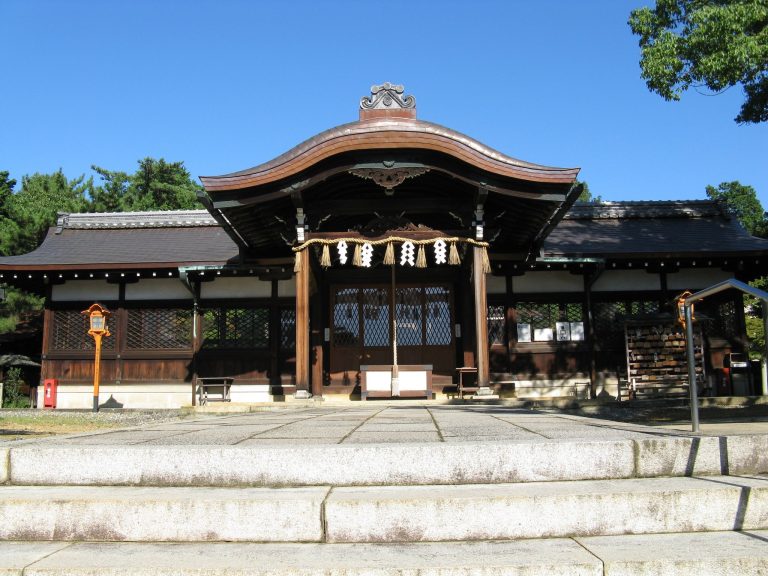
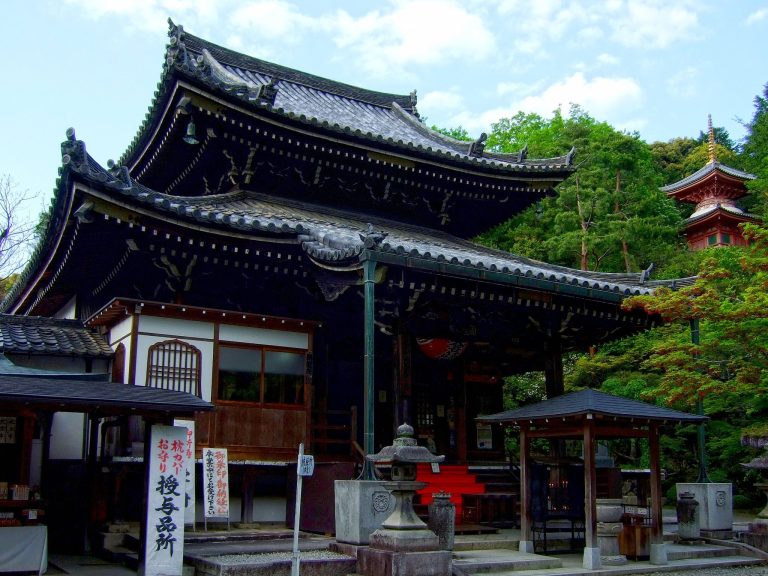
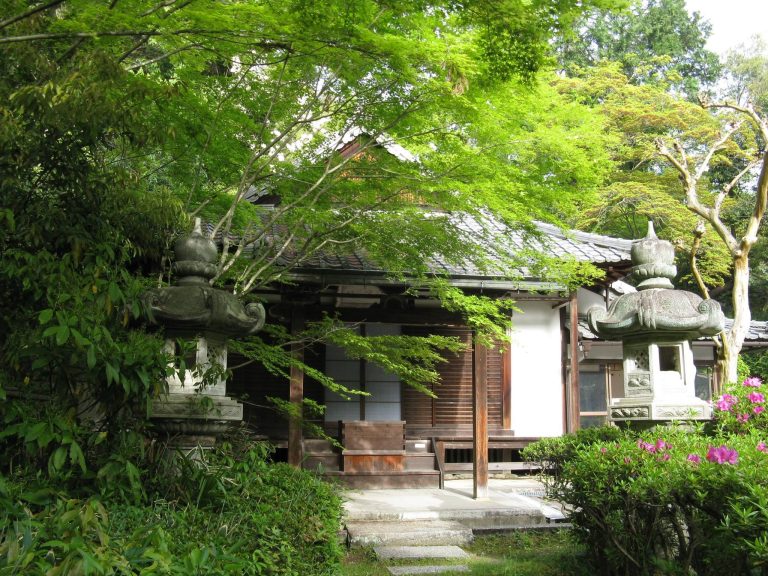
Imakumano Shrine’s precincts retain a Kumano-zukuri main sanctuary, a worship hall, a shrine office, subsidiary shrines, and sacred trees. A path modeled on the Kumano Kodo runs along the northern side of the grounds on top of an embankment, recalling the pilgrimage landscape associated with the shrine’s origins.
Main sanctuary
The main sanctuary is a representative example of the rare Kumano-zukuri style, which is associated with the principal sanctuaries of the Kumano shrines. The present building dates from the reconstruction of 1673. It is designated a tangible cultural property by Kyoto City.
Subsidiary shrines and sacred trees
Wakamiya, Upper, Middle, and Lower Shrines
Wakamiya Shrine enshrines Amaterasu. The Upper Shrine is dedicated to Hayatama-no-Ōkami and Ketsumiko-no-Ōkami. The Middle Shrine enshrines Ame-no-Oshihomimi, Ninigi, Hoori, and Ugayafukiaezu, while the Lower Shrine is dedicated to Wakumusubi, Kagutsuchi, Haniyamahime, and Mizuhanome.
Camphor Shrine and the great camphor tree
Camphor Shrine enshrines the Camphor Great Gongen and is also called Camphor-tree Benzaiten Shrine. The associated great camphor tree was planted by Retired Emperor Go-Shirakawa and is also known as the Great Camphor of Divine Manifestation. Kyoto City designates it as a natural monument. A sacred nagi tree was planted in the precincts in 1980 by the emperor during a visit after his coming-of-age ceremony; it was 20 years old when planted.