Saeno Shrine: A Shinto Shrine of Historical Traditions and Ritual Practice in Japan


Site at a Glance
- Rating
- 4.1
- Popularity
- Low
- Country
- Japan
- Primary era
- Medieval
- External website
- Open
- Eras represented
- Medieval
- Civilizations
- Ashikaga shogunate
- Site type
- Religious
- Remains
- Sanctuary
On this page13 sections
History
Saeno Shrine is a Shinto shrine in Natori, Japan, traditionally founded in 110 during the fortieth year of Emperor Keiko’s reign, when Yamato Takeru’s eastern expedition led to its enshrinement. Its principal deities are Sarutahiko Okami and Ame-no-Uzume-no-Mikoto, regarded as a divine married couple, and its main complex is built in the three-bay Nagare-zukuri style, characterized by a projecting curved gabled roof over the front of the sanctuary.
Foundation Traditions and Early History
The shrine’s origins are preserved through several traditions. One places an earlier sanctuary at Yatsumine during the reign of Emperor Suinin, while another attributes the construction of a shrine building to the reign of Emperor Yuryaku. These accounts connect the site with Japan’s early imperial chronology and with Yamato Takeru, a semi-legendary imperial prince associated with military expeditions into eastern Japan. The early history remains uncertain because a wildfire in 1602 destroyed the shrine’s ancient documents and treasures.
The shrine’s long-standing name was Doso Shrine. Sarutahiko’s role as the guide of Ninigi during his descent from heaven is associated with the titles Doso-jin and Sai-no-kami, from which the name Saeno is derived. This connection led to veneration for opening the way in life and ensuring traffic safety, along with matchmaking, agricultural fertility, commercial prosperity, and the flourishing of households.
Date-Lord Patronage and Religious Status
The honden was constructed on October 23, 1522. Date Masamune repaired the shrine buildings on February 15, 1592, and Date Tsunamura repaired the haiden and provided a rice-field endowment of 20 koku on October 19, 1701. Date Masamune was a prominent daimyo of the late sixteenth and early seventeenth centuries, while Date Tsunamura was an eighteenth-century lord of the Sendai domain. Their interventions, together with support from local worshippers, reflect the shrine’s continuing patronage under successive Date lords.
In 1733, Saeno Shrine received a Sogen senji and the divine rank Shoichii, or Senior First Rank. It was known as Doso Shrine until the early Meiji period, when the name Saeno Shrine came into use. Previously designated a village shrine, it was elevated to the rank of country shrine in November 1908 and became eligible for official ritual offerings in March 1910. In 1908, it also absorbed Sague Shrine, an ancient shrine listed in the Engishiki, together with ten shrines from the surrounding area. The Engishiki is a tenth-century compilation of court regulations and ritual procedures that includes official shrine lists.
Deities, Legends, and Ritual Tradition
Ame-no-Uzume is regarded as Sarutahiko’s divine consort and as the deity who danced before the heavenly rock cave. Her association with dance, music, and the performing arts gives Saeno Shrine additional connections with artistic skill and marital harmony. People connected with the performing arts are said to visit the shrine.
The annual festival takes place on April 20. Tradition holds that it has been celebrated on that date every year since Yamato Takeru’s eastern expedition. The precincts also preserve the practice of Doso-jin Kagura, ritual music and dance performed for Shinto deities. The performance was transmitted from Kashima Shrine in Hitachi Province in 1819 by the shrine priest Shishido Iki-no-kami. Its distinctive rhythm follows an Izumo-style three-beat pattern. Miyagi Prefecture has designated the kagura an intangible cultural property, and it is also performed at festivals of nearby shrines, including Suwa Shrine in Koriyama.
Sague Shrine’s history is linked to a local legend recorded in the medieval chronicle The Rise and Fall of the Genji and Heike. After Middle Counselor Sanekata was banished to Mutsu by Emperor Ichijo, he allegedly refused to dismount and pray before Sague Shrine despite a warning about the deity’s power. The offended deity then killed Sanekata and his horse. The legend also associates the deity with prayers involving phallic-shaped offerings. Sague Shrine’s deity has been interpreted in different ways and is now identified as Takamimusubi-no-kami, one of the three creator deities of Shinto cosmology.
Matsuo Basho, a major early-modern Japanese poet, and his companion and disciple Sora came to the area intending to visit Saeno Shrine and the reputed grave of Sanekata. On the fourth day of the fifth lunar month, corresponding to about June 20, muddy roads and fatigue from their long journey caused them to abandon the visits. They viewed the area from a distance instead, and Basho composed the poem translated as, “Where is Kasajima?—the muddy road in the Fifth Month.”
Remains
The precincts contain the principal shrine complex, a gate that also serves as a kagura hall, subordinate shrines, a large tara tree, and the present sanctuary of Sague Shrine. Related features survive beyond the immediate grounds, including the former Sague Shrine site, a sacred-boundary stone arrangement, and a route marker associated with the approach toward Saeno Shrine and the reputed grave of Sanekata.
Principal Shrine Complex
Haiden, Heiden, and Honden
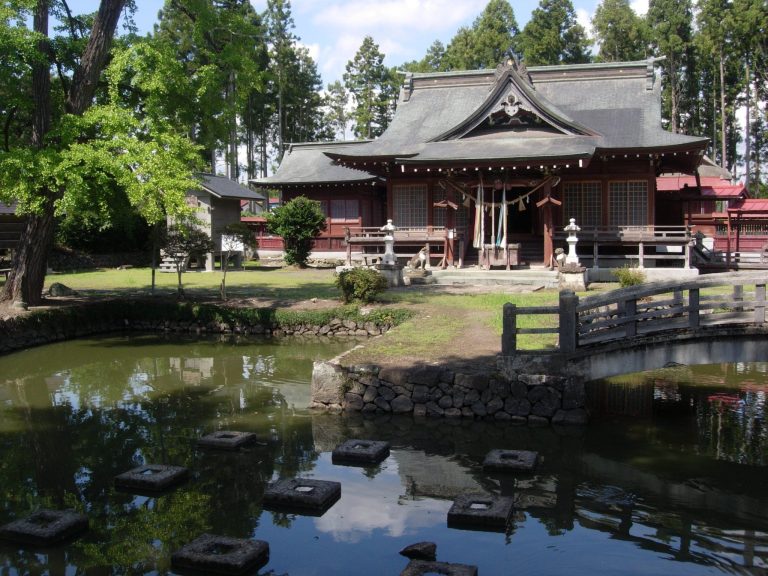
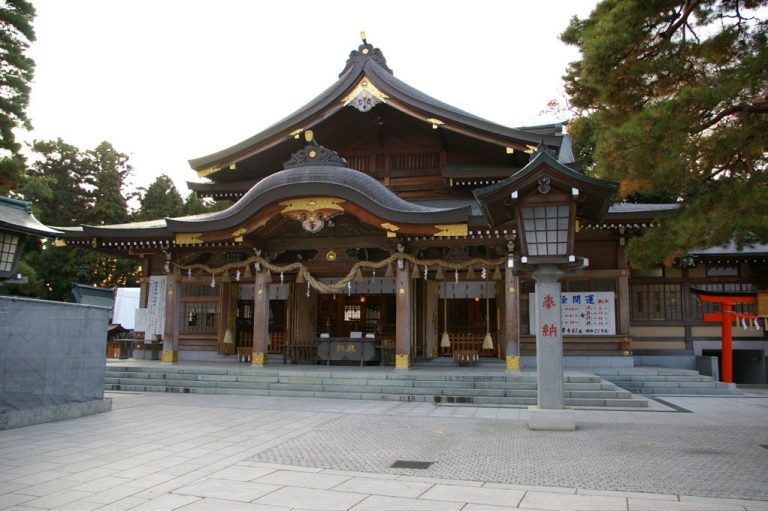
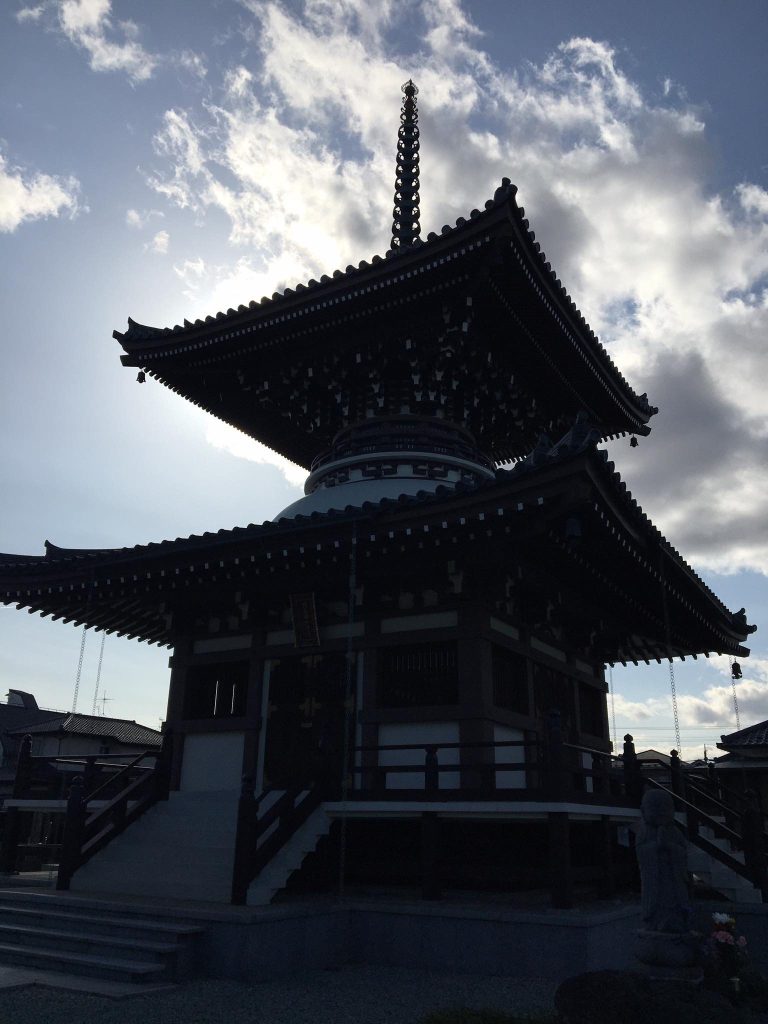
The main complex consists of a haiden, or worship hall, a heiden, or offering hall, and a honden, or main sanctuary. Together they form a three-bay composition in the Nagare-zukuri style, whose defining feature is a curved gabled roof projecting over the sanctuary’s front. The honden dates to October 23, 1522, while the haiden was repaired in 1701.
Gate and Kagura Hall
A gate within the precincts also functions as a kagura hall. It is the venue for Doso-jin Kagura during the April 20 annual festival, linking the physical structure directly with the shrine’s ritual tradition. The performance uses a distinctive Izumo-style three-beat rhythm and is also presented at festivals of nearby shrines.
Subordinate Shrines and Tara Tree
Okuni Shrine and Shoichii Tamura Shrine stand within the Saeno Shrine precincts. A large tara tree also grows on the grounds. It is approximately 20 meters high, with a trunk measuring about 80 centimeters. Trees of this size are described as uncommon near the northern limit of the species’ range.
Sague Shrine and Associated Sites
Present Sague Shrine Sanctuary
The present sanctuary of Sague Shrine stands on the western side of the Saeno Shrine grounds. It is built in the compact Kasuga-zukuri style, which is associated with a front-facing gabled roof. The sanctuary represents Sague Shrine after its merger with Saeno Shrine in 1908.
Former Sanctuary and Sacred-Boundary Site
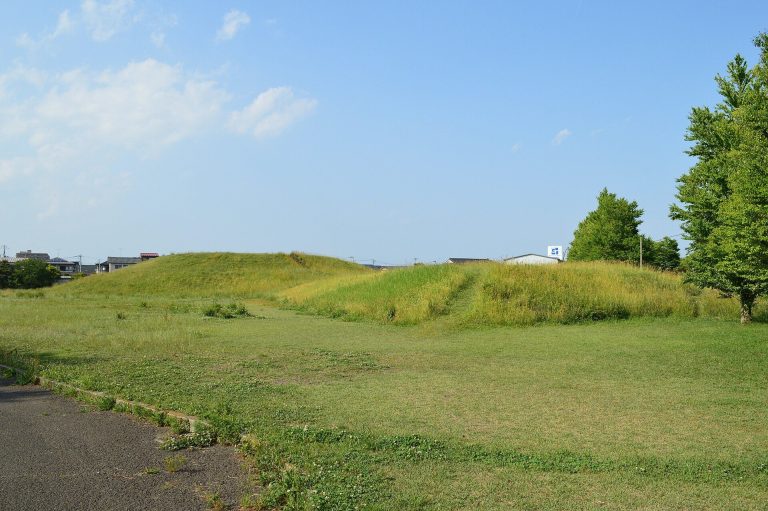
Before the merger, Sague Shrine occupied a small sanctuary approximately one kilometer north of Saeno Shrine, west of the reputed grave of Sanekata and behind a private house. This location is identified as the original site of Sague Shrine. Several meters north of it is a stone arrangement known as the Sague Shrine sacred-boundary site. It is regarded as a yorishiro, a material object or place believed to receive or embody a deity’s presence.
Doso-jin Route Marker
A stone marker known as the Doso-jin Route Marker stands beside a river about 450 meters southwest of Tatekoshi Station. It is associated with the route toward Saeno Shrine and the reputed grave of Sanekata, extending the shrine’s network of remembered sacred places beyond the main precincts.