Scola Tower: A Genoese Coastal Fortress in Italy


Site at a Glance
- Rating
- 4.6
- Popularity
- Very Low
- Country
- Italy
- Primary era
- Early Modern
- Eras represented
- Early Modern
- Civilizations
- Genoese
- Site type
- Military
- Remains
- Tower
On this page8 sections
History
Scola Tower is a fortified coastal structure in Italy, built by the Republic of Genoa in 1606 to defend the Ligurian coast and the sea approaches around Palmaria and the Gulf of Poets. It formed part of the Genoese defensive program of the sixteenth and seventeenth centuries, when the Senate of this maritime republic directed fortifications to protect ports, settlements, and sea routes. Its construction reflected changing political conditions and advances in military and ballistic technology, at an estimated cost of 56,000 Genoese lire.
Genoese Defensive System
The tower stood within Palmaria’s network of defensive positions, alongside Fort Cavour, Fort Umberto I, and the Semaforo Battery. Together, these works belonged to the wider fortified system of the Gulf of La Spezia. Scola Tower could house up to eight members of a garrison, consisting of six soldiers, a captain, and a master bombardier, the specialist responsible for operating and maintaining artillery. Its ten cannons covered the waters between Palmaria Bay, Olivo Bay at Porto Venere, and the Gulf of Lerici.
Responsibility for the tower passed through several successive states and military authorities. It was used by the Republic of Genoa, the Ligurian Republic, the Kingdom of Sardinia, the Kingdom of Italy, and eventually the Italian Navy. The Ligurian Republic was a short-lived French-supported government that ruled the former Genoese territories from 1797 to 1805.
Damage and Abandonment
On 23 January 1800, during the War of the Second Coalition, the tower became involved in a naval engagement between British and French fleets. This conflict, fought from 1798 to 1802, brought Britain and other European powers against Revolutionary France and later Napoleonic France. British cannon fire severely damaged Scola Tower and breached one side of its curtain wall, the defensive wall enclosing the position.
The damage led to the tower’s complete abandonment during the first half of the nineteenth century. The Italian Navy later used it for target practice, and demolition was scheduled in 1915. Ubaldo Mazzini, an inspector of monuments, petitioned the Ministry of Public Education to prevent its destruction. The tower was consequently converted into a signaling lighthouse, a structure that communicates warnings or navigational information through visible signals or light.
Restoration
After a long period of ruin and erosion, the perimeter walls underwent major restoration and consolidation between 1976 and 1980. These works stabilized the surviving structure and preserved the remains of the former coastal defense post.
Remains
Fortified Form and Setting
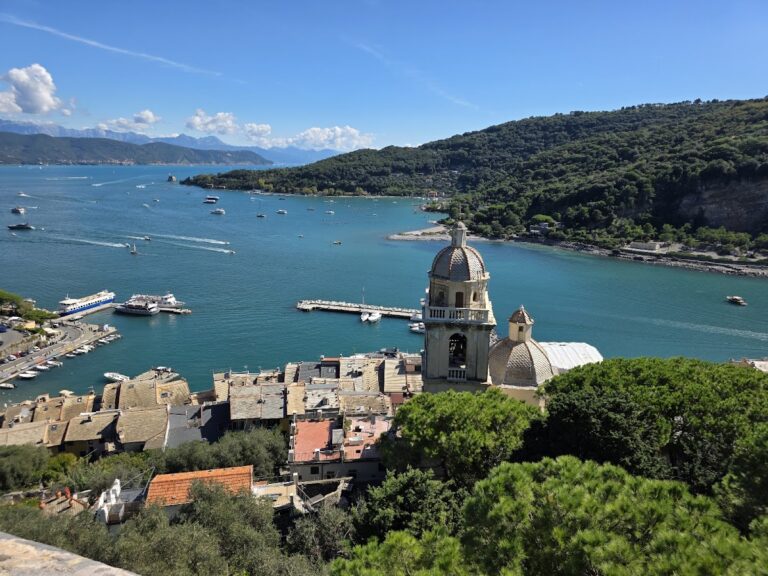
Scola Tower occupies a rock or small islet just beyond the northeastern tip of Palmaria, at Punta Scola in the municipality of Porto Venere. The structure has a pentagonal plan, with stone and marble walls averaging about 4 metres in thickness. Tall buttresses reinforce the inner facing, and the tower reaches a maximum height of approximately 13 metres. Its position and artillery arrangement were designed to control the surrounding sea approaches between Palmaria, Porto Venere, and Lerici.
Access and Defensive Features
A steep flight of steps still climbs from the rocky shore to the entrance. The portal once carried Genoese insignia, which have since been destroyed. Five lookout turrets stood at the five corners of the perimeter walkway, while the ten cannon positions served the tower’s role within Palmaria’s coastal defenses.
Construction Inscriptions
A description from 1773 recorded two marble plaques connected with the tower’s construction. The first was placed above the entrance and carried a 1606 dedication by Geronimo Asereto, son of Giovanni Battista, acting under orders from the commander and governor of the Republic of Genoa. The second plaque, made slightly later, was positioned inside the tower beneath the floor layer. It carried a 1608 dedication by Giulio Rapallo, son of the late Giovanni Battista, also acting under orders from the Genoese commander and governor.
Nearby sites