Rocca Ubaldinesca: A Renaissance Fortress in Sassocorvaro, Italy


Site at a Glance
- Rating
- 4.6
- Popularity
- Very Low
- Country
- Italy
- Primary era
- Medieval
- External website
- Open
- Eras represented
- Medieval, Early Modern, Modern
- Civilizations
- Duchy of Urbino, Italian, Papal States
- Site type
- Military
- Remains
- Castle
On this page9 sections
History
Rocca Ubaldinesca is a Renaissance fortification in Sassocorvaro, Italy, built around 1475 for Federico da Montefeltro, Duke of Urbino, during the early years of the architect and military engineer Francesco di Giorgio Martini’s service to the duke. The fortress belonged to Ottaviano degli Ubaldini della Carda, Federico’s brother, and its heraldic symbols are associated with Ottaviano. Its unusual design places it within the experimental architecture of the Renaissance.
From the Duchy of Urbino to the Papal States
After 1511, the fortress passed to the Doria family of Genoa, who held the title of counts of Sassocorvaro. When the Doria counts died out in 1626, the territory entered the Papal States, the central Italian territories governed by the papacy until the nineteenth-century unification of Italy.
In 1706, ownership was granted to Giovanni Cristoforo Battelli, Archbishop of Amasia, librarian, and counselor to Pope Clement XI Albani. Battelli restored the castle, rebuilt its chapel, and established a library inside the fortress. He also added papers and volumes from the archbishopric, extending the building’s role beyond military defense and residence.
Wartime refuge for works of art
During the Second World War, Pasquale Rotondi, superintendent of fine arts for the Marche, made the fortress part of Operation Rescue, a protection effort that concealed more than 10,000 works of art between 1939 and 1946. The works came from cities and territories including Venice, Milan, Rome, Urbino, Pesaro, Fano, Ancona, Lagosta, Fabriano, Jesi, Osimo, Macerata, Fermo, and Ascoli Piceno.
The deposits first protected the artworks from English and French bombing and later from looting by retreating Nazi forces. This wartime history gave Rocca Ubaldinesca the additional name “Ark of Art.” The fortress is now owned by the Municipality of Sassocorvaro Auditore and functions as the municipal museum. It is described as well preserved and restored, and it also contains an esoteric library and an alchemical laboratory with alembics, vessels used in distillation, and instruments associated with the Great Work, the alchemical process traditionally linked with producing the philosopher’s stone.
Remains
Fortification and courtyard
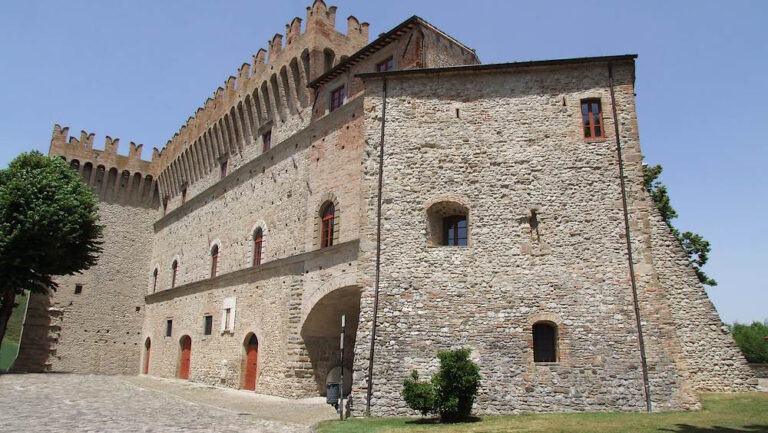
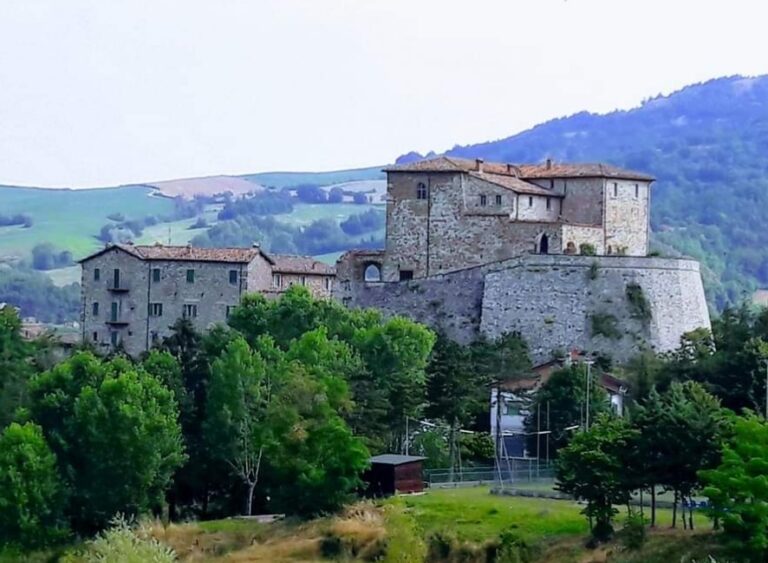
The fortress stands in the center of Sassocorvaro on a hill overlooking the valley of the Foglia River. It is a relatively small, compact building constructed principally from brick and stone, with wood also listed among its materials. Tall sloping walls enclose a plan organized around a small internal courtyard.
Rocca Ubaldinesca was built over earlier structures, including a pre-existing tower that was preserved and incorporated into the facade facing the courtyard of honor. The whole plan has a distinctive turtle-like form, created by the complex intersection of convex shapes. Its zoomorphic design reflects Martini’s investigations of anthropomorphism, the use of human bodily ideas or proportions in architecture, and of animal-like forms in building design.
The turtle-shaped arrangement differs from contemporary transitional fortifications with quadrangular plans and circular towers, as well as from later fortifications with angled bastions. It is characterized as a singular and experimental work within Martini’s architecture.
Interior spaces and artistic remains
Chapel and library
The chapel was rebuilt during Battelli’s restoration, while a library was established within the fortress and supplied with papers and volumes connected with the archbishopric. The building’s interiors were refurbished in the late nineteenth century to create a large hall.
Rocca Theatre
The Rocca Theatre occupies one of the fortress’s largest rooms, formerly identified as the main hall. It became a public theatre in 1860 and was decorated by Enrico Mancini in 1895 in a neoclassical style. The fortress also contains drawings and works by Mancini, an Italian artist and decorator active from the late nineteenth into the early twentieth century.
Paintings and wartime deposits
The museum collection includes an early sixteenth-century altarpiece by Evangelista da Pian di Meleto showing the Madonna and Child with Saints Sebastian, Roch, and Nicholas. The fortress’s wartime deposits included Giorgione’s The Tempest, The Ideal City, and works by Raphael, Piero della Francesca, Carlo Crivelli, Titian, Lorenzo Lotto, Paolo Uccello, and Andrea Mantegna.