Menshikov Battery: A Coastal Fortification in Kronstadt

Site at a Glance
- Rating
- 4.8
- Popularity
- Very Low
- Country
- Russia
- Primary era
- Modern
- External website
- Open
- Eras represented
- Modern
- Civilizations
- Russian
- Site type
- Military
- Remains
- Fort
On this page7 sections
History
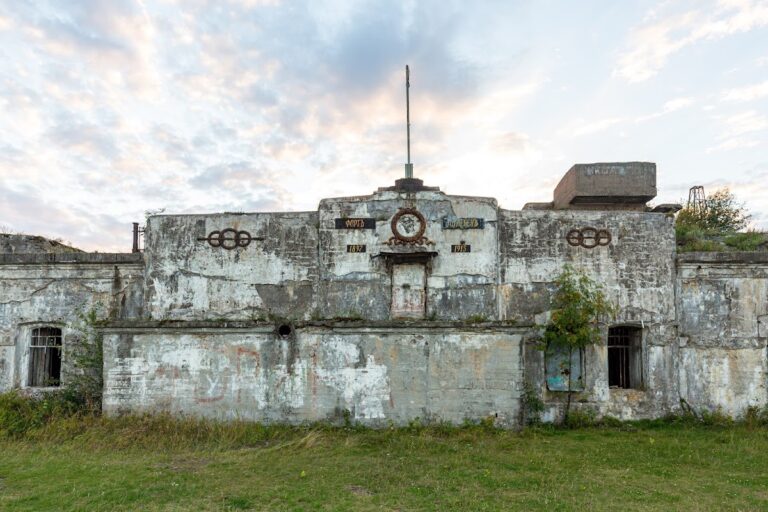
Menshikov Battery is a Russian coastal fortification in Kronstadt, Russia, built between 1843 and 1850 as a four-tier casemated strongpoint. A casemate is an enclosed chamber designed to shelter artillery, personnel, or ammunition. The battery formed part of Kronstadt’s naval defenses and was intended to stop hostile ships from advancing through the fairway toward the Small Kronstadt Roadstead.
From Wooden Battery to Casemated Fortification
A wooden, two-level battery armed with 24 guns stood at the entrance to Merchant Harbour in 1826. In 1841, authorities decided to replace it with a permanent fortification consisting of three enclosed tiers and one open tier. Engineer-Captain I. A. Zarzhetsky prepared the design in three weeks, and construction proceeded from 1843 to 1850. After completion, the battery was named for Admiral Prince A. S. Menshikov, the Russian admiral and statesman who headed the Naval Ministry.
The Mine-and-Artillery Defense System
From 1854, plans for defending the eastern Gulf of Finland relied on a mine-and-artillery position. This system combined underwater mine barriers with shore-based guns to block and attack ships moving through a controlled naval passage. Menshikov Battery, together with Forts Pavel I and Alexander I, covered three mine barriers in the Southern Fairway. Its specific task was to deliver frontal fire against ships attempting to break through the fairway toward the Small Kronstadt Roadstead.
Decline and Twentieth-Century Use
Developments in artillery reduced the battery’s defensive value, and in 1896 the Minister of War ordered its removal from the defensive system. It then served as a storage site for ammunition and military equipment until the beginning of the Great Patriotic War, the Soviet term for the Soviet Union’s participation in the Second World War from 1941 to 1945. Between 1942 and 1944, two 100 mm B-34 guns were installed there, and the position was designated Battery No. 668. After the war, the two upper enclosed tiers were completely dismantled.
Remains
Menshikov Battery survives as a permanent defensive fortification whose present condition is considered unsatisfactory. Its plan formed a rectangle with two annexes along the rear side. The harbor wall and the foundation of the earlier battery were strengthened during construction with piles and underwater buttresses, adapting the structure to its position at the harbor entrance.
Casemates and Defensive Construction
The enclosed tiers contained six casemates, each intended for two three-pood guns. A pood was a traditional Russian weight of approximately 16.4 kilograms, so a three-pood gun was classified by a projectile weighing roughly 49 kilograms. Granite slabs protected the front of the battery. The rear annexes held hoists, magazines for bombs and charges, and staircases for personnel.
Armament and Later Alterations
The nineteenth-century armament comprised 44 guns, including 42 three-pood bomb guns. The later military installation consisted of two 100 mm B-34 guns, placed at the battery between 1942 and 1944. The complete dismantling of the two upper enclosed tiers in the postwar period substantially altered the surviving form of the fortification.
Nearby sites