San Lorenzo: The Romanesque Sanctuary of the Madonna Bianca in Portovenere


Site at a Glance
- Rating
- 4.6
- Popularity
- Very Low
- Country
- Italy
- Primary era
- Medieval
- Eras represented
- Medieval, Early Modern
- Civilizations
- Genoese
- Site type
- Religious
- Remains
- Sanctuary
On this page13 sections
History
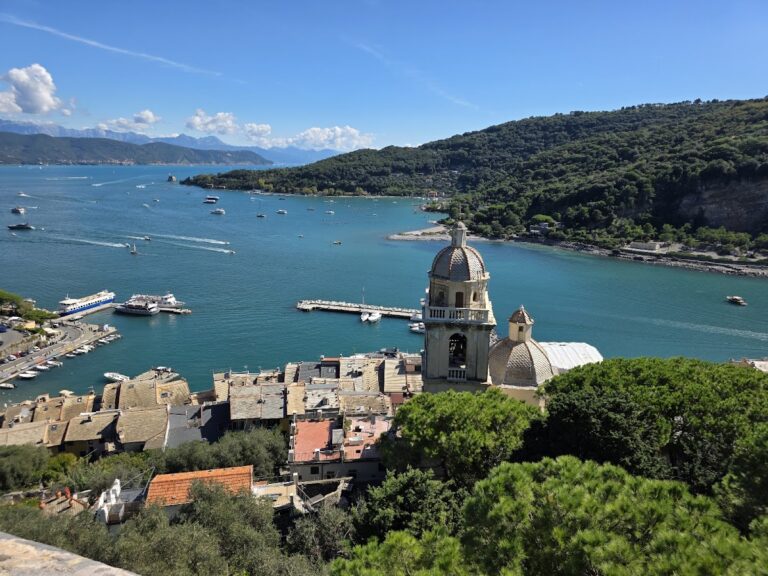
San Lorenzo is a Roman Catholic church in Portovenere, Italy, now known as the Sanctuary of the Madonna Bianca. Built in the Romanesque style from 1098 by decision of the Genoese colony of Portovenere, it was consecrated in 1130 by Pope Innocent II. The church probably occupies the site of an ancient temple dedicated to Jupiter and later became an important religious centre for the community.
Medieval Origins and Transformation
At the end of the fourteenth century, San Lorenzo inherited the parish title previously held by the church of San Pietro. The building suffered damage when a severe fire spread through Portovenere in 1340. Restoration after the fire introduced Gothic elements into the earlier Romanesque structure, adding a new layer to the church’s medieval appearance.
The cult of the Madonna Bianca is traditionally linked to a plague that struck Portovenere in 1399 during the French occupation. On the night of 16–17 August, a local man named Lucciardo prayed before an image of the Virgin Mary. The colours of the image were said to shine suddenly, and the end of the epidemic was attributed to the Madonna. The image was then transferred to San Lorenzo, where the Madonna Bianca became the patron of Portovenere. Her principal feast takes place on 17 August and includes an evening torchlit procession through the town.
War, Restoration, and Devotion
During the Battle of Portovenere in July 1494, artillery from the Aragonese fleet partially destroyed the church. Major restoration continued from 1494 to 1582 and followed Renaissance principles. The older load-bearing columns in Portoro marble were replaced with white-marble columns, the presbytery’s bell tower was demolished and replaced by an octagonal dome, a bell tower was built beside the apse, and the apse itself was replaced by an elongated square choir. A capital inside the church bears the date 1582.
A plaque in the chapel of the Madonna Bianca gives thanks for protection during the Second World War. San Lorenzo is included in Italy’s General Catalogue of Cultural Heritage, reflecting its place within the country’s protected historic inheritance.
The Cedar Beam and Sacred Treasure
In 1204, fishermen from Portovenere found a cedar beam in the sea and brought it ashore. Reliquaries and other precious objects were concealed inside it. A tradition recorded in a written report of 1665 says that a ship fleeing Caesarea during the Muslim conquest had thrown the beam overboard. Another historical document connects it with the seizure, in the same year, of a ship from Constantinople by six Genoese galleys.
The objects found with the beam were combined with treasures already kept at San Lorenzo. In 1644, Cardinal Stefano Durazzo compiled an inventory that included the body of Saint Pachomius the Abbot, three Byzantine gold crosses said to have belonged to Constantine, a fragment of the True Cross, silver vessels containing relics, and ivory reliquaries holding relics of saints and martyrs. Sacrilegious thefts in 1878 and 1914 removed much of this precious material. A plaque and the surviving furnishings nevertheless preserve the church’s long association with relics, maritime traditions, and the devotional life of Portovenere.
Remains
Facade and Exterior
The church has a Romanesque gabled facade crowned by a row of small arches. Its side sections are built in stone, while the projecting centre displays the characteristic Genoese pattern of alternating white and black stripes. The central entrance has a pointed arch framed by two twisted columns. In the lunette, a sculpture shows Saint Lawrence receiving the martyr’s palm from an angel. Above the entrance are an ornate Gothic three-light window and a deeply splayed round window. The left portal remains Romanesque, while the pointed right portal carries the date 1686 on its keystone.
Interior Layout and Liturgical Features
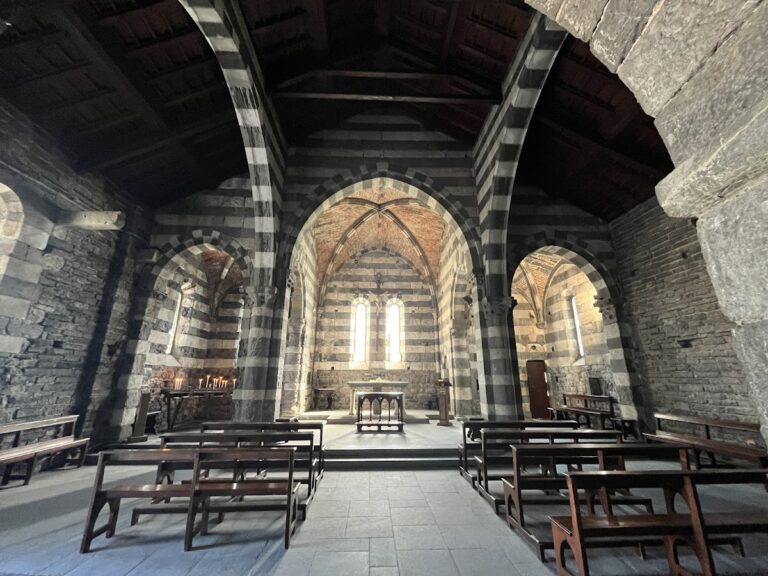
San Lorenzo follows a basilica plan, with a central nave flanked by two lower side aisles. Carrara-marble columns divide the aisles and support semicircular arches, while the older presbytery piers are made of stone and retain Romanesque capitals. The central nave rises above the side aisles and receives light through single-light windows opened in the projecting lateral walls. Simple wooden trusses support the roof.
The presbytery is carried by two massive cruciform piers of local black stone with cubic capitals. On the left, a carved marble pulpit depicts Saints Peter, Paul, Venerius, and Pachomius. The altar is Baroque. The church also preserves a baptismal font and a holy-water stoup carved from the marble of a medieval ambo, together with a fifteenth-century tomb slab mounted on a nave wall.
Cardinalino’s Tomb
The chapel to the left of the presbytery contains the tomb inscription of Giuseppe Graffigna, known as Cardinalino. A corsair from Portovenere, he served in the papal fleet and was buried in the chapel in 1620 by Admiral Francesco Centurione.
Relics and Devotional Images
The Cedar Beam
A Lebanese cedar beam more than three metres long is displayed on the left wall of the nave. It contains a cavity about 1.5 metres long and approximately 30 centimetres deep. The cavity was formerly closed with a nailed board and pitch, and held reliquaries and four decorated caskets whose ornamental designs have the characteristics of eleventh-century Persian art.
The Madonna Bianca Altarpiece
At the rear of the right aisle, the Madonna Bianca is preserved at the centre of an altarpiece by the Italian Renaissance sculptor Mino da Fiesole. Painted on parchment, the image shows the enthroned Virgin Mary with the infant Jesus, who holds a scroll bearing the words, “Mother, whatever pleases you pleases me, provided that the sinner repents from evil.” Saint Christopher and a second, later-added saint whose identity is unknown also appear in the image. A detailed restoration established that the painting dates from the fourteenth century and that its tempera colouring was applied later.
Historic Furnishings and Maritime Objects
San Lorenzo preserves furnishings from the fourteenth and sixteenth centuries, including a Crucifix triptych with the Virgin Mary and Saint John at the foot of Christ’s cross, and a polyptych dedicated to Saint Martin. A polyptych is an altarpiece composed of several painted or carved panels.
Galley Figureheads
Two historic figureheads from Portovenere galleys are also preserved in the church. They once decorated vessels that fought at the Battle of Meloria in 1284 and the Battle of Lepanto in 1571, linking the church’s surviving objects with the maritime conflicts remembered in Portovenere’s history.