Church of St. Peter: A Historic Roman Catholic Church in Porto Venere

Site at a Glance
- Rating
- 4.9
- Popularity
- Very Low
- Country
- Italy
- Primary era
- Medieval
- Eras represented
- Classical, Medieval
- Civilizations
- Genoese, Roman
- Site type
- Religious
- Remains
- Church
On this page11 sections
History
The Church of St. Peter is a Roman Catholic church in Porto Venere, Italy, whose surviving complex combines a fifth-century early Christian basilica with a thirteenth-century Genoese Gothic church. Dedicated to Saint Peter, one of Jesus’s Twelve Apostles and traditionally the first bishop of Rome, it occupies a rocky promontory at the end of the town and belongs to the Diocese of La Spezia-Sarzana-Brugnato.
Early Christian and Benedictine foundations
A small early Christian church stood here by the fifth century, partly over the remains of a Roman pagan sanctuary probably dedicated to Venus Ericina, a regional form of the goddess Venus associated with the sanctuary at Eryx in Sicily. A Benedictine monastery, whose members followed the Rule of Saint Benedict, was later established beside the church.
Pope Gelasius II dedicated the church to Saint Peter on 19 July 1118 and presented it with a relic of the apostle. The building was consecrated in 1198. The Benedictine abbey later declined, and the church’s institutional role changed as Porto Venere developed.
Genoese expansion and later decline
During the thirteenth century, the Republic of Genoa built a second church beside and connected to the earlier building. This work probably took place between about 1256 and 1277, creating the larger unified complex that survives in altered form.
Toward the end of the fourteenth century, the Church of St. Peter lost its position as Porto Venere’s parish church, which passed to the Church of St. Lawrence. Secular clergy continued to serve it until 1798.
War, abandonment, and conservation
A major fire damaged the church in 1494. In the same year, attacks by the fleet of Charles VIII during the First Italian War and an Aragonese artillery bombardment during the Battle of Porto Venere on 16 July caused further severe damage. The church subsequently fell into ruin, and ornamental materials were removed for reuse in the Church of St. Lawrence and other buildings.
During the Napoleonic Wars, Austro-Russian troops occupied the complex and used it as a bivouac, or temporary military camp. Napoleonic troops later removed the paintings, melted down the bells, burned roof timbers for fuel, and installed an artillery battery at the site.
Initial conservation began in the early twentieth century. Archaeological investigations and major restoration between 1929 and 1934 repaired and reinstated the early Christian and medieval areas, and the church was reconsecrated in October 1934. It is included in Italy’s General Catalogue of Cultural Heritage and has formed part of the Porto Venere, Cinque Terre, and nearby islands World Heritage complex since 1997. The poet Eugenio Montale identified the church with the “Christian temple” in his poem about Porto Venere.
Remains
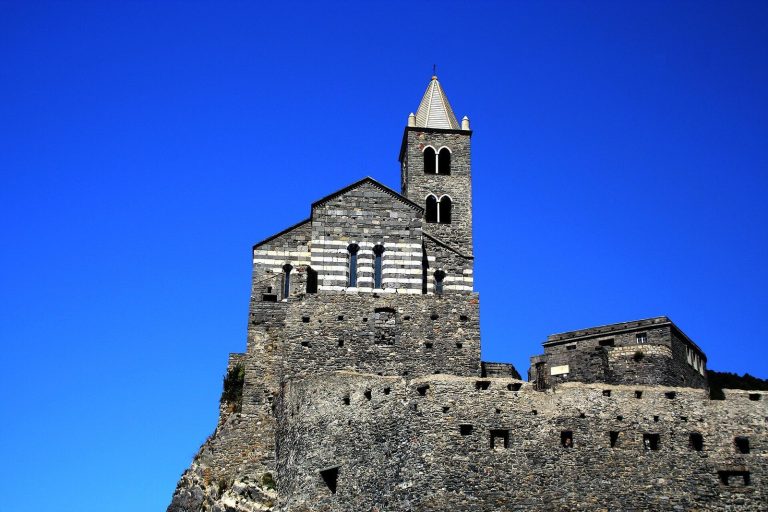
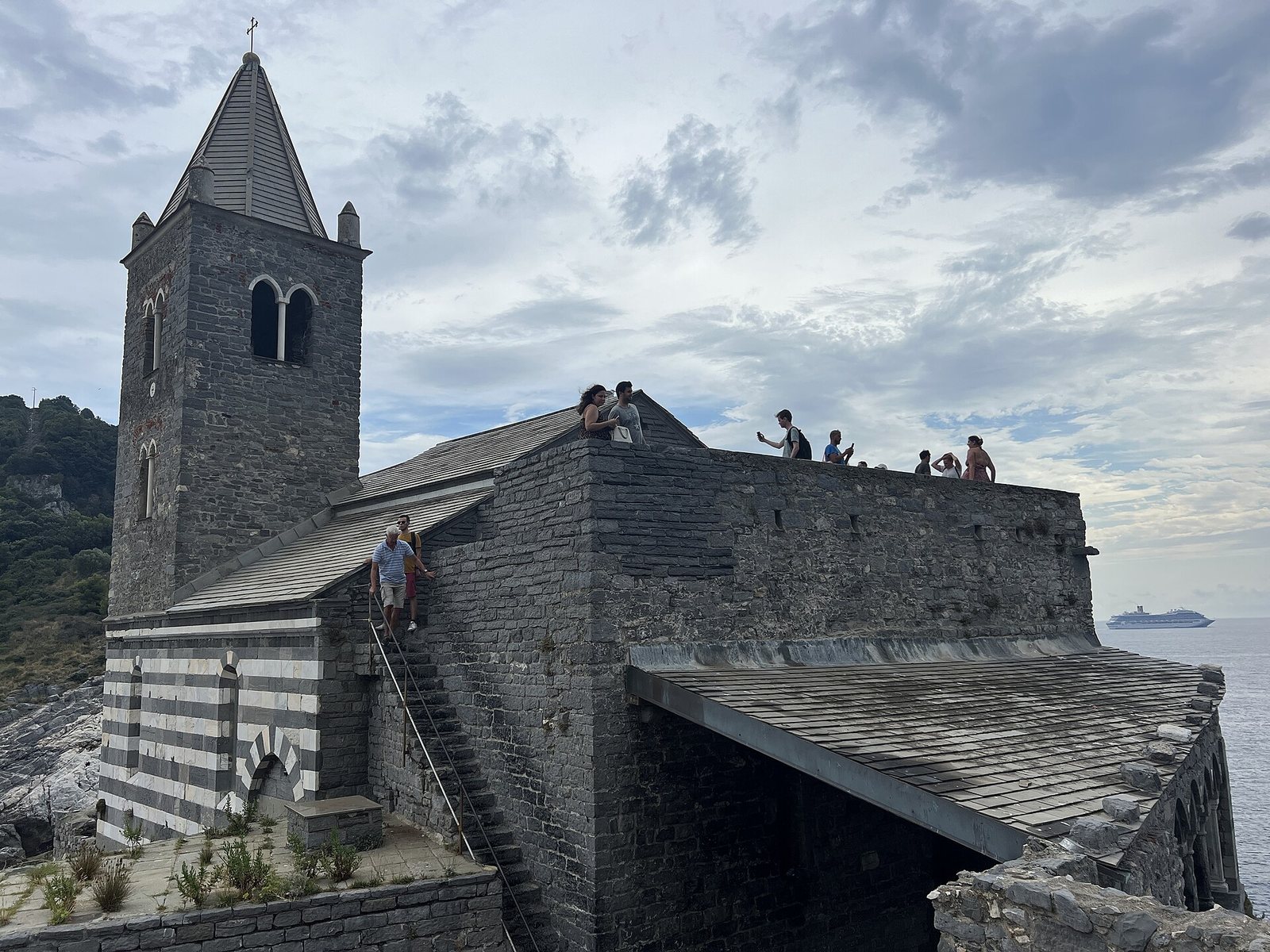
The church stands on a steep rocky promontory projecting toward the open sea and facing the Gulf of Poets. Its surviving fabric brings together a small early Christian basilica, traces of the Benedictine complex, and the larger Genoese Gothic church. Dark stone, patterned marble, and alternating bands of white and black stone express the different phases of construction.
Early Christian and monastic remains
Fifth-century basilica
The earliest building is a small fifth-century basilica of Syriac architectural type. It has a rectangular plan and a semicircular apse, and occupies the area to the right of the present entrance. Its floor is decorated with opus sectile, a technique in which thin pieces of stone or marble are cut and arranged into geometric designs. Here, the marble forms circles, bands, and stars, using several varieties, including stone brought from distant sources.
Archaeological work beneath the apse floor revealed what is probably the base of a statue, possibly surviving from the earlier pagan sanctuary. A copy of the bronze statue of Saint Peter in Saint Peter’s Basilica in Vatican City now stands in the apse. The early Christian structure retains a simple exterior facing of dark stone.
Benedictine abbey and sea-facing loggia
Only scant remains of the Benedictine abbey survive. A small cloister connected the monastery to the early Christian church, while the cloister area was later occupied by the Genoese Gothic church after the abbey was destroyed.
The abbey also included a Romanesque loggia overlooking the sea and the Cinque Terre. Its four columned openings incorporate Roman-period building elements, probably spolia, meaning architectural pieces taken from an earlier structure and reused in a later one. These elements were likely taken from the temple associated with Venus.
Thirteenth-century Genoese church
Banded Gothic building
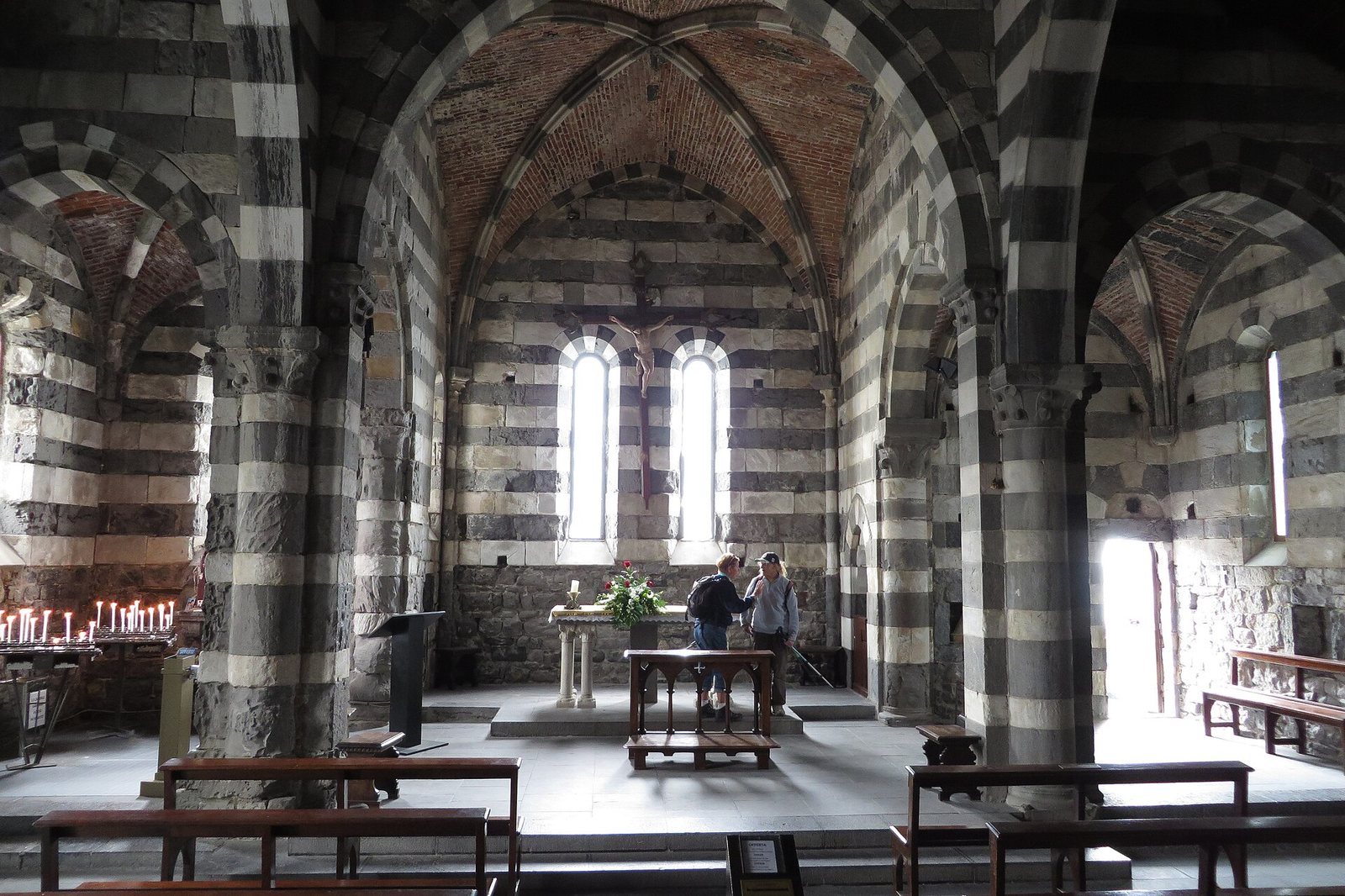
The thirteenth-century Genoese church is distinguished by alternating horizontal bands of white and black stone, a characteristic treatment in Genoese ecclesiastical architecture. The pattern appears on both the exterior and the interior. Two arched openings connect the Gothic building with the earlier Christian chamber.
Inside, the church has three aisles. The side aisles are narrower than the central nave, which contains a simply made white-marble altar. Ogival cross-vaults cover the interior and rest on clustered piers. A weathered Latin inscription carved in marble, and transcribed when it was still legible, preserves a possible date for completion of the Gothic works.
Bell tower and entrance
A bell tower rises on the left side of the church. Its massive exterior is lightened by superimposed tiers of biforate windows, each divided into two openings by a central column or mullion.
The modern door, titled Gate of Heaven, has silver-and-marble leaves made in 1992 by the sculptor Lello Scorzelli.