Schloss Würting: A Gothic and Renaissance Castle in Austria
Site at a Glance
- Rating
- 3.6
- Popularity
- Very Low
- Country
- Austria
- Primary era
- Early Modern
- Eras represented
- Medieval, Early Modern
- Civilizations
- Habsburg, Holy Roman Empire
- Site type
- Domestic
- Remains
- Castle
On this page17 sections
History
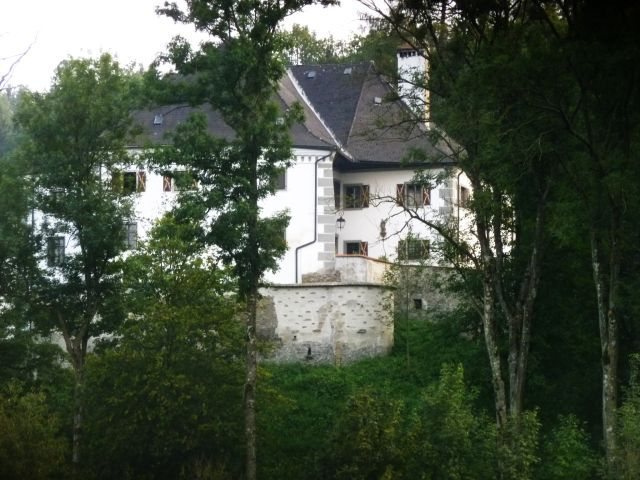
Schloss Würting is a historic castle in Austria, in the village of Würting within the municipality of Offenhausen, Upper Austria. Its first known mention dates to 814, when the estate was associated with Count Richarius, and its surviving form reflects a Gothic expansion completed by 1462 and a Renaissance rebuilding finished by 1610.
Early lordship and medieval castle
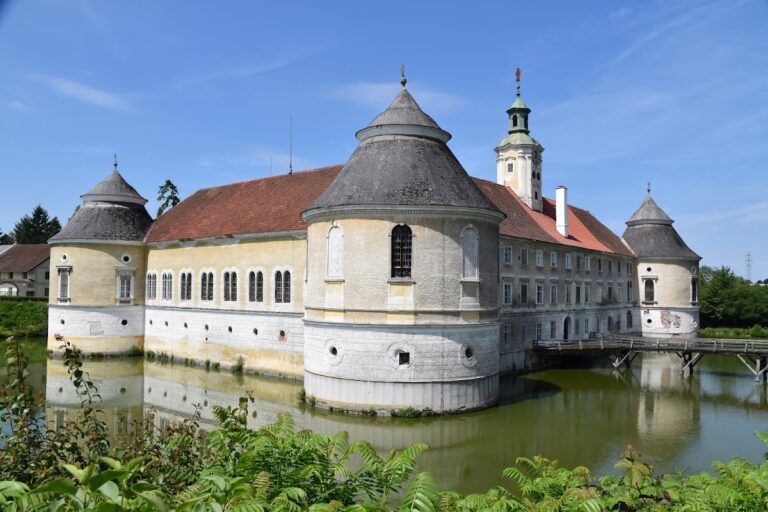
The beginnings of the Würting aristocratic estate are uncertain. A Romanesque inn or tavern has been proposed for the period around its first mention, but this interpretation remains conjectural. By the medieval period, the property was probably a fortified residence surrounded by a water-filled moat.
From the tenth century, Würting belonged to the Counts of Wels-Lambach. Their last male representative, Adalbero, Bishop of Würzburg, founded the nearby Benedictine Abbey of Lambach in 1056. After Adalbero died in 1090, Würting passed to the Bishopric of Würzburg, an ecclesiastical principality of the Holy Roman Empire.
Duke Leopold of the Babenberg dynasty purchased Würting in 1220. The lordship thereby passed to the Dukes of Austria, who later granted it as a fief, meaning a lordship held from a superior ruler in return for allegiance and service. In 1380, Duke Albrecht III of the Habsburg dynasty enfeoffed Jörg Rathalminger with the property.
The Perkheimers and the Gothic expansion
Jörg Rathalminger’s daughter Susanna was his sole heir and feudal successor. In 1422, she brought Würting into her marriage to Jörg II Perkheimer. During their tenure, the residence was expanded into a Gothic moated castle. The basic plan that survives today was completed by 1462.
Jörg II and Susanna died without children, so the inheritance passed to their nephew Kaspar Perkheimer, who lived from 1454 to 1520. Kaspar became a personal friend of Emperor Maximilian I, who appointed him Vizedom of Upper Austria from 1498 to 1501. A Vizedom was a senior territorial official responsible for financial and governmental administration on behalf of a ruler. In 1498, Kaspar also received the lordship of Pernstein as a pledge from the emperor.
Jörg III Perkheimer and the Protestant era
Kaspar’s son Jörg III Perkheimer, born in 1504 and deceased in 1559, inherited Schloss Würting. He had grown up there with his brothers Wolfgang and Kaspar the Younger and received an advanced education from Wilhelm Pullinger, a scholar who later became Maximilian I’s personal physician.
Jörg III converted to Protestantism during a period when many members of the Upper Austrian nobility and much of the local population adopted the new faith. From 1529, he represented the knightly estate in the Linz provincial parliament and served as its delegate to several Imperial Diets. He supported the Protestant cause, including negotiations associated with the Peace of Augsburg in 1555. That settlement temporarily regulated the coexistence of Catholic and Lutheran territories within the Holy Roman Empire.
In 1534, Jörg III secured market-town status for Offenhausen at the request of its inhabitants from King Ferdinand I. His will also established a foundation for the local elementary school. A Protestant boys’ school planned for Schloss Würting in a joint testament by Jörg III and his brother Wolfgang was never established; the school was later created in the Linz Landhaus, the historic seat of Upper Austria’s provincial estates.
Jörg III had already assigned 6,000 gulden to the Protestant estates of Upper Austria, and another 18,000 gulden came from his estate. Wolfgang Perkheimer, who had held the lordship of Rosseg in the Carinthian Rosental, moved to Weidenholz, which he and Jörg III acquired together in 1547. Wolfgang died in 1556, followed by the childless Jörg III in 1559. Their male line ended, and the property passed through Wolfgang’s daughter Christina to her husband, Georg Achaz von Losenstein.
The Weiß and Seeau periods
Christoph Weiß, a wealthy merchant and burgrave of Wels, bought Schloss Würting in 1604. Hoping to rise to the rank of baron, he enlarged the castle in the Renaissance style, adding an upper level known as a Gaden, extending the building eastward and southward, and refitting the interiors. The work was complete by 1610 and gave the castle much of its present appearance.
Weiß’s patron was Emperor Matthias, whom an allegorical painted cycle at the castle honored for supporting his rise in status. The emperor personally visited Schloss Würting in 1612. Christoph Weiß died in 1617, and his son Christoph Ludwig inherited the property. Christoph Ludwig died at 23, leaving a widow and his three-year-old son Hans Christoph Weiß. Minority guardianship and the economic disruption of the Thirty Years’ War, the major European conflict of 1618 to 1648, quickly weakened the family’s finances. Emperor Ferdinand III raised Hans Christoph to the rank of baron in 1651, but he died penniless later that year.
Between 1648 and 1650, Schloss Würting passed from the Weiß family to the Counts of Seeau. Elias von Seeau finally purchased it from an administrator in 1650 after a lengthy insolvency lawsuit. His first wife, Susanna Magdalena Alt von Altenau, connected him by marriage to the Weiß family.
Elias’s son Johann Friedrich Count von Seeau, who lived from 1659 to 1729, established the Würting branch of the family. He also held the lordship of Moos in Offenhausen, probably brought into the marriage by his wife Maria Eleanora von Gera. Johann Friedrich and his wife were buried in the Seeau family crypt in St. Anna Church in the parish of Timelkam.
The Seeau family retained Würting into the nineteenth century and made no major structural changes during that period. From 1707, accusations of mismanagement and corruption in the Salzkammergut damaged the family’s standing with the imperial court. Their authority declined, followed by financial difficulties.
Grillmayer preservation and twentieth-century owners
After the male line of the Seeau family ended, its last heiress, Mathilde Földvary von Földvar, sold Schloss Würting in 1860 to Johann Evangelist Grillmayr. Grillmayr, who lived from 1809 to 1881, founded the Kleinmünchen spinning mill, now Linz Textil AG. He and especially his son Johann Karl Grillmayer devoted considerable effort to preserving the castle. Johann Karl commissioned or made early photographs and wrote a chronicle of its history.
The Grillmayers restored the castle toward its Renaissance appearance and renovated the chapel. Johann Karl also supported civic organizations in Offenhausen and established the region’s first childcare institution there in 1889. He left Offenhausen in 1900 and sold the property to the timber merchant Josef Welz. Welz sold the estate grounds and farmyard before reselling the castle in 1902.
Lily Thornton, later Countess Alberti d’Enno, acquired Schloss Würting on 1 May 1902 for 144,000 crowns. She donated a motorized fire pump to the volunteer fire brigade and a new organ to the parish church. Because the castle no longer generated income after the loss of its landholding and remained expensive to maintain, she sold it in 1918 to Countess Alice Hoyos of Stixenstein.
Hoyos sold the castle in 1919 to the Viennese industrialist Wilhelm Hermann “Willy” Gutmann, who acquired it for his second wife, Stefanie Gutmann, née Sobotka. The property was then in poor condition, but renovation brought a brief revival of its cultural life.
Scholars, artists, and the Gutmann circle
During the Gutmann period, Schloss Würting became a retreat and workplace for scholars, artists, musicians, and philosophers. It also hosted Viennese high society and international visitors. The chess player Arthur Kaufmann lived there as a guest from about 1923 for approximately ten years, and Richard Nikolaus Coudenhove-Kalergi was also welcomed by the family.
Coudenhove-Kalergi reportedly wrote his programmatic book Pan-Europe at Schloss Würting in 1923, allegedly within three weeks. The book advocated a united Europe and is regarded as the beginning of the Paneuropa Union, a political movement founded that year to promote cooperation and eventual unity among European states.
The biologist Paul Kammerer spent several summers at Würting resting and writing. The Slovenian-born entomologist Ivan Regen, his internationally recognized colleague, was also there during the summer of 1923. In August 1929, the castle hosted the premiere of composer Armin Kaufmann’s Opus 14, No. 3 Sonata for Violin and Piano.
Nazi confiscation, restitution, and later history
In December 1938, Stefanie Gutmann transferred the castle to her “Aryan” son-in-law Emanuel Walderdorff in an attempt to prevent compulsory expropriation under Nazi rule. Before the transfer could be approved and entered in the land register, the property passed for a fraction of its value to the Reichsgau Oberdonau, the Nazi German administrative unit that encompassed Upper Austria after the annexation of Austria.
Stefanie Gutmann fled to Belgium in March 1939 and survived the German occupation in hiding. The Reichsgau Oberdonau placed Schloss Würting at the disposal of the SA Group Alpenland. The SA, or Sturmabteilung, was the Nazi Party’s paramilitary organization, and it installed a leadership school in the castle. Valuable furnishings were sold or disappeared through undocumented channels, although an inventory prepared in 1941 still listed them at the property.
American troops briefly occupied the castle in May 1945. From 17 August of that year, it housed ethnic German refugees and residents of Vienna whose homes had been destroyed by bombing. Between 1947 and 1951, it served as a state educational home for girls.
Stefanie Gutmann asserted her claims to the property in September 1945. A settlement dated 13 March 1952 granted her restitution after a prolonged legal dispute. The provincial authorities had first felled the castle forest, and the estate was severely damaged. Gutmann also had to meet the costs of the legal proceedings and settlement, so she immediately resold the property. She died later in 1952, and the purchaser was the sawmill owner Josef Neuhofer of Stadl-Paura.
Anna Rogalla-Rumpel bought Schloss Würting from Neuhofer in 1954 and lived there with her husband, Rüdiger Rogalla. After her death in 1969, he transferred the possession rights to a Liechtenstein foundation. Following his death in 1971, an emergency operation removed the Renaissance ceiling paintings from Austria.
The paintings were believed to have been lost until 1994, when the Association for Monument Preservation in Upper Austria secured them through a rescue purchase with assistance from the province and the Federal Monuments Office, Austria’s national authority for protecting historic monuments. After extensive restoration, they were placed on display in the Schlossmuseum Linz.
In 1975, the castle passed to the artist and paleontologist Herbert Schaffer, who housed his paleontological collection there. He died on 25 June 2019. Schloss Würting remains in poor condition and is not open to the public. In 2025, the Swiss entrepreneurs Julia and Gerhard Lehner, who have Austrian roots, took over the castle with the stated aim of restoring it for renewed private and public access.
Traditions and associated memorials
A local tradition tells of the “Black Woman of Würting,” supposedly a castle mistress killed by her husband after he discovered her with her lover in a tower room during a banquet in the great hall. The story says that she was condemned to return at the hour of her death in black clothing. Yellow marks on the tower-room floor were said to be traces of human blood.
Christoph Weiß was buried in a family crypt beneath the southern side chapel of Offenhausen parish church. A large memorial to him was later converted into an altar and remains in the opposite side chapel. His wife, son, and grandson were also buried there, but after the Counter-Reformation, the Catholic response to the spread of Protestantism, their coffins were removed on 22 July 1776 under Pastor Johann Georg Wiringer. The family’s Protestant remains were then buried at an unknown location.
A bust of Christoph Weiß made by the sculptor Friedrich Thön is said to remain at Schloss Würting, although this attribution is uncertain. The castle also has an indirect connection with the later Trapp Family Singers because Countess Alice Hoyos, its owner from 1918 to 1919, was the aunt of Agathe von Trapp, the first wife of Georg Ludwig von Trapp.
Remains
Castle plan and building phases
The surviving castle combines a medieval fortified layout with the Renaissance form created under Christoph Weiß. Its earliest arrangement is unknown, although the medieval residence was probably enclosed by a water moat. The main structures derive from the Gothic expansion undertaken by Jörg II Perkheimer and Susanna and completed by 1462. A Perkheim family heraldic stone above the entrance gate probably commemorates the completion of that work.
Christoph Weiß’s rebuilding, completed by 1610, added an upper Gaden level, meaning an extra upper storey, and extended the building toward the east and south. This Renaissance phase produced the form that remains largely preserved. The former estate also included a farmyard and associated grounds, which Josef Welz sold before he resold the castle in 1902.
Renaissance interiors
Entrance hall and stucco work
The entrance hall has a basket-handle barrel vault with a richly decorated stucco ceiling. Additional stucco survives in the staircase and arcade passage. These works are attributed to the Italian sculptor and stucco artist Elia Castello, who lived from 1572 to 1602.
Ceiling paintings
The Renaissance interiors contained numerous stucco decorations and painted ceilings. Among them was an artistically important allegorical cycle attributed to Claude Aubertin or Pieter Isaacsz. The major ceiling paintings were removed from the castle during the emergency operation after 1971, restored after their rescue purchase in 1994, and transferred to the Schlossmuseum Linz, where they are displayed.
The west tower collapsed in 1877 when its supporting piles rotted. It was not rebuilt, and the former tower no longer survives. The castle itself is currently in poor condition, while the rescued ceiling paintings remain preserved away from the building.
Chapel and furnishings
Castle chapel
The castle chapel was renovated during the Grillmayer period. Its 1893 Coronation of Mary altar, made by Hans Greil, is now the choir altar of the parish church at Vorderweißenbach in the Mühlviertel.
Gutmann-period interiors
During the Gutmann period, the castle was renovated and refurnished with valuable furniture and paintings. The collection included oil paintings by John Quincy Adams, Stefanie Gutmann’s first husband. The Gutmann renovations accompanied the short period when the castle again served as a residence and cultural meeting place.