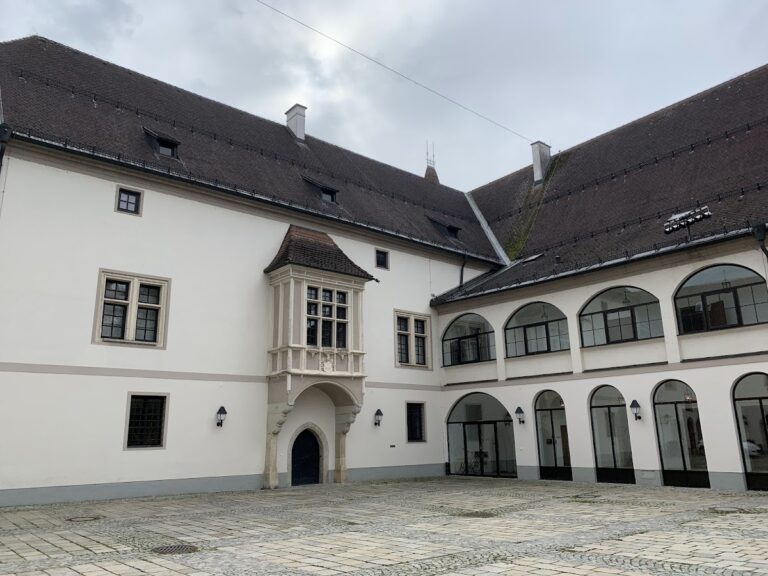
Lambach Abbey: A Benedictine Monastery in Austria


Site at a Glance
- Rating
- 4.6
- Popularity
- Low
- Country
- Austria
- Primary era
- Early Modern
- External website
- Open
- Eras represented
- Medieval, Early Modern
- Civilizations
- Duchy of Austria, Habsburg, Holy Roman Empire
- Site type
- Religious
- Remains
- Monastery
On this page13 sections
History
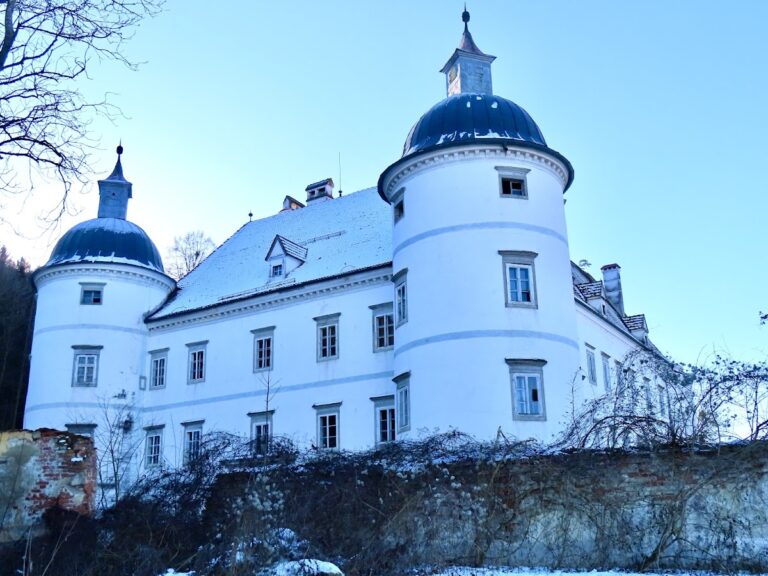
Lambach Abbey is a Benedictine monastery in Austria, founded around 1040 and transformed into a Benedictine abbey in 1056. Its present complex is predominantly Austrian Baroque, reflecting extensive rebuilding between the seventeenth and early eighteenth centuries. The monastery stands on the Traun River in Lambach and has remained an important religious, artistic, educational, and musical institution.
Foundation and Benedictine beginnings
Count Arnold II of Lambach-Wels founded a monastery at Lambach around 1040. The foundation followed a violent episode in February 1050, when attackers raided the castle at Lambach and killed Arnold II’s mother, his son Arnold and Arnold’s wife, and his other son Gottfried. Arnold II and his son Adalbero survived. Arnold II then housed secular canons and twelve clerics at the castle before the foundation became a monastery.
After Arnold II’s death, Adalbero, Count of Wels and Lambach and Bishop of Würzburg, reorganised the institution as a Benedictine abbey in 1056. Benedictines are members of the Order of Saint Benedict, a monastic tradition governed by the Rule of Saint Benedict. Adalbero brought monks from Münsterschwarzach in Franconia and dedicated the foundation to Saint Kilian and his companions. He spent much of his later life at Lambach, died there in 1090, and was buried at the monastery. He was later recognised as a saint.
Medieval destruction and Baroque rebuilding
The abbey and church were largely destroyed during the Bavarian invasion of 1233, when Duke Otto II of Bavaria attacked the territory ruled by the Austrian Babenbergs. The church was subsequently restored. A later rebuilding campaign, carried out under Abbots Placidus Hieber of Greifenfels, Severin Blaß, and Maximilian Pagl between 1640 and 1725, created the main surviving complex. The work gave Lambach its strongly Baroque character, with many extensions undertaken during Maximilian Pagl’s abbacy. These included the north wing, its ambulatory, and the summer refectory, much of the construction being carried out by members of the Carlone family.
The abbey church is dedicated to the Assumption of the Virgin Mary, while the monastery has continued its institutional connection with the Benedictine world. Lambach joined the Austrian Benedictine Congregation in 1625 and the Benedictine Confederation, the wider international organisation linking Benedictine congregations and monasteries, in 1893.
Dissolution, revival, and wartime occupation
Emperor Joseph II dissolved the abbey in 1784. Abbot Amandus Schickmayr later secured the restoration of monastic life. During the Second World War, from 1941 to 1945, the monastery buildings housed a NAPOLA, a National Socialist elite political-educational school established under the Nazi regime. The monastic community returned after the war.
From 1972 to 1982, and again from 1992 to 1994, Hans Puchhammer and Gunther Wawrik constructed new extensions below the historic monastery. As of January 2021, the community consisted of twelve monks: seven priest-monks, one deacon, three other monks, and one novice.
Music, education, and cultural associations
Lambach maintained a strong musical tradition through its organists, choirmasters, and composers. Beniamin Ludwig Ramhaufsky, Joseph Balthasar Hochreither, and Romanus Weichlein were among the musicians associated with the abbey’s Baroque tradition. Its musical relationships also included Wolfgang Amadeus Mozart and Michael Haydn. The music archive remains particularly rich in eighteenth-century works, including Mozart’s so-called Lambach Symphony, K. 45a. The surviving revised version was dedicated in January 1769 to Abbot Amandus Schickmayr and bears a presentation inscription identifying it as a gift from Mozart.
The abbey school also became part of the history of Adolf Hitler, who lived in Lambach with his parents in 1897 and 1898 and attended the monastery school. During that time, he saw the hakenkreuz, a hooked-cross motif that had earlier uses in several cultural and religious contexts, carved in decorative stone and woodwork at the monastery. He later adopted the symbol for the Nazi Party.
The Baroque theatre tradition was revived under Abbot Amandus Schickmayr, who had the theatre refurbished in 1770. Marie-Antoinette visited the abbey that year while travelling from Vienna to Versailles. After a later renovation, the theatre returned to operation in 1983 and is used for annual productions, readings, and concerts.
Remains
The surviving monastery is principally a seventeenth- and early eighteenth-century Baroque complex, organised around historic convent buildings and expanded wings. Its architectural fabric combines monumental rebuilding with older medieval survivals, including Romanesque wall paintings in the former bell house. The church, ambulatory, refectory, theatre, library, archive, and collections preserve different aspects of the abbey’s religious and cultural development.
Abbey church
Church structure and decoration
The Church of the Assumption of the Virgin Mary was rebuilt between 1422 and 1436 as a two-aisled hall church. Its present form comes mainly from the reconstruction of 1652 to 1656, designed by Filiberto Lucchese. That work produced a single-aisled church with a three-bay nave and a two-bay choir ending in a straight wall. Stucco decoration from 1655 is attributed to Thomas Zaisel of Linz, while life-sized figures set in niches between the double pilasters were made in 1656 by Christoph Abraham Walther of Regensburg.
Melchior Steidl, a court painter from Munich, completed the frescoes in 1698. The large painted fields show episodes from the life of the Virgin Mary; smaller fields contain Marian attributes and female predecessors of Mary. Angels holding instruments and liturgical objects appear above the organ gallery, in the lunettes, and in the side-altar niches. The main portal, built by Jakob Auer in 1692, forms a ceremonial entrance to the church.
Medieval paintings and high altar
Romanesque frescoes survive in the former bell house of the westwork, the monumental western section of a medieval church. Wall paintings in the vaults were first noticed in 1868, and further paintings were found behind Baroque reinforcing walls in 1957. Dating from the third quarter of the eleventh century, they depict New Testament scenes including the Magi, the childhood of Jesus, and his public ministry. They are among the oldest surviving Romanesque wall paintings in Austria and the southern German region.
The high altar was made in 1716 and 1717, probably to a design by Antonio Beduzzi and following the model of the altar at Mariazell by Johann Bernhard Fischer von Erlach. It is built from Salzburg marble. Joachim von Sandrart’s 1655 altarpiece was transferred from the earlier altar. Lorenzo Mattielli made the over-life-size marble statues of Saints Kilian, Maximilian, Catherine, and Barbara. Paolo d’Allio and Diego Francesco Carlone produced the Trinity group and angels in applied stucco above, while Paolo d’Allio and Niclas Wendlinger worked on the tabernacle. Sandrart also painted the side-altar pictures between 1656 and 1661.
Furnishings and founder’s tomb
Christoph Egedacher the Elder made the organ case in 1657, enlarged it in 1668, and supplemented it with a rear organ division around 1780. Other furnishings include the wrought-iron screen beneath the organ gallery from 1662, a tapestry from 1712 possibly made in Antwerp, Adalbero’s 1659 founder’s-tomb cover slab, and a pulpit from 1756.
Convent buildings and garden
The Baroque summer refectory was built by Carlo Antonio Carlone between 1706 and 1708. Wolfgang Andreas Heindl of Wels painted its later frescoes around 1740. The room now serves as a festival hall for concerts and conferences while retaining part of its original function. The abbey also contains a richly decorated ambulatory by Diego Francesco Carlone. In the convent garden, Baroque sandstone dwarf sculptures made by Johann Baptist Wanscher in 1711 remain part of the architectural setting. The former abbey tavern on the market square survives with its Baroque facade and is now used as a pharmacy.
Library, archive, and collections
The abbey library was refurbished in the Baroque period in 1699 and contains approximately 60,000 historical volumes. Its archive holds about 1,000 boxed volumes, 700 manuscripts, and other materials relating to the monastery’s history. A monks’ reading wheel dated 1730 remains in the library. After the Second World War, many medieval manuscript fragments from the library entered the international antiquarian market; most identified fragments are now held by the Beinecke Rare Book and Manuscript Library at Yale University in New Haven.
The permanent collection includes sacred-art objects, paintings, frescoes, manuscripts, sculptures, the Adalbero Chalice, and a crozier dated to 1480. The chalice is a medieval vessel dating to around 1200 and is rarely displayed. The abbey once possessed a substantial collection of musical instruments, of which only a few survive.
Theatre
The Baroque abbey theatre is Austria’s oldest playable theatre space. Refurbished in 1770 and returned to working order after restoration in 1983, it remains a functioning performance room used for several annual productions as well as readings and concerts.
Nearby sites