Mniszech Palace in Warsaw: A Late-Baroque Residence and Belgian Embassy

Site at a Glance
- Rating
- 4.6
- Popularity
- Very Low
- Country
- Poland
- Primary era
- Modern
- External website
- Open
- Eras represented
- Early Modern, Modern
- Civilizations
- Polish–Lithuanian Commonwealth, Russian
- Site type
- Civic
- Remains
- Palace
On this page11 sections
History
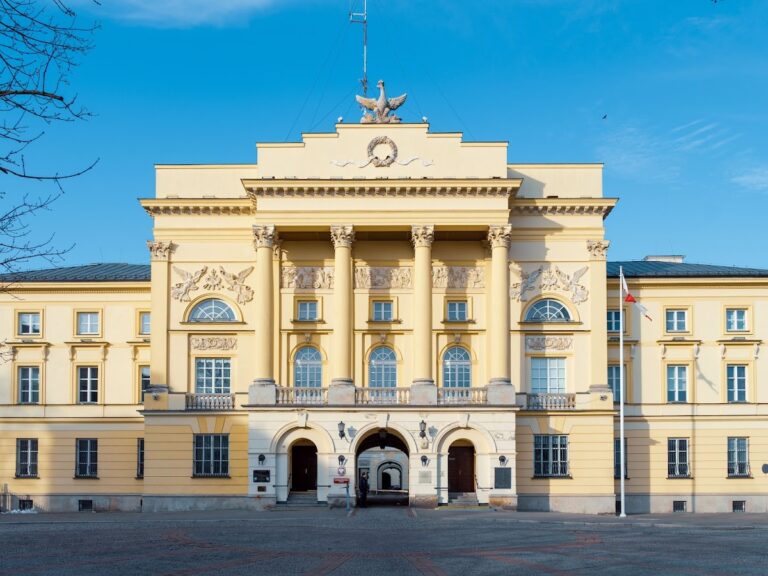
Mniszech Palace in Warsaw is a late-Baroque residence in Poland, built for Józef Wandalin Mniszech, Grand Marshal of the Crown, a senior Polish court and administrative official. Mniszech purchased the site in 1714, and construction began in 1715. The palace later became a venue for cultural and commercial life, served as a wartime hospital during the Second World War, and was destroyed in 1944 before being reconstructed as the Embassy of Belgium.
Foundation and eighteenth-century changes
Burkhard Christoph von Münnich, an eighteenth-century military engineer and architect, directed the construction from 1716 and probably designed the residence. Karol Bay, an architect associated with the interiors, may also have worked on the palace. Before 1762, Pierre Ricaud de Tirregaille remodelled the building. Around 1780, Bernardo Bellotto, known as Canaletto, painted the palace, preserving an image of its appearance during that period.
The palace garden hosted one of the first balloon flights in Poland on 14 May 1790. The participants included the ballooning pioneer Jean-Pierre Blanchard, the writer and traveller Jan Potocki, and Potocki’s Turkish servant Ibrahim. In the same year, Józefina Potocka, born Mniszech and married to Szczęsny Potocki, sold the property to Stanisław Poniatowski. Antoni Protazy Potocki acquired it later that year.
In 1801, Protazy Potocki gave the ensemble to Jan and Feliks Potocki. They retained the main palace, sold the two wings, and divided the garden into separate portions. A Masonic lodge may have used the building toward the end of the eighteenth century.
Nineteenth-century cultural and commercial use
A fire damaged the palace in 1805. Friedrich Wilhelm Mosqua, a Prussian official, subsequently acquired the property, renovated it in the Classical style, and installed a concert hall. The music society Harmonia was based there. Its founder was E. T. A. Hoffmann, the German Romantic writer, composer, and musician who had also worked in Warsaw.
Piotr Steinkeller owned the palace in 1829 and commissioned a thorough Classical-style reconstruction from Adolf Schuch for the Warsaw Merchants’ Resursa. This social and commercial association used its premises for meetings, lectures, entertainments, and formal events. The Resursa became the legal mortgage owner in 1839 and retained the building until its destruction in 1944. Until 1939, the palace hosted meetings, lotteries, lectures, balls, and jubilee celebrations. Before 1914, the former palace courtyard was known as Resursa Square.
Wartime destruction and reconstruction
At the beginning of the Second World War, the palace became the site of a Malta Hospital, a wartime medical institution associated with the Order of Malta’s charitable tradition. It was the only branch of Ujazdów Hospital and operated from 1939 to 1944 during the German occupation and the Warsaw Uprising.
The wounded were evacuated on 14 August 1944 under the direction of Colonel Doctor Leon Strehl, chief medical officer of the Home Army, and Captain Doctor Jerzy Dreyza, the hospital’s chief physician. After the suppression of the Warsaw Uprising, German forces burned and destroyed the palace in the autumn of 1944.
The building was reconstructed in the early 1960s under a design by Mieczysław Kuźma for use as the Embassy of Belgium, which remains its Warsaw seat. A memorial plaque was placed on the front wall on 7 September 1989, the fiftieth anniversary of the Malta Hospital’s establishment. The ceremony was attended by Belgium’s ambassador Thierry de Gruben, members of Prince Janusz Radziwiłł’s family, and former hospital staff. Mniszech Palace is listed as a historic monument under registry number 530 and is recognized as an architectural heritage monument.
Remains
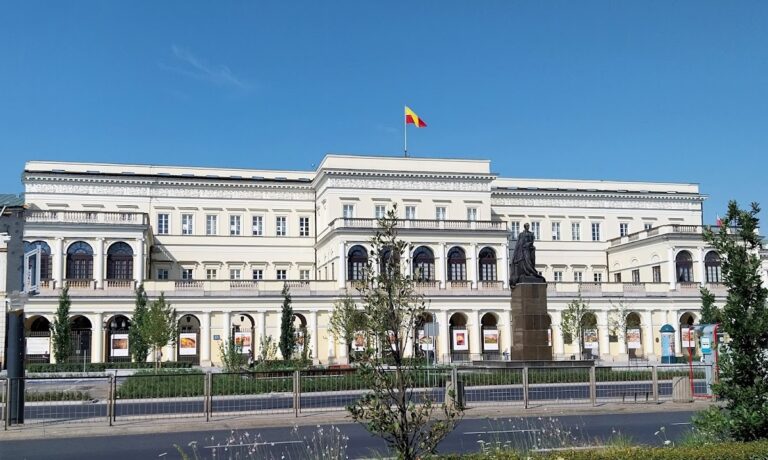
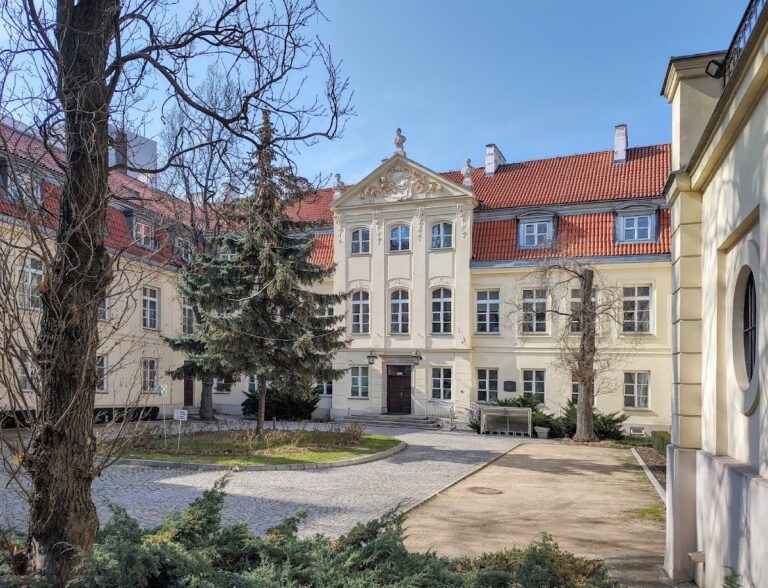
The palace is set back about 80 metres from Senatorska Street in Warsaw’s Śródmieście district. A short access road reaches the building through the area that was once the ceremonial courtyard. The original residence consisted of a main block and two perpendicular side wings, probably arranged in the late-Baroque manner. The surviving palace is a postwar reconstruction with a Classical-style appearance, and the wartime hospital plaque remains attached to its front wall.
Palace and original courtyard
Main palace
The main block formed the centre of the original residence and faced the large courtyard enclosed by the palace wings. In the 1762 depiction linked with Tirregaille’s city plan, the palace had no portico. Its present exterior reflects the Classical-style reconstruction carried out after the building was destroyed in 1944.
Side wings
The two original wings stood perpendicular to the main block and helped enclose the ceremonial court. They were two storeys high, with mansard roofs over their central sections. The wings were later sold and replaced by other buildings around the courtyard, changing the physical arrangement of the palace ensemble.
Surrounding buildings and garden
Buildings around the courtyard
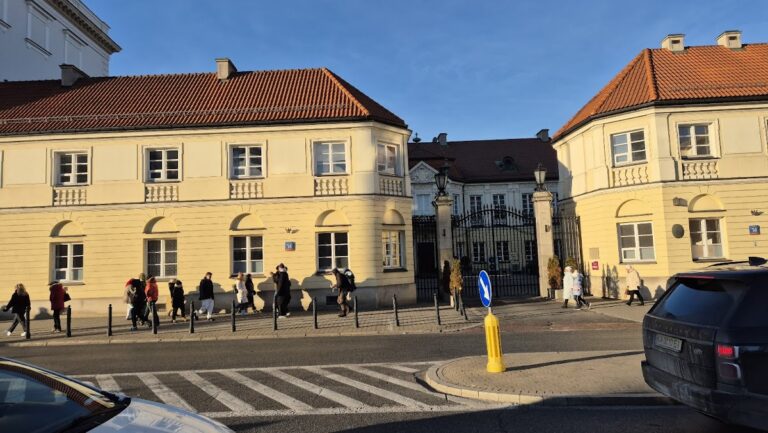
A postwar residential building now occupies the site at Senatorska 32. On the western side of the courtyard stands the former Wilhelm Landau Bank House at Senatorska 38, erected between 1904 and 1906 in the Art Nouveau style to a design by Gustaw Landau-Gutenteger. Prewar tenement houses belonging to the Seydel family stood on the eastern side but were not rebuilt after the war.
Remaining garden
The palace garden survives as a narrow strip about 15 metres deep to the north of the building. It extends to Antoni Corazzi Street, preserving only a small part of the grounds that once formed part of the palace ensemble. A Baroque statue of Saint John of Nepomuk by the sculptor Jan Civerotti formerly stood in front of the palace. Saint John of Nepomuk is traditionally associated with the protection of bridges, waterways, and confession.
Nearby sites