Schloss Unterbessenbach: A Neoclassical Castle and Estate in Germany
Site at a Glance
- Popularity
- Low
- Country
- Germany
- Primary era
- Modern
- Eras represented
- Early Modern, Modern
- Civilizations
- Holy Roman Empire, Kingdom of Bavaria
- Site type
- Domestic
- Remains
- Manor House
On this page9 sections
History
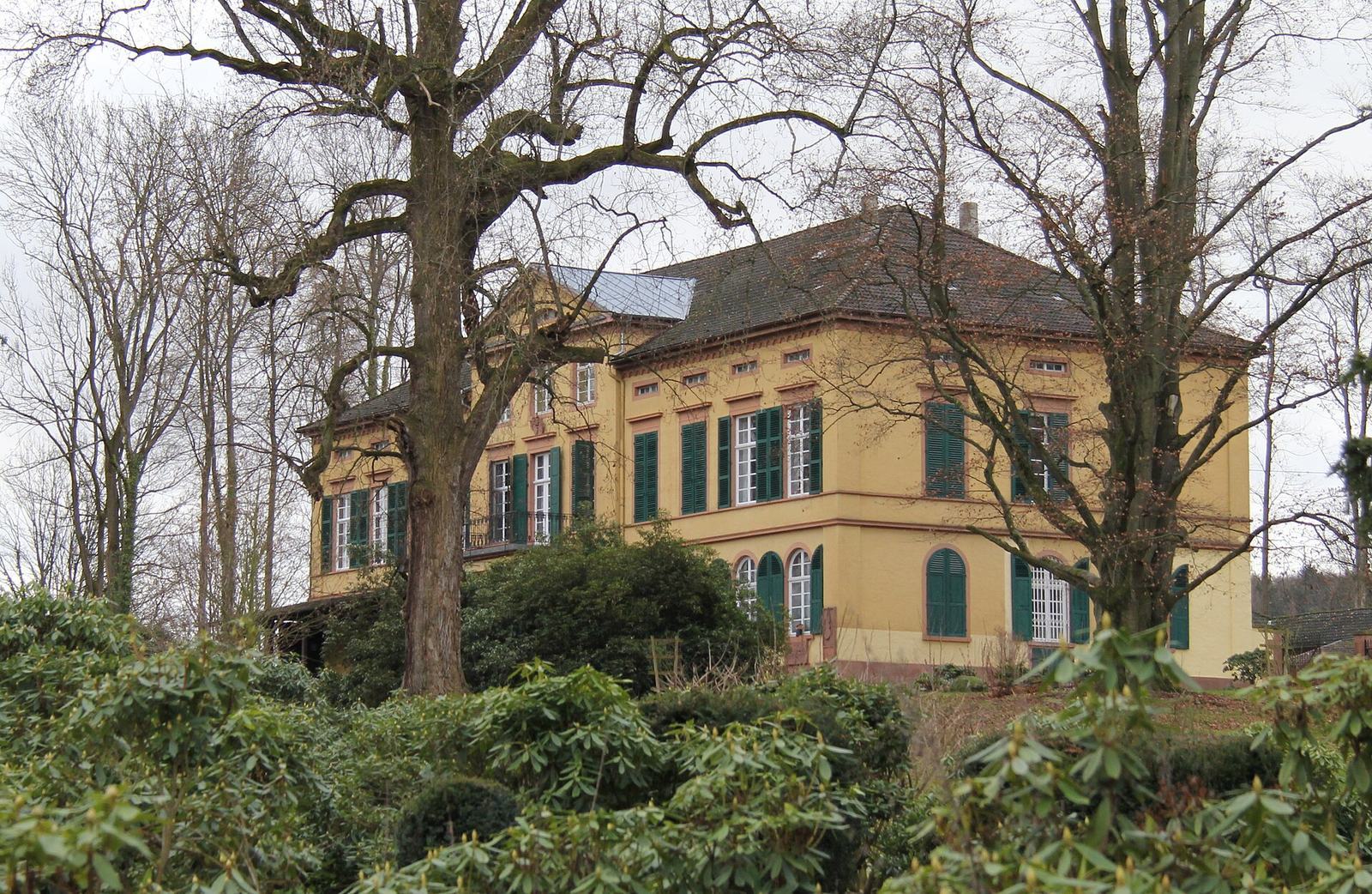
Schloss Unterbessenbach is a castle and estate in Germany, built in 1842 by Baron Gustav Johann von Gemmingen-Hagenschieß in the Neoclassical style, which draws on ancient Greek and Roman forms. Before the castle was built, the estate served as the administrative center of the Lords of Hettersdorf’s scattered holdings.
The Hettersdorf manor and Kurmainz
The Lords of Hettersdorf had been established in Bessenbach since 1326. They built a manor house there in 1577 as the estate’s principal residence. Family members often held forestry posts, which involved administering woodland resources, in the Spessart, a wooded upland region in western Germany. In 1658, the family was raised to the rank of imperial barons, members of the baronial nobility of the Holy Roman Empire.
During the eighteenth century, male members of the family served the Electors and Archbishops of Mainz in urban offices, while stewards largely managed their estates. The family remained under Kurmainz, the territory ruled by the archbishops of Mainz, who also held the rank of prince-elector. Electors were princes entitled to take part in choosing the Holy Roman Emperor. In 1790, Kurmainz asserted territorial sovereignty over Underbessenbach.
Transfer of the estate and construction of the castle
In 1804, Franz von Hettersdorf, reputed to be fond of gambling, leased the estate to his manager, Sartorius. Bankruptcy was declared over the estate on 22 November 1806, and it was subsequently leased to Alois Dessauer, a merchant from Aschaffenburg. The Counts of Fugger-Kirchheim-Hoheneck bought the estate in 1820. On 13 August 1841, Philipp Karl von Fugger sold it to Gustav Johann, also known as Hans, von Gemmingen-Hagenschieß (1808–1895).
Gustav built the present castle in 1842, and he and his family moved in the following year. The neglected chapel had been used for storage, including as a grain depot and a room for pressing wine. In 1853, it was adapted as a small church for Evangelical Lutheran services, part of a Protestant tradition that began with the Reformation.
The Gemmingen estate in the nineteenth and twentieth centuries
The family later again used the name von Gemmingen-Steinegg. Gustav’s son Oskar (1838–1918) developed the estate grounds. Oskar’s son Hans Dietrich (1869–1958) arranged a comprehensive renovation of the castle in 1907. In 1913, Crown Prince Rupprecht of Bavaria, heir to the Bavarian throne before the monarchy ended, stayed with Hans Dietrich for several days.
Albrecht Dietrich von Gemmingen-Steinegg took over the estate’s previously leased business in 1937, when it employed about 50 to 60 people. Called up for military service in 1939, he briefly returned to manage the estate after the campaign in western Europe, then was called up again. He died in Soviet captivity in 1946. His widow, Luise, née Baroness von der Recke, continued to run the estate as its tenant.
After Hans Dietrich died in 1958, the estate passed to Albrecht Dietrich’s then-minor son, Albrecht Viktor von Gemmingen-Steinegg (1943–2004). Following his agricultural engineering studies, Albrecht Viktor substantially reorganized the operation from the 1970s. Eleven hectares of estate land were ceded for the construction of the nearby A3 motorway. The castle remains in private ownership of the Gemmingen barons. The Evangelical parish of Goldbach uses the chapel for occasional Sunday services; it is dedicated to the Good Shepherd, a Christian title for Jesus.
Remains
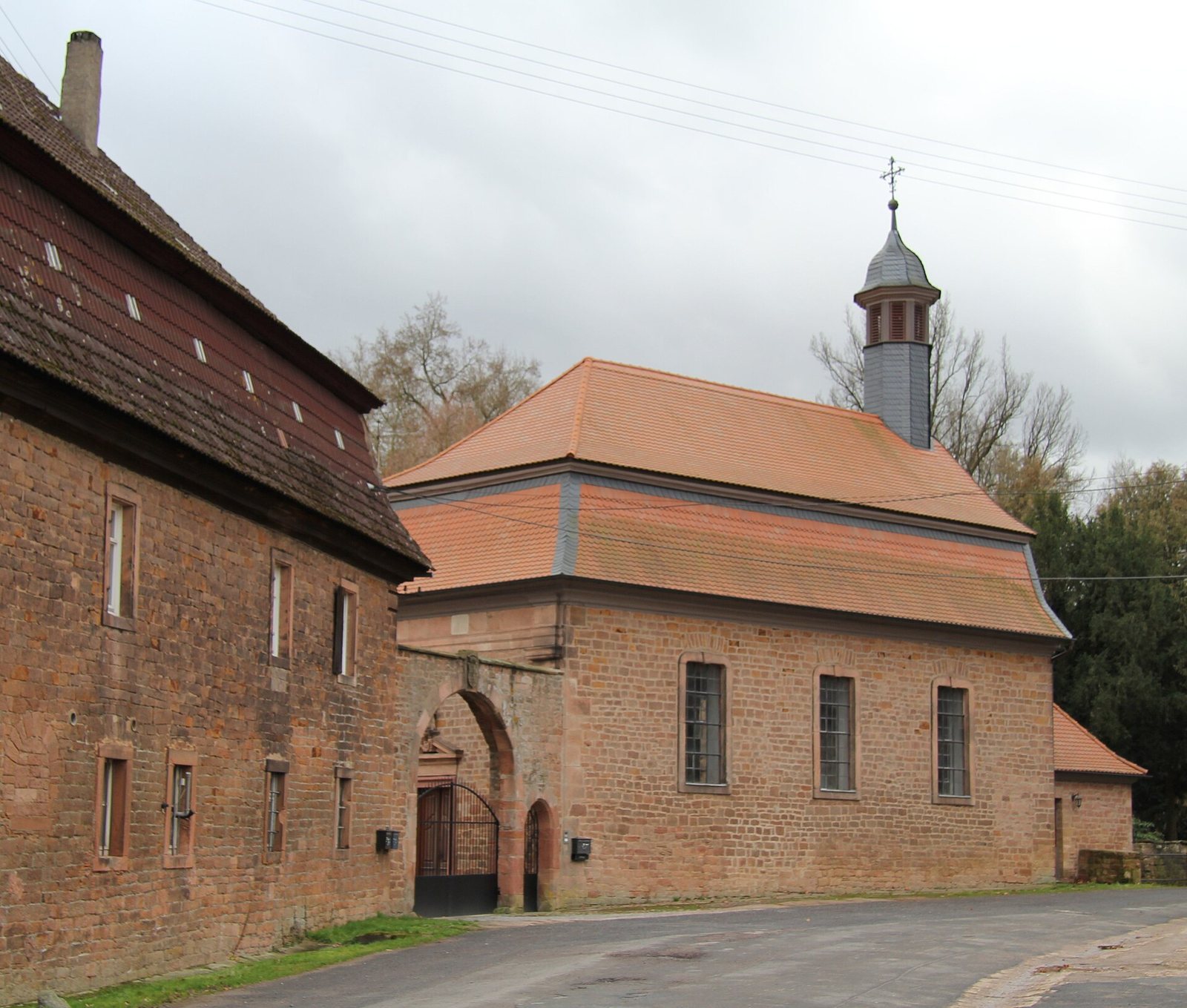
The castle, park, water features and estate farm form a connected ensemble. The castle stands on a small rise southwest of the earlier manor house, while the chapel is incorporated into the farm complex.
Buildings and grounds
Castle
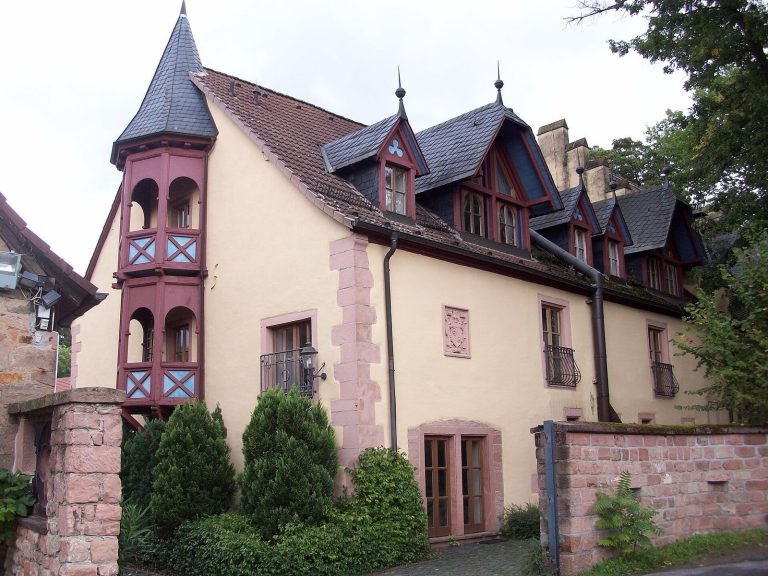
The castle’s front is organized around a central section that projects forward and is topped by a pediment, with a wing extending on each side. The building stands close to both the A3 motorway and the Aschaff stream.
Farm and chapel
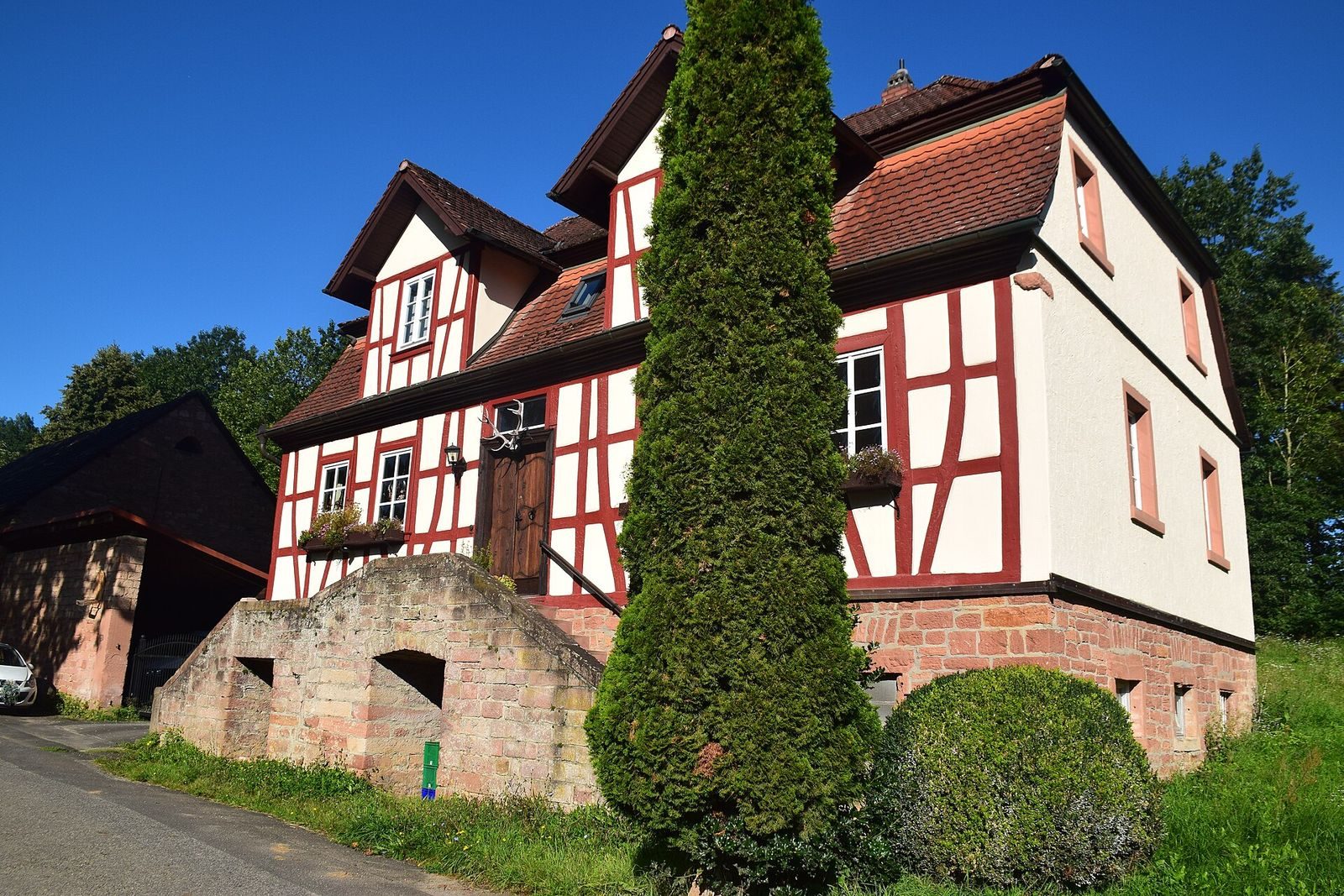
The estate farm forms part of the built ensemble, and the castle chapel is integrated into the farm buildings.
Park and ponds
The grounds include a castle park with ponds. Seven further ponds lie in the forest; Oskar von Gemmingen-Steinegg created these forest ponds as well as ponds in the park.