Schloss Matzenau: A Classicist Manor House in Slovenia


Site at a Glance
- Rating
- 4.4
- Popularity
- Low
- Country
- Slovenia
- Primary era
- Modern
- External website
- Open
- Eras represented
- Modern
- Civilizations
- Habsburg, Hungarian
- Site type
- Domestic
- Remains
- Manor House
On this page8 sections
History
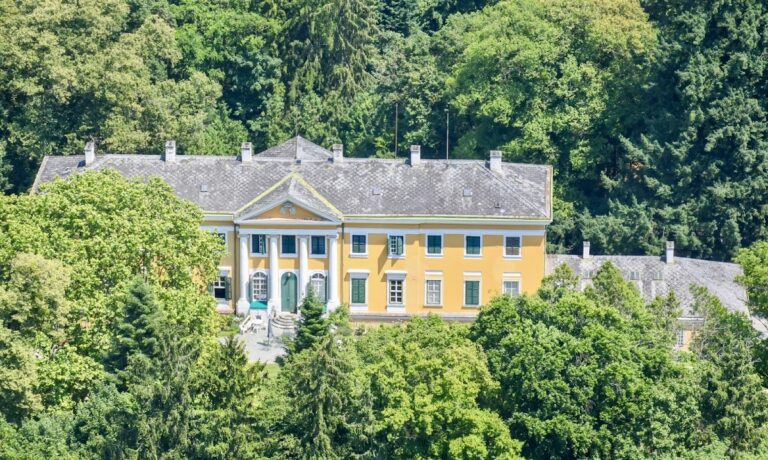
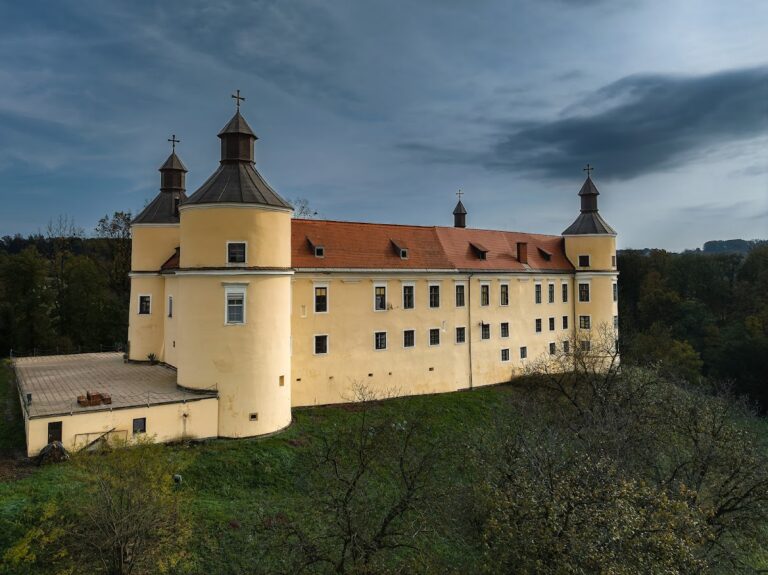
Schloss Matzenau is a nineteenth-century manor house in Slovenia, built during the first half of the nineteenth century in the Classicist style. Classicism draws on the symmetry and restrained forms of ancient Greek and Roman architecture, and the building is considered one of its rare examples in Slovenia. Its exact construction date, the circumstances of its construction, and the identity of its builder or builders are unknown.
Origins and aristocratic ownership
Local tradition places the manor’s construction in the Napoleonic period and claims that Napoleon stayed there overnight. This story remains unverified. The estate first entered the land register in 1866, when Olga, the widow of Karl Freiherr von Simbschen, transferred it to her father, Prince Joseph von Wrede. After Joseph died at Prosnyákfa on 26 December 1871, his heirs sold the manor and estate to Vilmos Boschan in 1873.
The property changed hands repeatedly during the following decades. It passed to Boschan’s wife in 1876 and to Josef Lenner of Budapest in 1879. When Lenner encountered financial difficulties, a Budapest bank auctioned the estate in 1880, and Henrik, Gyula, and Vilmos Pick acquired it. Ferenc Count von Egger became its owner in 1890 and sold it in 1893 to Dionys Julius Franz Baron Craigher von Jachelutta. The Craigher family transferred the estate to Karl Friedrich Franz Matzenauer, Count von Matzenau, in 1900. It is not known whether Dionys and his wife, Amalie Baroness von Flotow, lived there or whether their daughter Carla, born on 15 June 1894, spent her childhood at the manor.
The Matzenauer estate after 1900
Karl von Matzenauer was a diplomat who moved from Nikolsburg in South Moravia with his wife and children, including two children from his first marriage. The family thereafter lived at the manor and managed the surrounding estate. After the First World War, the political status and borders of Prekmurje, a historical region in northeastern Slovenia, became contested. South Slav troops occupied the region for the Kingdom of Serbs, Croats and Slovenes on 12 August 1919, with the approval of the Paris Peace Conference. The Treaty of Trianon, the 1920 peace settlement that defined Hungary’s postwar borders, established the new border on 4 June 1920.
Matzenauer served as an adviser to the boundary commission in the area around Prosenjakovci and Magyarszombatfa. Although only about 11 percent of Prosenjakovci’s population was Slovenian in the 1910 census, the village and the family’s entire estate, which covered approximately 150 hectares, were incorporated into the Kingdom of Serbs, Croats and Slovenes. The estate was not affected by the agrarian-reform law adopted by the Belgrade government in May 1922. That law provided for the compensated expropriation of holdings exceeding 75 hectares of arable land or 200 hectares in total.
Karl von Matzenauer died on 5 February 1932. His widow, Maria Theresia, née Krischker, managed the estate until her death in 1938. Ownership then passed to their two children, the 34-year-old Emerich von Matzenau and his 37-year-old sister Maria.
War, confiscation, and restitution
Hungary occupied Prekmurje on 16 April 1941, returning the estate to Vas County and restoring the settlement’s Hungarian name, Pártosfalva. During this period, the Matzenauers enlarged the estate, modernized and expanded its farm buildings, and increased their landholding by approximately 70 hectares, bringing it to about 220 hectares.
In the final days of March 1945, armoured units of the Red Army’s Third Ukrainian Front reached eastern Goričko through the Zala Valley. The army requisitioned the manor and used its rooms as a field hospital until the end of the war, forcing the Matzenauer family to leave. After the Red Army withdrew, Tito’s Partisans, the communist-led Yugoslav resistance movement commanded by Josip Broz Tito, took over the building. The Yugoslav People’s Army later stationed border guards there. During this period, the manor was completely looted and the family lost its personal possessions.
Agrarian-reform legislation issued on 23 August 1945 and adopted in Slovenia on 17 December that year deprived the Matzenauer family of the manor, its farm buildings, and all its land. The agricultural land around Prosenjakovci was later consolidated and operated by a state agricultural cooperative, which also used the manor. Various people subsequently occupied the building, and some rooms served as chicken and rabbit sheds. This misuse caused the manor to deteriorate completely over the following years. Emerich Matzenauer, the last male descendant of the family, died in tragic circumstances in 1952 at the age of 47. His sister Maria died in 1987 at the age of 86.
Under Slovenia’s denationalization law of 20 November 1991, denationalization being the legal restitution of property confiscated or nationalized by the state, Maria’s descendants regained the family’s confiscated property. The restitution was confirmed by the Slovenian Constitutional Court on 25 April 1997.
Remains
The manor and its setting
The ruinous manor stands in the middle of an overgrown park on the edge of Prosenjakovci, in the municipality of Moravske Toplice. The settlement is also known by its historical Hungarian name, Pártosfalva. Schloss Matzenau is a Classicist building whose symmetry and restrained architectural language are concentrated in the principal façade.
Central façade
A strongly projecting central risalit, meaning a section that extends outward from the main wall, contains the balcony portal. Above it, a triangular pediment survives with its gable collapsed. Between the balcony portal and the damaged pediment is an alliance coat of arms that remains almost intact. Although its colours were probably altered incorrectly during an earlier renovation, the shield designs still identify the two families represented.
Alliance coat of arms
The shield on the visually left is surmounted by a baron’s crown and belongs to the von Simbschen family. It is quartered, or divided into sections displaying different arms, around a silver central shield showing an ostrich standing on a green three-peaked hill and holding a horseshoe in its beak. The first quarter is blue with three diagonally placed gold stars, the second and third are silver with three red pales, or vertical bands, and the fourth is blue with four gold stars arranged in two pairs.
The shield on the visually right is topped by a prince’s hat and belongs to the von Wrede family. It shows a green laurel wreath on a gold field, entwined with five red roses arranged in a 1, 2, 2 pattern. A blue quarter in the upper right contains an upright unsheathed sword with a gold hilt. The motto reads “Virtuti pro patria,” meaning “For bravery for the fatherland.” Together, the two arms form an alliance coat of arms commemorating the marriage of 43-year-old Carl Baron von Simbschen and 23-year-old Olga Princess von Wrede in Graz on 1 May 1862.
Nearby sites