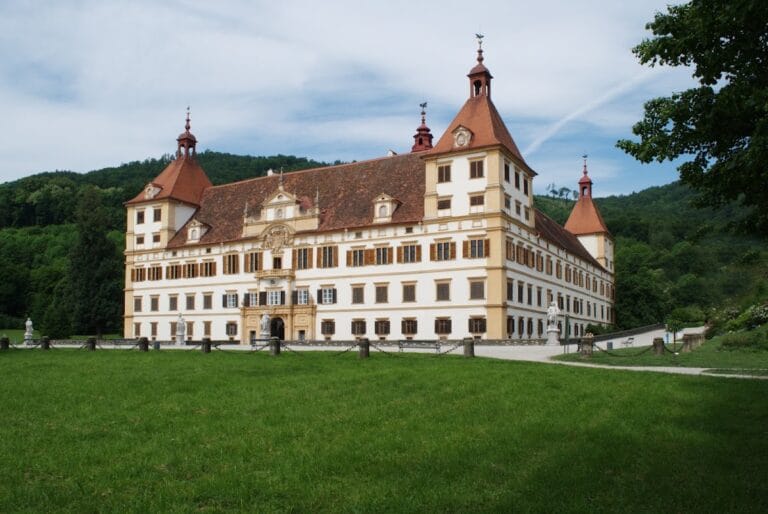
Schloss Klingenstein: From Farm Estate to Castle in Austria

Site at a Glance
- Rating
- 4.7
- Popularity
- Low
- Country
- Austria
- Primary era
- Early Modern
- External website
- Open
- Eras represented
- Early Modern, Modern
- Civilizations
- Habsburg, Holy Roman Empire
- Site type
- Domestic
- Remains
- Castle
On this page12 sections
History
Schloss Klingenstein is a castle in Austria, near Vasoldsberg, whose development from a rent-paying farm into a noble residence and later castle unfolded mainly in the seventeenth century. The estate retained the name of the Chlingsteiner farming family, who had held an earlier farm on the site or nearby.
Origins as a farm estate
The Chlingsteiner family first appears in the surviving record on 4 November 1481, when Ulrich Chlingsteiner bequeathed his farm in Affental to his wife Ursula. Historian Robert Baravalle considered this property possibly identical with the later Schloss Klingenstein site. In 1544, Christof Klingensteiner owned the farm, which was subject to regular dues owed to a superior lord. Andree Khlingstainer, the next known owner, expanded his holdings by purchasing rents near Hausmannstätten in 1602 or 1603. From 1605, he also served as administrator of the hereditary estates of the deceased Andree Prantner.
Andree Khlingstainer later sold the farm to Balthasar von Thanhausen. Although it formed part of the Breitenhilm rent estate, it continued to bear the name of its former owners. Thanhausen sold it to Mathias Thurkowitsch in 1616, after which it passed to Thurkowitsch’s widow, Helena, née Zörzer.
Conversion into a noble residence
In 1626, Helena Thurkowitsch sold the farm, then already called Klingenstein, together with its rent estate to Regina Globitzer, the widow of Peter Globitzer. Regina began converting the former farm into a small noble residence. As a Protestant, however, she was required to leave Styria within a year from 1628 under the Counter-Reformation, the Habsburg policy that restricted and suppressed Protestantism in its territories. She therefore sold the residence near Vasoldsberg to Maria Renata Freiin von Herberstein.
Maria Renata’s husband, Hans Albrecht Freiherr von Herberstein, sold the estate in 1631, together with the lordship of Vasoldsberg, to Stainz Abbey, a religious foundation exercising lordship over property. The date and seller of this transaction remain uncertain. In 1635, Stainz Abbey exchanged the lordship of Vasoldsberg, including the Klingenstein farm, with Christof Moritz Freiherr von Herberstein for the lordship of Lankowitz.
Christof Moritz transferred the farm to his stepson Johann Gabriel Maschwander in 1635. Johann Gabriel sold it to his mother, Maximiliana Freiin von Herberstein, in 1637, and she later transferred it to her other son, Johann Lukas Freiherr von Maschwander. Johann Lukas sold Klingenstein and the Breitenhilm farm back to his mother in 1640 or 1643.
Debt, seizure, and rebuilding
These repeated transfers were accompanied by a dispute over the original purchase price. The Globitzer family had not received the money owed to them, so their guardian, Georgen Adlß, demanded the principal and accumulated interest from Christof Moritz von Herberstein on behalf of Peter Globitzer, who was living abroad. The estate was seized and appraised in 1644. After a settlement with the Globitzers, Maximiliana von Herberstein retained Klingenstein.
Debts connected with the dispute led Maximiliana to transfer the grain tithe, a customary levy on part of the grain harvest, to her daughter Euphrosine Scholastica, the wife of Jonas Freiherr von Wilfersdorf. After Maximiliana’s death in 1656, Johann Lukas von Maschwander reclaimed the grain tithe belonging to Klingenstein and Breitenhilm in 1658. Georg Bartlmee Graf Khiesel later seized the farm for unpaid debts, while Johann Gabriel Freiherr von Maschwander redeemed it in 1665. The final settlement ended the Herberstein family’s ownership.
Joachim Friedrich von Sartori, Upper War Commissioner of Inner Austria, probably acquired Klingenstein from Maschwander in 1676. A purchase deed dated 22 May of that year survives in Sartori’s estate, although proposed purchase dates also include 1661 and 1690. Sartori initially converted the former noble residence back into a rent-paying farm, then probably began rebuilding it as a castle. A coat-of-arms stone dated 1678 and an inscription on a bell cast in 1680 mark this building phase.
Sartori also enlarged the estate by purchasing peasant properties near Premstätten in 1686 and 1688. Because these properties were subject to the lordship of Vasoldsberg, the acquisitions placed Sartori formally under that lordship. He died heavily indebted in 1704. Privileged creditors, including Georg Olivier von Wallis, brought claims against his property, and bankruptcy proceedings followed. Sartori’s widow, Maria Anna Sartori von Ehrenbichl, unsuccessfully sought the return of assets.
Later ownership and preservation
Jeremias Georg Hauslaub, also written as Haußlaib, purchased the estate in 1720. Franz Anton Graf von Schrottenbach became the next owner, though the transfer has been dated variously to 1720, 1725–1726, or 1730. On 9 October 1735, Schrottenbach named his wife, Charlotta Anthonia, née Countess von Thurn, his universal heir. She may already have received Klingenstein earlier, with proposed dates including 1 November 1733 and 1722.
Charlotta Anthonia sold the castle to Eustachius von Weiss und Sternsee. His daughter Anna Catharian sold it to Joseph Sigmund von Pollan on 28 November 1744. Pollan was a Court Chamber Councillor and chief post-office administrator. Later in 1744, the property passed to Franz Xaver and Johana Häubl; Franz Xaver was also known as Franz Xaver Hartl.
The Häubl, or Hartl, family sold Klingenstein to Josef von Moßmüllner in 1786. His son Josef inherited it on 26 March 1796 and in 1799 transferred the estate, together with property near Glanzberg and a newly acquired castle, to the lordship of Vasoldsberg. Ownership changed several times in 1807, when Josef Anton Winter acquired and then sold the castle to Anton Winter. Count Friedrich von Bellegarde finally acquired the estate on 21 November that year.
The Counts of Bellegarde built a chapel in 1830. Since 1959, Schloss Klingenstein has belonged to the Carli family, which restored the building after it became structurally dilapidated during the occupation period following 1945.
Remains
Schloss Klingenstein occupies a long, partly wooded ridge in the hilly country of eastern Styria. The ridge extends south from Kerscheck, with slopes descending toward the Ferbersbach valley on the south, the Schiebenbach on the west, and the dispersed settlement of Tiefernitz and the Tiefernitzbach on the east. The castle lies in the western part of the market municipality of Vasoldsberg, in the southwestern part of the Premstätten cadastral municipality, about 1,500 metres northwest of Vasoldsberg village.
Farm complex and castle fabric
Early estate buildings
An appraisal from 1644 presents the estate as a neglected complex following the frequent ownership changes of the preceding decade. It comprised a masonry building, a timber building, a stable, a barn, a press, a farm manager’s house, two vineyards, fields, meadows, and woodland. These buildings formed the agricultural basis from which the later castle developed.
Seventeenth-century castle
A stone bearing a coat of arms and the date 1678 is built into the castle’s southwestern corner. Together with the inscription on the bell cast in 1680, it points to the period when Joachim Friedrich von Sartori probably began reconstructing the property as a castle. The dated elements preserve evidence of this transformation within the later building.
Entrance tower and chapels
Entrance tower and bell
The tower above the entrance contains the bell cast in 1680. Its inscription may indicate that Sartori established an early castle chapel on the tower’s first floor. The bell therefore provides a possible link between the entrance structure and the seventeenth-century rebuilding phase.
Chapel of 1830
The presumed early chapel was probably destroyed during nineteenth-century alterations. The Counts of Bellegarde built the later chapel in 1830, adding a new religious space during their ownership of the castle. The building was subsequently restored by the Carli family after its structural deterioration during the post-1945 occupation period.
Nearby sites