Castle Meyenburg: A Historic Manor House and Estate in Germany


Site at a Glance
- Rating
- 4.6
- Popularity
- Low
- Country
- Germany
- Primary era
- Medieval
- External website
- Open
- Eras represented
- Medieval, Early Modern, Modern
- Civilizations
- German, Holy Roman Empire, Kingdom of Prussia, Margraviate of Brandenburg
- Site type
- Domestic
- Remains
- Manor House
On this page7 sections
History
Castle Meyenburg is a historic manor house in Meyenburg, Germany, whose origins lie in the medieval aristocratic estates of the von Rohr family. The present building combines fifteenth- and sixteenth-century fabric with a major remodelling in the North German Renaissance style carried out in 1865–1866.
Medieval Origins and the von Rohr Estate
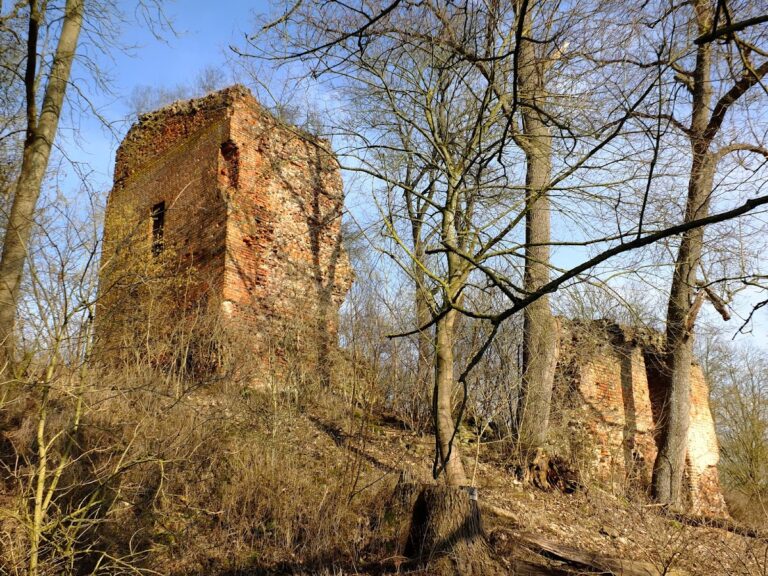
An earlier fortified castle stood slightly north of the present site. Bishops associated with the Havel region built it at the beginning of the thirteenth century, and it later passed to the powerful Gans von Putlitz family. Elements of this medieval predecessor were incorporated into the later complex.
The von Rohr family held Meyenburg from about 1367, when Klaus von Rohr possessed the property. In 1424, ownership was reaffirmed under his great-grandson Hans von Rohr, after which a distinct Meyenburg branch of the family inherited the estate. The von Rohr-Wahlen-Jürgaß family became one of the wealthy dominant families of the Prignitz and remained associated with the estate into the twentieth century. Magdalene, Imperial Countess von Harrach, née von Rohr-Wahlen-Jürgaß, who lived from 1881 to 1945, was recorded as its owner.
Manorial Administration and Nineteenth-Century Remodelling
Meyenburg was organized as a manor with a knightly estate, a noble landed property connected with agricultural production and manorial authority, until the land reform. The family established a fideicommiss, an inheritance arrangement intended to keep an estate intact within the family and restrict its division or unrestricted sale. In 1879, the estate covered 1,000 hectares, including a brickworks and 182 hectares of woodland. A total of 982 hectares was recorded in 1929. Extensive sheep farming formed its principal economic activity, supported by 70 horses, while an administrator managed the estate.
Berlin architect Friedrich Adler substantially remodelled the castle in 1865–1866 for a patron probably identified as Otto von Rohr-Wahlen-Jürgaß. The work gave the building its North German Renaissance appearance, a regional Renaissance style especially associated here with elaborate gables and façades. Further alterations followed in 1914 under his son, Theodor von Rohr-Wahlen-Jürgaß, lord of Meyenburg and holder of the family entail on the neighbouring estate of Ganzer. The building was modernized and electrified in 1918.
Twentieth-Century Uses and Restoration
In 1934, the castle became a sports school of the SA, the Nazi Party’s paramilitary organization. From 1936 to 1945, it housed the local branch of the Reich Labour Service, a compulsory state labour organization under Nazi Germany. During the German Democratic Republic, the building continued to serve as a school with boarding facilities.
Restoration and repair between 1996 and 2002 returned the castle to its 1866 appearance, while the park was restored in 1997. The castle and park are protected as historic monuments. The complex now contains the Meyenburg Fashion Museum, a castle museum, and a public library. The fashion museum displays part of a major European collection of twentieth-century clothing, covering 1900–1970, assembled by the East Berlin collector Josefine Edle von Krepl, who opened East Berlin’s first boutique.
Remains
Castle Building
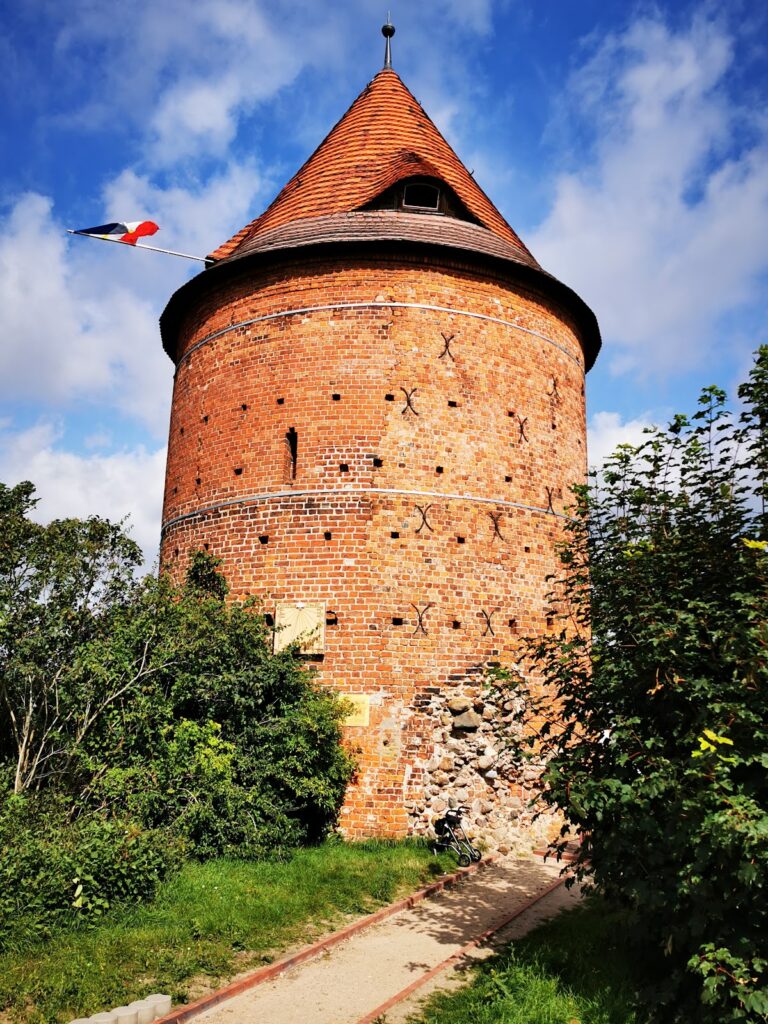
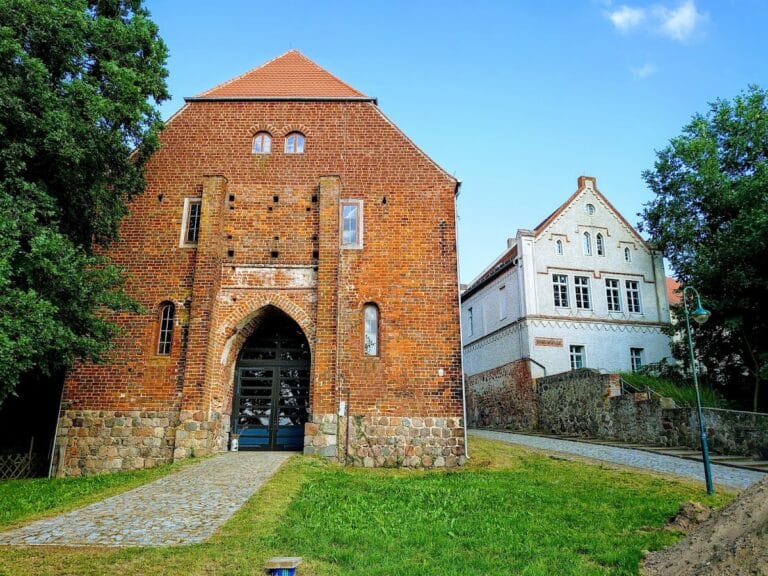
Despite its customary name, Castle Meyenburg is more precisely an elaborate, palace-like manor house. It is a two-storey brick building with two wings arranged in an L-shaped plan. Parts of Meyenburg’s medieval town fortifications survive within the building fabric. The core dates from the fifteenth century, while other sections derive from sixteenth-century construction; elements of the earlier medieval castle are also incorporated into the complex.
Adler’s remodelling supplied the present North German Renaissance character, particularly through the design of the gables. Above the entrance portal, a volute gable carries the von Rohr family coat of arms. The bronze-coloured shield is divided into red and silver sections arranged in a pointed pattern. A helmet with red-and-silver mantling rises above it, with a leaping natural fox set before seven alternating silver and red roses on green stems.
Park and Present Interior Uses
The park was created in 1868 by the Berlin court gardener Fink. Bounded on the east by the Stepenitz, it extends down to the river. Heavy overgrowth preceded its restoration in 1997.
The complex is divided among its current cultural functions. The fashion museum occupies one section and presents clothing from 1900 to 1970, another section contains the castle museum, and three rooms hold a public library with 10,000 items available for borrowing.
Nearby sites