Schloss Poneggen: An Aristocratic Residence and Hosiery Factory in Austria
Site at a Glance
- Rating
- 5
- Popularity
- Very Low
- Country
- Austria
- Primary era
- Early Modern
- Eras represented
- Early Modern
- Civilizations
- Habsburg, Holy Roman Empire
- Site type
- Domestic
- Remains
- Castle
On this page8 sections
History
Schloss Poneggen is a former rural aristocratic residence in Schwertberg, Austria, whose name appears in connection with a fief in 1297 and whose noble seat was first mentioned in the fourteenth century. Around 1380, Hans der Lasberger was recorded as its owner, although surviving documents from that period do not confirm the existence of a castle.
Noble ownership and rebuilding
In 1537, Hans Wankhammer bequeathed the building to Hans and Michael Schätzl and Andre Stockinger. On 9 March 1538, they sold it to the brothers Hans, Lassla, and Andreas Prager. An entrance-door lintel carries the date 1531, although the inscription is difficult to read with certainty.
Friedrich Prager left the castle in 1598 to his third wife, Elisabeth Freiin von Roggendorf. Because she was abroad and Protestant, her brother-in-law Wilhelm von Starhemberg leased the property in 1623 to Christoph Ernst Kölnböck von Ottsdorf, the Pfleger, or estate administrator, of the Schwertberg lordship. Count Leonhard Helfried von Meggau acquired the castle in 1635. After his death in 1644, the two castles at Poneggen passed to Susanne von Meggau, who brought them into her marriage to Count Heinrich Wilhelm von Starhemberg.
Johann Jakob Offner became the owner in 1651. The castle burned almost completely in 1655 and was rebuilt afterward. Following Offner’s death, it passed to Count Johann Ferdinand von Salburg, who united the two estates in Schwertberg. Later proprietors included Count Lobgott von Kuefstein and Count Gundacker von Thürheim.
Conversion into an industrial estate
Count Thürheim sold the castle to a hosiery factory in 1764. The building was converted into a small factory that operated until 1818. A hosiery factory produced knitted garments such as stockings, and much of the work could be distributed among domestic workers rather than performed entirely in a central workshop. Empress Maria Theresa, the Habsburg ruler of the hereditary lands from 1740 to 1780, granted the enterprise an eight-year monopoly on its products in 1768.
The factory grew out of the Thürheim family’s unsuccessful attempt to establish silkworm breeding. In 1767, it employed 4,028 people, including 2,942 spinners and 1,086 knitters, most of whom worked at home. The Enns hosiery factory at Schloss Lerchental was taken over in 1774 and transferred to Poneggen. Ownership changed again in 1807, and production ended in 1818.
Sixteen small houses were built southeast of the factory for its permanent workforce. This row-house settlement, known as the Häuselzeile, is described as one of Austria’s oldest workers’ housing estates. Owners and proprietors during the factory period and afterward included Franz Güglleithner, Augustin Glück, Johann Kaspar Zötl, Johann Nepomuk Wildauer, Wildauer’s widow, Johann Pautsch, Ferdinand Wall, Baroness Therese Schniter, and the Counts Hoyos. The property later passed from the Hoyos family to Karl Lammerhuber.
The former castle is protected as a historic monument and is now used for rental housing. The name Poneggen, also recorded as Pöniken, derives from the Old Slavic word ponikva, meaning a water hole.
Remains
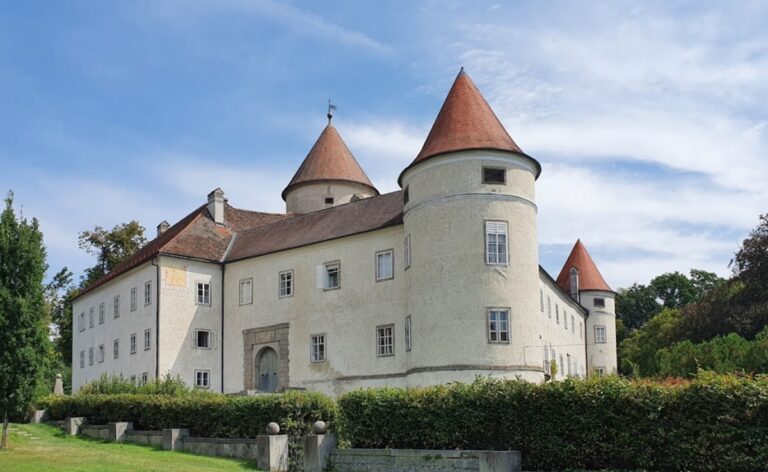
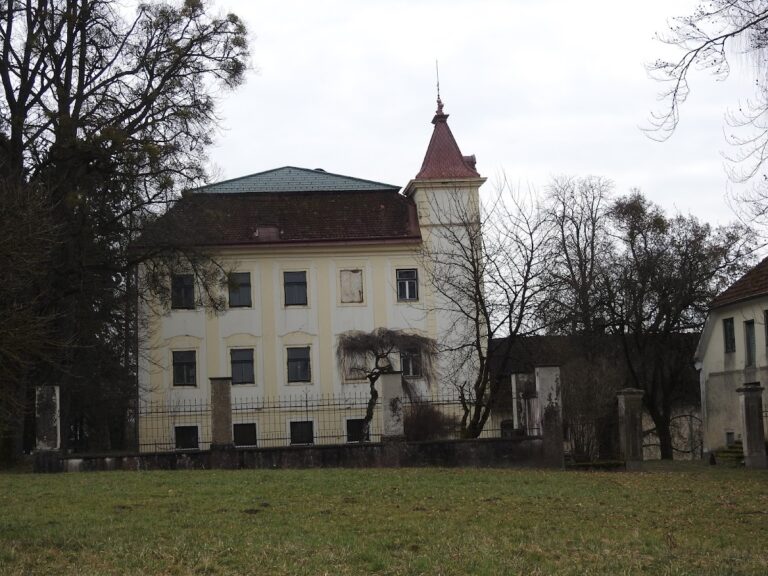
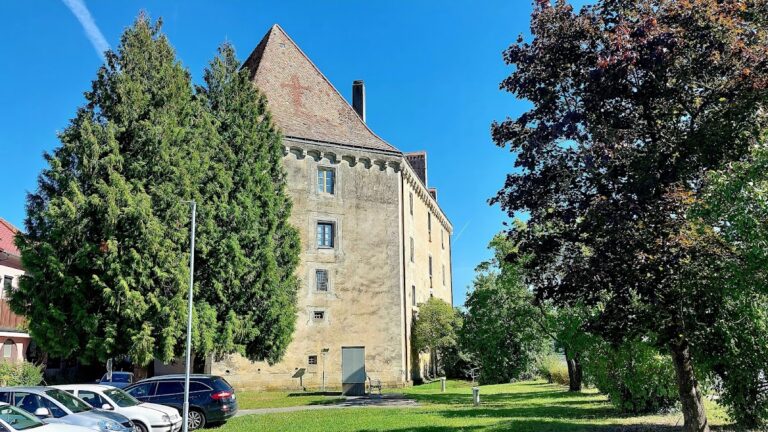
Schloss Poneggen survives as a substantially altered residential building. Its former economic courtyard, enclosing walls, and other associated elements have disappeared, while a spacious parking area surrounds the house. Newer residential buildings occupy the wider setting.
Main building
Tower extension
A tower once stood free at the northwest side of the castle and rose only slightly above the roof ridge. It is now a clearly recognizable extension of the main building. A staircase inside the tower connects the floors, preserving a functional part of the earlier castle layout.
Arcaded galleries
Arcaded galleries adjoin the tower, especially along the western side. They were later bricked up and fitted with windows. Apartments now occupy the individual floors of the former castle. A 1674 engraving by Georg Matthäus Vischer depicts Schloss Poneggen from the south.
Häuselzeile
Southeast of the former factory stands the Häuselzeile, a row of sixteen small workers’ houses. Built for the permanent workforce of the hosiery enterprise, the settlement preserves the domestic residential setting created alongside Poneggen’s industrial conversion.
Nearby sites