Langenburg Castle: A Medieval Fortress and Aristocratic Residence in Germany
Site at a Glance
- Rating
- 3.7
- Popularity
- Very Low
- Country
- Germany
- Primary era
- Medieval
- Eras represented
- Medieval, Early Modern
- Civilizations
- Holy Roman Empire
- Site type
- Domestic
- Remains
- Palace
On this page12 sections
History
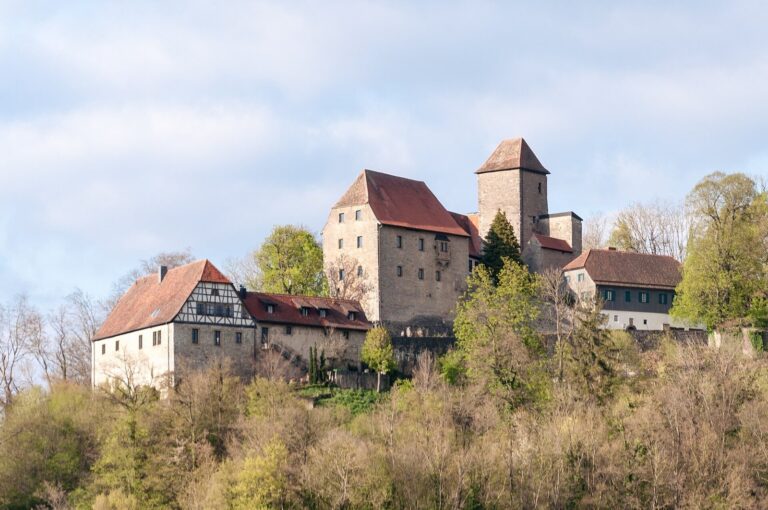
Langenburg Castle is a medieval fortress and later aristocratic residence in Germany, above the Jagst valley. Its beginnings are generally dated to the 12th century, and it was recorded around 1226 as a castle and town called Langenberg.
Fortification and residence
Major rebuilding began in 1235, strengthening the castle into a heavily defended stronghold. In the 15th century, it was adapted to resist gunpowder artillery, or cannon-based weapons.
Between 1610 and 1616, Langenburg became an important residence of the Hohenlohe-Langenburg branch of the German princely House of Hohenlohe. Count Wolfgang zu Hohenlohe-Langenburg made it the administrative centre of his extensive lands. His successor, Count Philip Ernst zu Hohenlohe-Langenburg, invested heavily in rebuilding, and the household and court moved to the castle. A princely residence was the formal home of a prince and his court.
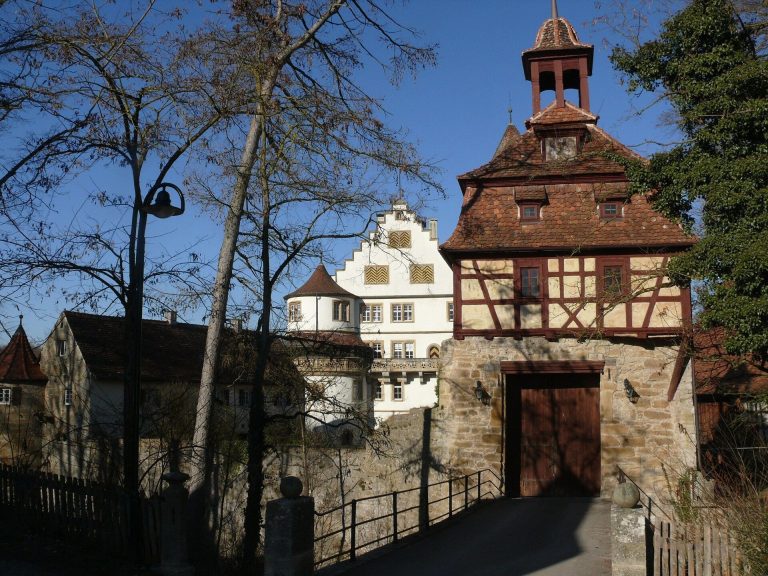
In 1757–1759, the complex was remodelled in a restrained Baroque style, a later European style in architecture and the visual arts. Two permanent bridges across the defensive ditches took the place of earlier drawbridges, which could be raised to block access.
War, fire and reconstruction
The castle’s exterior changed little during the 19th and 20th centuries, when work mainly involved restoration and cosmetic repairs. During the Second World War, it avoided the bombing and fighting that struck neighbouring settlements. From spring 1944, rooms were cleared for use by the Wehrmacht, Germany’s armed forces under Nazi rule. A military hospital was established there shortly before the war ended.
A faulty chimney in the east wing started a major fire during the night of 23–24 January 1963. Dense fog, temperatures of about −20 °C and frozen water supplies hampered the fire crews. In all, 275 people fought the blaze, which destroyed the main residential wing and damaged other parts of the complex. The estimated loss was six million Deutsche Mark, Germany’s currency before the euro.
Rebuilding began in spring 1963 and was completed in summer 1968. Princess Charlotte zu Hohenlohe-Langenburg, an art historian who had directed Christie’s branches in Munich and Frankfurt, played a major role in the work.
Ownership and museums
The Hohenlohe-Langenburg family, part of a Protestant Christian tradition that emerged from the Reformation, continues to own the castle and use it as a residence. Parts of the complex have housed a public museum since 1960. Prince Kraft zu Hohenlohe-Langenburg and racing driver and motoring journalist Richard von Frankenberg conceived the German Automobile Museum in 1969. It opened in the former stables in 1970.
Remains
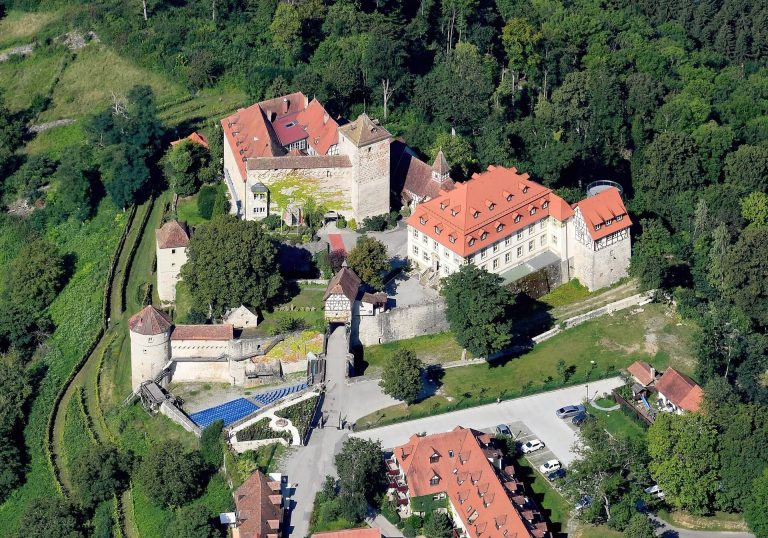
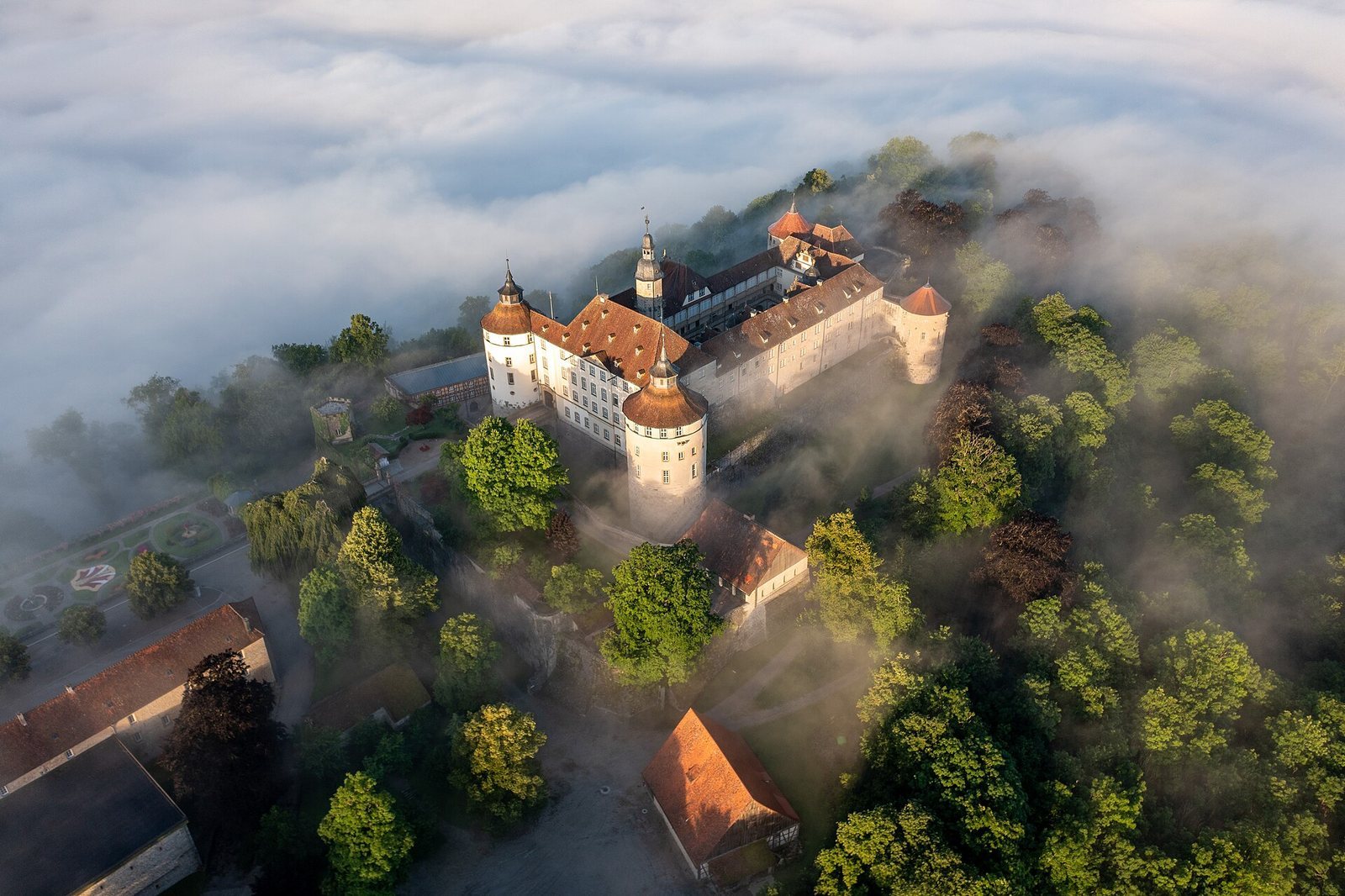
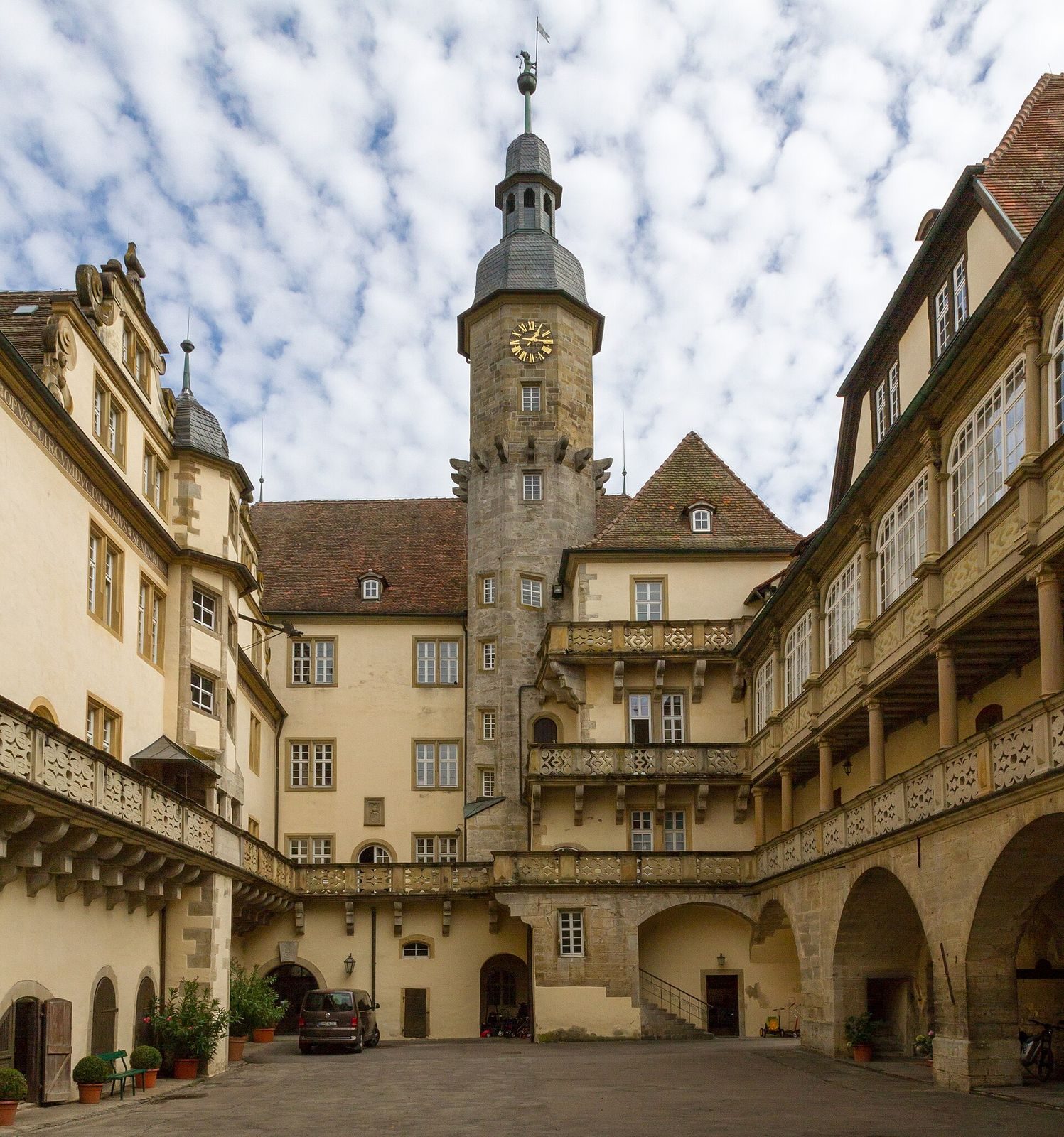
Built of stone, the castle forms an elongated rectangle running west to east, with large round towers at its ends. Four residential wings enclose an inner courtyard, where covered galleries surround a tall, slender clock tower. The galleries, gables and stair towers have Renaissance features, from a European cultural and artistic period.
Castle and surrounding grounds
Fortifications and courtyard
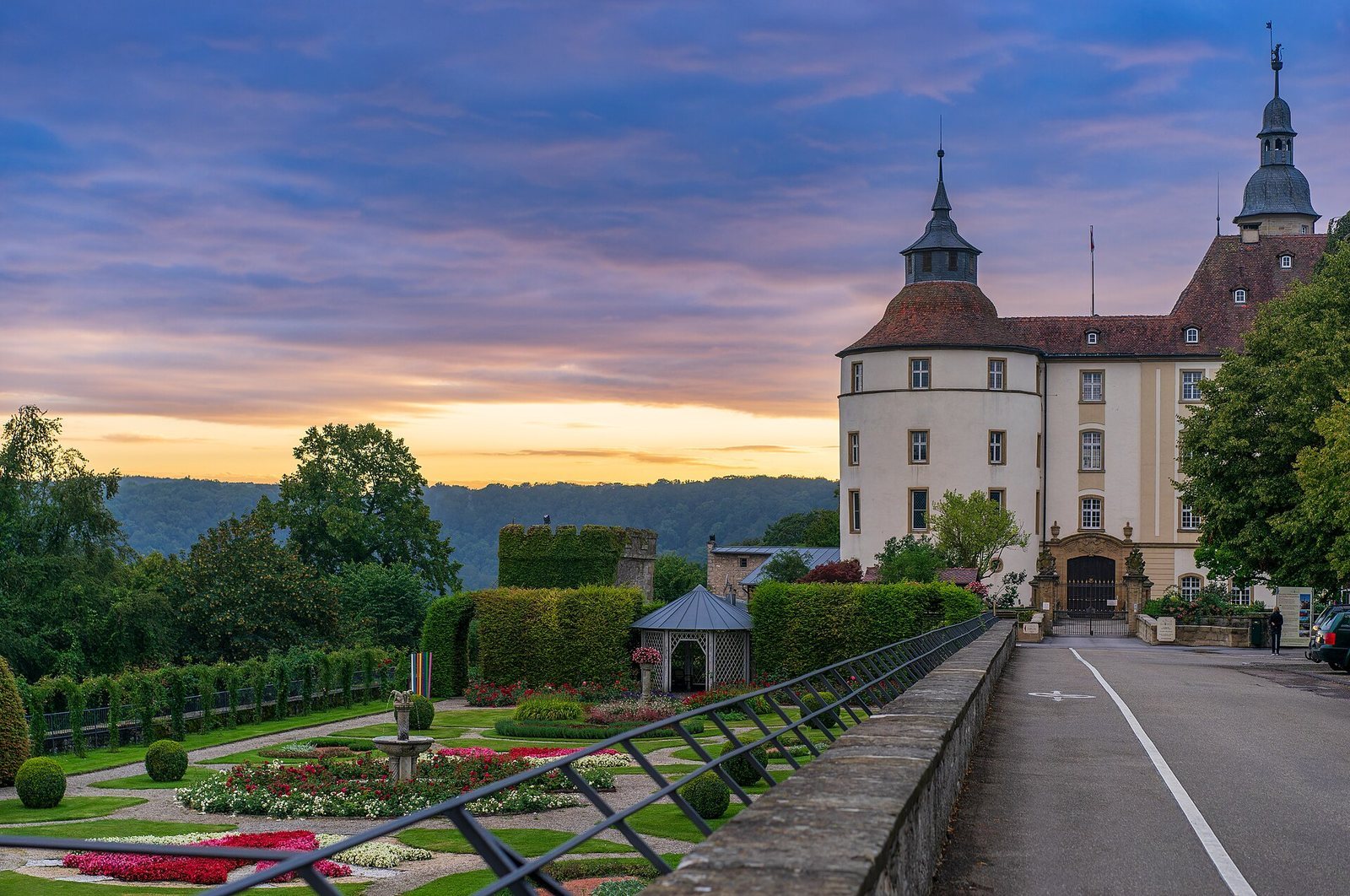
The main entrance is on the eastern side, reached by two fixed bridges over the defensive ditches. The former outer bailey, the castle’s outer fortified area, lay before the main gate and held storage buildings, stables, a smithy and other service buildings. A drawbridge once controlled entry to the inner stronghold.
Garden and park
A Baroque garden occupies the southern part of the former outer bailey. It contains a gazebo, fountain, flowerbeds and plantings of exotic species. A wooded park surrounds the castle on all sides except the east, with paths running through it.
Chapel
The three-storey chapel is inside the round tower at the southeast corner. Its interior has painted wooden galleries, a wooden pulpit and wooden pews. The 1963 fire spared the interior but damaged the tower’s roof.
Museum collections
Castle museum
The castle museum includes the Renaissance courtyard, known for its acoustics, the chapel and seven rooms: the Plank Corridor, New Dining Room, Archive Room, Baroque Hall, King’s Corner Room, Feodora Library and Linden Tree Room. Its displays include historic furniture, tapestries, paintings, glazed earthenware, porcelain, weapons, armour and hunting trophies.
German Automobile Museum
The former stables, between the castle and the rest of the town, house the German Automobile Museum. Its displays include historic and racing cars.