Schloss Wasserberg: Castle and Episcopal Estate in Austria

Site at a Glance
- Rating
- 4.5
- Popularity
- Very Low
- Country
- Austria
- Primary era
- Medieval
- External website
- Open
- Eras represented
- Medieval, Early Modern, Modern
- Civilizations
- Holy Roman Empire
- Site type
- Military
- Remains
- Castle
On this page14 sections
History
Schloss Wasserberg is a castle in Austria, situated in the municipality of Gaal near Knittelfeld in Styria. The site developed under the influence of the Archbishops of Salzburg and, from the thirteenth century, the Diocese of Seckau, which built a castle there around 1260. It later became an episcopal palace, the center of a large lordship, and a property adapted for tourism before returning to religious ownership.
Salzburg Origins and the Medieval Castle
The upper Ingering and Gaal valleys came under the Archbishops of Salzburg around 860. A fortified structure may already have stood on the hill in the tenth century, staffed by Salzburg ministeriales, service nobles who commonly performed military and administrative duties. In 1174, Margrave Ottokar confirmed Poppo of Tirnberch’s donation of a forest near Wasserberg to Seckau Abbey. Reinbert of Mureck, acting for the margrave, marked the forest boundaries for the abbey.
The foundation of the Diocese of Seckau in 1218 changed the site’s institutional setting. The Archbishop of Salzburg donated the area around Wasserberg to the new Catholic diocese in Styria. Around 1260, Bishop Bernhard of Seckau built a castle on the estate, and the building took its name from the surrounding area. During the thirteenth and fifteenth centuries it was sometimes called Seccoburg or Seccauburg, reflecting its connection with Seckau, but Wasserberg remained the lasting name.
Otto of Wasserberg, from the Galler or Geuler family, is recorded as the bishop’s burgrave in 1261. A burgrave was the governor or administrator of a castle. In 1276, Dietmar of the Geul captured Wasserberg and expelled its Bohemian occupants. Bishop Wernhart of Seckau had handed the castle to the Bohemians while supporting King Ottokar, but King Rudolf of Habsburg returned it to the Bishop of Seckau later that year.
Episcopal Administration and Conflict
Wasserberg continued to function as an administrative center for the bishops. Bishop Rudmar of Hader issued numerous documents there. In 1338, Duke Albrecht II granted him fishing rights on Lake Ingering, and in 1358 he received the right to appoint the priest serving the parish church in Gaal.
The Geuler family remained associated with the castle’s administration. Otto the Geuler served as burgrave in 1343, and in 1347 he held the office jointly with Niklas the Geuler, who continued until 1367. Nicla the Ennstaler then became burgrave and regional judge, an official responsible for local judicial authority. He still held both roles in 1403.
Wasserberg was drawn into the conflicts of the late fifteenth century. In 1479, Bishop Christoph of Seckau handed the castle to the Hungarians. Imperial troops under Field Captain Andreas Lueger recaptured it in 1480. Lueger initially refused to surrender the building to Christoph’s successor, Bishop Matthias Scheit, and obstructed the bishop’s men. After Emperor Frederick III ordered him to comply, Lueger returned the castle to the Bishop of Seckau. Jörg Mertschtainer was recorded as the episcopal burgrave there in 1482, when the name Seccoburg was again in use.
Under Bishop Matthias Scheit, whose tenure is given as 1482 to 1503 or 1512, the medieval castle was enlarged into a palace. Matthias became involved in a prolonged dispute with the provost of Seckau Cathedral and died excommunicated at Wasserberg in 1512.
Leases, Administrators, and the Lordship
During the sixteenth century, Andree Zach of Lobming administered the palace from 1521 to 1538, followed by Lienhardt Muerer, who is recorded from 1540. Heavy taxes imposed because of the Ottoman wars placed pressure on the bishopric. In 1555, Bishop Petrus pawned Schloss Wasserberg and its lordship to Christoph Haymer for 10,000 florins, with redemption permitted within ten years.
After the property was redeemed, the lordship was leased to Zacharias Gabelkhoven for ten years in 1565. His widow assumed the lease in 1573. The following year, Paul Persicus, recommended by the Archbishop of Salzburg, and Adam of Gallenberg, recommended by Archduke Charles, applied for the vacant lease.
From 1590, the bishop again appointed administrators who had to submit accounts. The recorded officeholders included Raimund Eberlein from 1599 to 1603, Hans Jakob von Gabelkhoven from 1610 to 1630, Hans Wilhelm Grießler from 1640 to 1649, Martin von Ehrberg from 1649 to 1664, Andreas Christoph von Rindsmaul from 1666 to 1671, Johann Egger from 1671 to 1690, and Franz Kammerlander from 1690 to 1700.
The effects of the Thirty Years’ War, the major European conflict that lasted from 1618 to 1648, continued to burden the estate after the fighting ended. In 1649, administrator Martin von Ehrberg complained that he had to provide daily rations for 40 soldiers and hoped that these unwanted guests would soon depart.
The lordship extended well beyond the castle itself. It included 36 mills, two stamping mills, a castle district, and subjects administered through widely dispersed offices. Its manorial farm comprised meadows, fields, and alpine pastures, making Wasserberg an administrative center for a substantial rural estate.
Private Ownership and New Uses
After almost six centuries of episcopal ownership, the lordship and castle were sold in 1844 to Maximilian Seßler, a member of the leading mining family in the Mürz Valley. He carried out major extensions and alterations between 1844 and 1848. Following his death in 1862, his heirs sold the property in 1880 to the Viennese Julius Maya, who operated a multi-blade sawmill for five years and a scythe works for two.
Gottfried Dub acquired the castle in 1884 and sold it to Baron Hans von Westerhagen in 1891. Westerhagen created a park on the southern and eastern sides. Leopold Grünhut owned the property in 1893 and 1894, followed by Count Max Arco-Zinneberg from 1894 to 1897 and Prince Arnulf of Bavaria from 1897 to 1906.
Arco-Zinneberg and Prince Arnulf adapted the castle for tourism. They converted it into an alpine hotel with a restaurant, which opened for summer visitors in June 1895. In 1897, the operation became a Kneipp and climatic sanatorium. A Kneipp sanatorium offered hydrotherapy and treatments based on a regulated lifestyle, while a climatic sanatorium promoted health through the local climate. The property had its own spa doctor. Karl von Thuillieres, Count of Montjoye la Roche, owned Wasserberg from 1906 to 1912 and ended the hotel operation.
Abbey Ownership and Twentieth-Century Changes
In 1913, Schloss Wasserberg passed to Heiligenkreuz-Neukloster Abbey, a Cistercian religious institution. During the First World War, Russian officers were housed there initially. After they left in June 1915, wounded Austrian officers were quartered in the castle. In the interwar period, the building served as a holiday colony for children requiring recuperation.
Following Austria’s annexation to Germany, the Reich Forestry Administration, the German state forestry authority, took control of the castle, forests, and lands in 1939. In 1945, responsibility passed to a trustee administration of the province of Styria. Heiligenkreuz Abbey pursued restitution proceedings, which were decided in its favor in 1950. The castle and forest estate then returned to the abbey.
Schloss Wasserberg is a protected monument in Austria and appears on the cultural-heritage monument list for Gaal. Today, the property accommodates the administration of an 11,650-hectare forest estate, rental housing, and holiday accommodation for members of the religious order.
Remains
Schloss Wasserberg occupies a small hill where the Gaal and Ingering streams meet. Four wings enclose a spacious courtyard, while the former broad moat and surrounding marshes formed part of the site’s defensive setting. The surviving fabric combines Romanesque, a medieval architectural style, Gothic, Baroque, and later nineteenth-century alterations. Several rooms were renovated in 2013, and the courtyard was redesigned during the same work.
Castle Layout and Towers
Southeastern Round Tower
The round tower at the southeastern corner contains Romanesque fabric and is the surviving example of the castle’s original four corner towers. The lower levels of the south, east, and north wings are Gothic, linking the present building to its medieval phases. A fifteenth-century well was uncovered in the southeastern corner during the 2013 renovation work.
Courtyard Gateway Tower
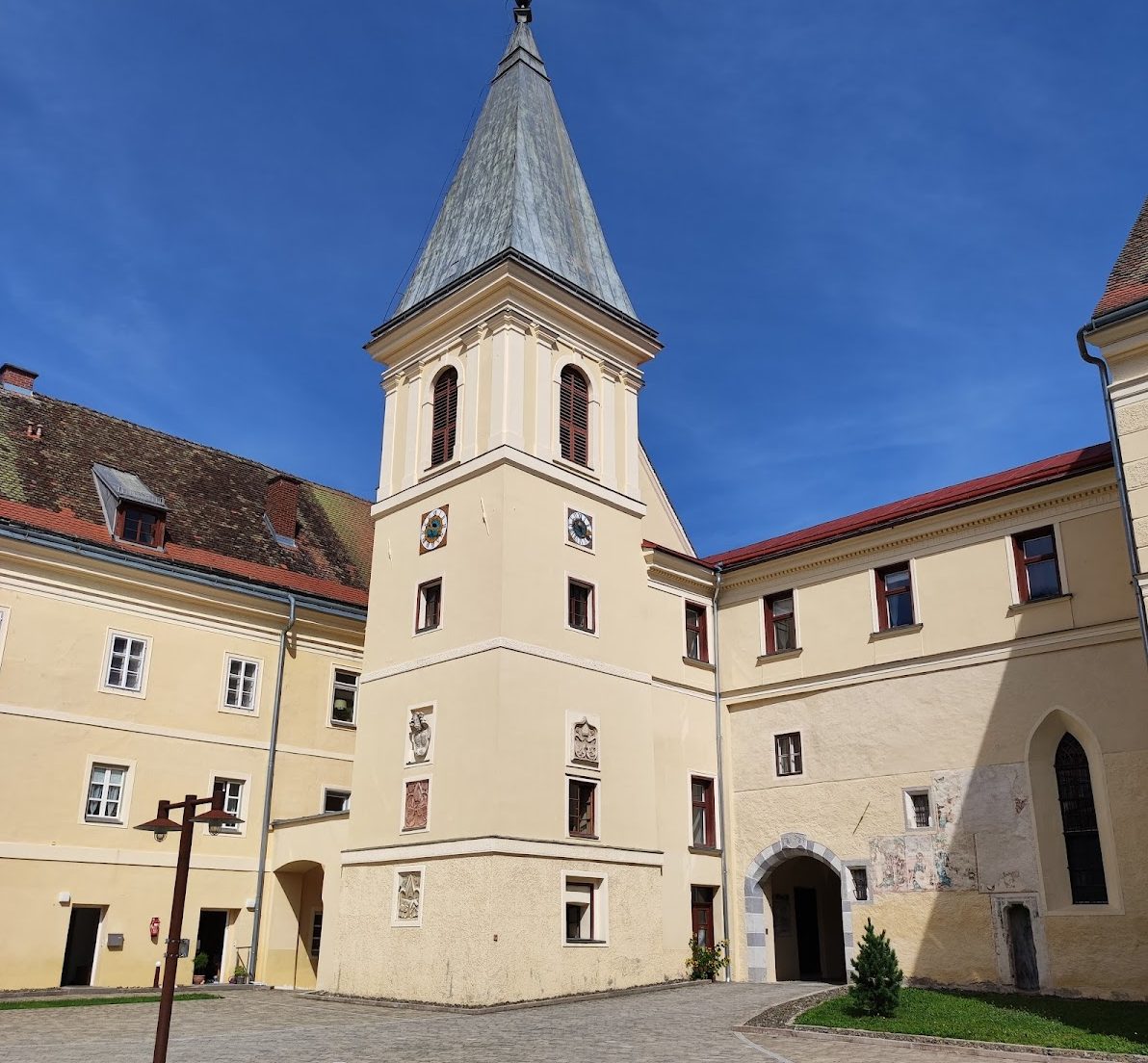
A tower stands beside the gateway in the northwestern corner of the courtyard. Its lower part is Gothic, while its upper story is Baroque and carries a pointed helmet, a steeply shaped tower roof. Two bells in the tower date from the fourteenth and fifteenth centuries. Heraldic stones commemorate Bishop Matthias Scheit with the date 1483, industrialist Maximilian Seßler with the date 1846, and Abbots Gregor Pöck and Franz Gaumannmüller.
The center of the courtyard is marked by a 12-ton stone from the surrounding area. It is associated with the name “Water Mountain” and is crowned by a bird sculpture made by Raphael Statt.
Castle Chapel
Late Gothic Chapel Interior
The castle chapel occupies the north wing. Its late Gothic interior has a star-rib vault, a ribbed ceiling whose ribs form a star-like pattern, supported by bundled shafts, groups of slender vertical supports. A copy of a painting by Martin Altomonte hangs on its Neo-Baroque altar.
Fifteenth-Century Frescoes
Restoration in 1976 exposed foundations that had been altered during the nineteenth century and revealed late Gothic frescoes visible from the courtyard. The paintings date from 1492. They include the Virgin Mary with the Christ Child, Saint Barbara on the right, and other saints on the left. The frescoes were restored in 1977.
Johannes Nepomuk Chapel
In front of the castle stands the small Baroque Johannes Nepomuk Chapel. It has a semicircular termination and an iron grille. Its statue of Saint John of Nepomuk and the exterior wall paintings of saints in Rococo frames date from the third quarter of the eighteenth century. Saint John of Nepomuk was a fourteenth-century Bohemian Catholic saint traditionally associated with protection from drowning and bridges.