Schloss Guttenburg: A Medieval Castle Transformed into a Palace
Site at a Glance
- Rating
- 4.6
- Popularity
- Low
- Country
- Germany
- Primary era
- Early Modern
- External website
- Open
- Eras represented
- Medieval, Early Modern, Modern
- Civilizations
- Duchy of Bavaria, Electorate of Bavaria, German, Holy Roman Empire
- Site type
- Domestic
- Remains
- Castle
On this page9 sections
History
Schloss Guttenburg is a historic palace complex in Germany, located in the Guttenburg district of Kraiburg am Inn, Bavaria. Duke Henry XIII commissioned its predecessor, Guttenburg Castle, around 1285, when his ministerial Heinrich von Taufkirchen built it on a small hill spur above the right bank of the Inn. The position allowed the castle to overlook the Salzburg exclave of Mühldorf am Inn, and Archbishop Rudolf unsuccessfully protested its construction.
Medieval castle and later palace
Guttenburg Castle was burned during the Bavarian War in 1426. It was rebuilt toward the end of the fifteenth century, after which the estate continued as the seat of a Hofmark, a landed estate whose lord held local administrative and judicial rights.
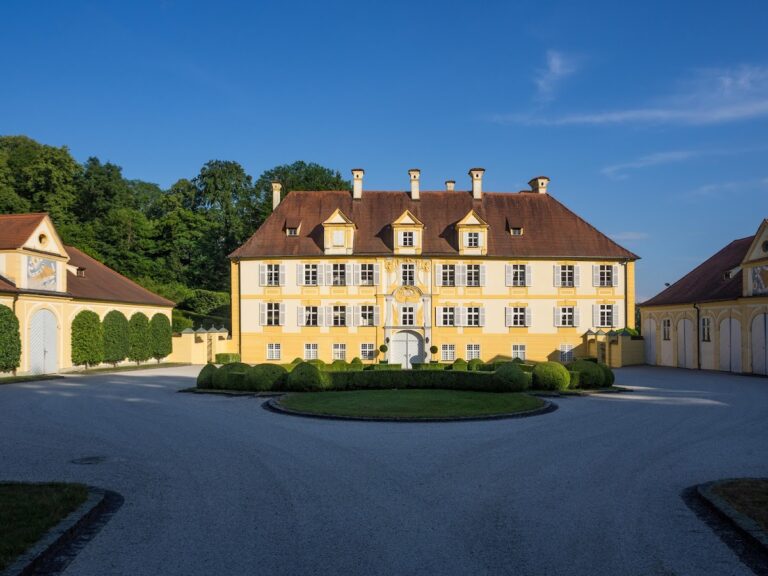
Between about 1660 and 1670, and again during the eighteenth century, the complex was reshaped into a palace with a Baroque garden. These alterations replaced the castle’s original defensive character with that of a Renaissance-style palace. The Taufkirchner family owned the estate until 1824. They became Imperial Barons in 1639 and Imperial Counts in 1684, before the last Taufkirchner of Guttenburg sold the palace to Baron von Gruben.
Nineteenth- and twentieth-century ownership
Anton Arnold von Linck owned the palace and Hofmark from 1842. The associated Class II patrimonial court, a court operated by a territorial landowner rather than directly by the state, was abolished in 1848 during the revolution. A diocesan description compiled by Mayer-Westermayer between 1874 and 1884 named Prince Cantacuzene as the palace owner. Graves bearing the names von Linck and Cantacuzene remain at the nearby village church of Frauendorf.
From 1904 to 1917, Bruno Ritter Mautner von Markhof, a member of the Austrian industrial Mautner Markhof family, owned the palace and the associated Guttenburg Castle Brewery. The brewery closed after his death in 1921. Nico Forster purchased the palace in 1999 and has since been renovating it.
Schloss Guttenburg is listed as a protected architectural monument. Underground medieval and early-modern remains connected with the palace, its predecessor buildings, and the Baroque garden are also designated as an archaeological monument.
Remains
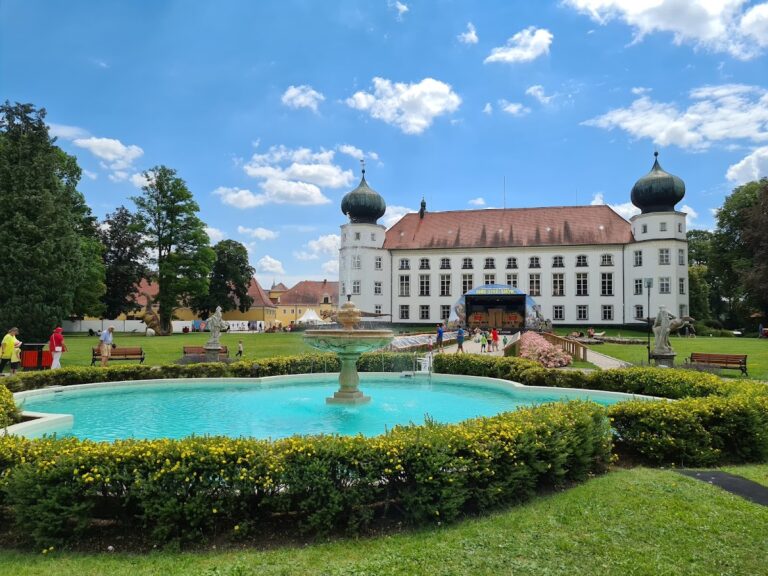
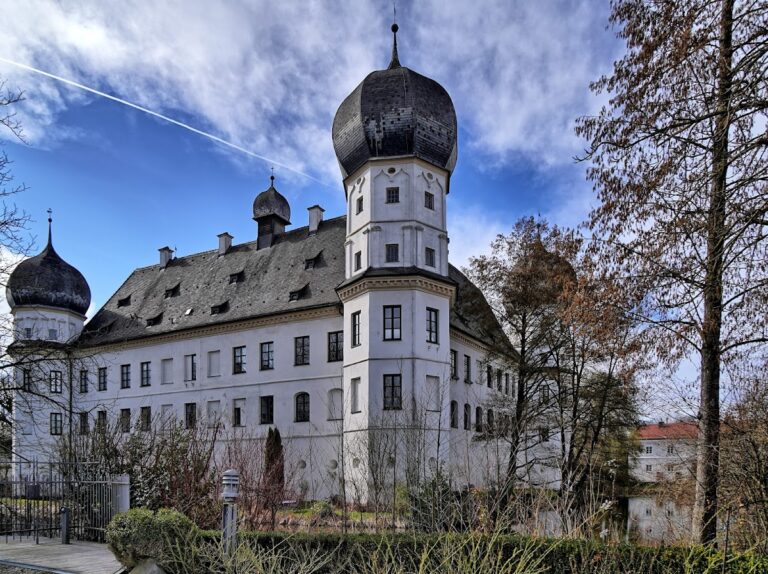
Schloss Guttenburg forms an irregular pentagonal complex, with palace wings enclosing a closed inner courtyard. A neck moat, which crosses the narrow land connection between a fortified site and the surrounding terrain, and a castle bridge protect the complex. The palace stands within a maintained park that includes a central flower rondel, while the wider complex is set within a golf course.
Palace and defensive elements
Gate tower
On the west side of the main building, a gate tower rises above the entrance. It has a Baroque hood roof and an articulated form that shifts from a round lower section to an octagonal upper structure. Numerous small loopholes, narrow openings through which weapons could be used, are set in the octagonal section.
Park and associated buildings
Baroque garden
The park preserves a flower rondel at its centre and a pavilion crowned by a small Baroque onion dome. An engraving made in 1721 by Michael Wening, an early eighteenth-century Bavarian engraver and topographical illustrator, depicts an extensive Guttenburg complex in which the park appears to have been enclosed by pavilions, farm buildings, and a wall.
Service courtyard and aircraft
The service courtyard has stepped gables added in the late nineteenth century in the historicist Neo-Gothic style. The park also displays two Soviet aircraft, an Antonov An-2 and a MiG-21 fighter aircraft formerly belonging to the National People’s Army of East Germany.
Nearby sites