St. Andreas: A Gothic Parish Church in Trostberg, Germany
Site at a Glance
- Rating
- 4.6
- Popularity
- Very Low
- Country
- Germany
- Primary era
- Medieval
- External website
- Open
- Eras represented
- Medieval, Early Modern, Modern
- Civilizations
- Duchy of Bavaria, Electorate of Bavaria, German, Holy Roman Empire
- Site type
- Religious
- Remains
- Church
On this page17 sections
History
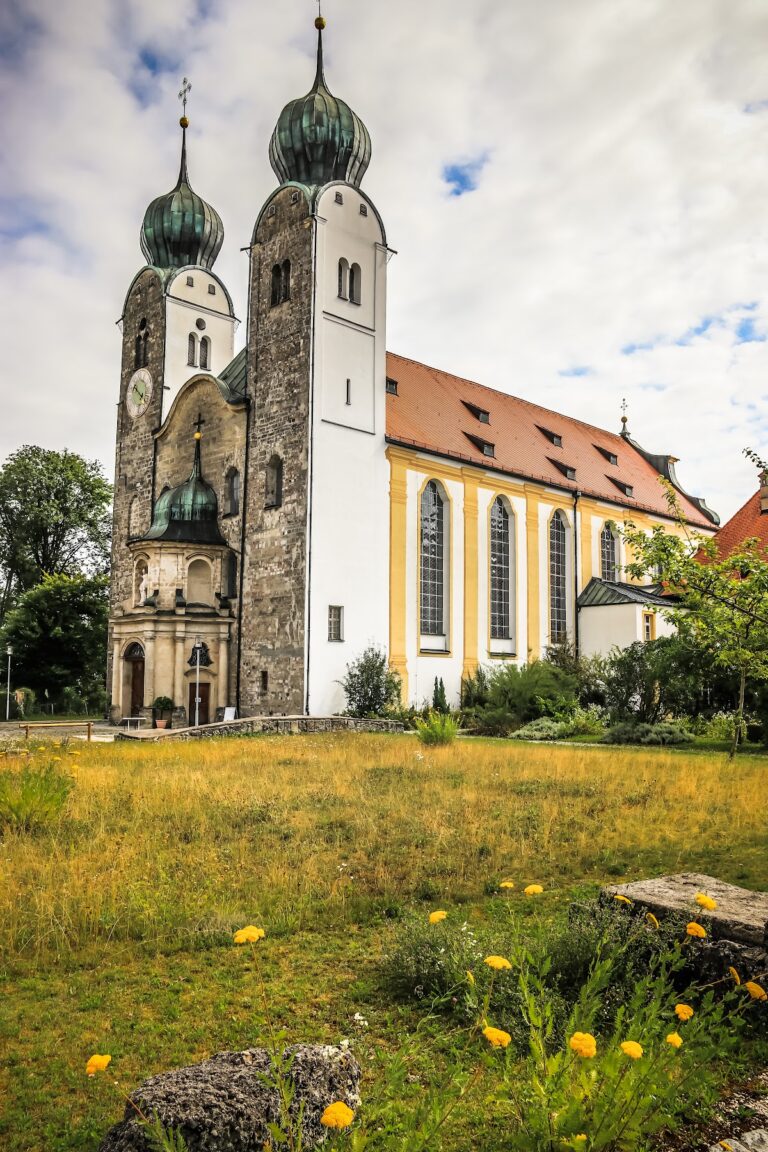
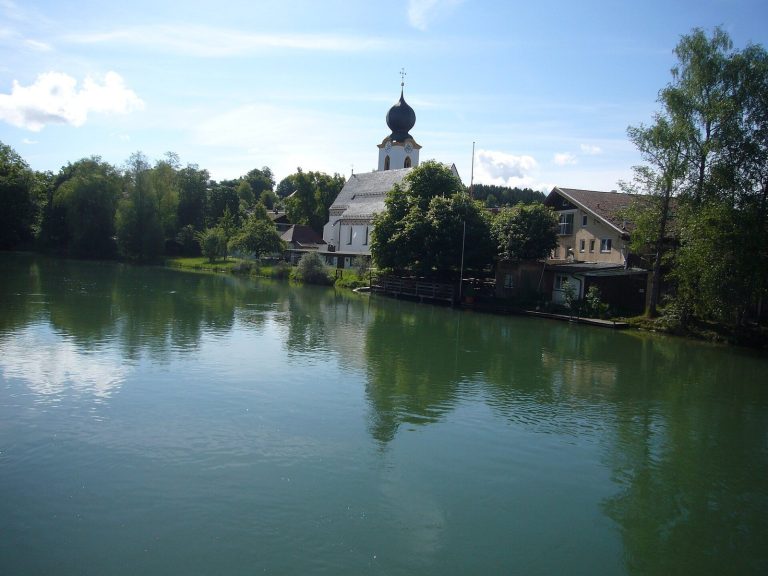
St. Andreas is a Roman Catholic parish church in Trostberg, Germany, built in the Gothic period and occupying a terrace above the Alz in the city center. It belongs to the Trostberg parish association in the Baumburg deanery of the Archdiocese of Munich and Freising. The present church developed through several medieval building phases, beginning with a predecessor consecrated in 1347.
Medieval construction
A new church was consecrated around 1420. Its surviving medieval fabric includes the choir, apart from its later renewed vault-rib network, and the Frauenkapelle. The sacristy was added in 1485. Construction of the nave and its gallery followed between 1498 and 1504, a phase dated by an inscription on the exterior of the building.
The church was associated with Hans III Hertzhaimer, a local nobleman identified as the donor of the late-Gothic building. Several memorials within the church preserve the memory of him and other individuals connected with Trostberg and its surrounding noble families.
Nineteenth-century remodelling
Between 1866 and 1869, the nave was extended by one bay and provided with a two-storey vestibule. This work occupied the site of the former Souls’ Chapel of St. Ursula, and the gallery was moved. The interior and exterior were then remodelled in the Gothic Revival style, a nineteenth-century movement that revived medieval Gothic forms.
The Gothic Revival work also affected the Frauenkapelle. Its decoration was restored in 1991, including the reinstatement of the stencil painting applied in 1869. The chapel’s net-rib vault had been installed earlier, in 1689.
Modern restoration and parish use
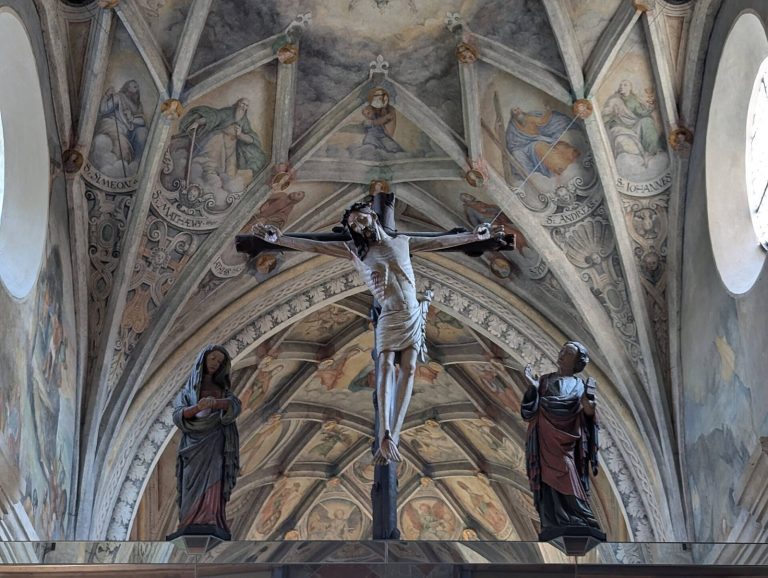
Exterior renovations took place in 1973 and 1974, followed by interior renovations in 1976 and 1977. The interior was restored to the version associated with 1504, while later furnishings and works remained part of the church’s historical fabric. The present choir altar group was assembled in 1956. Its central crucifix had originally stood on the chancel arch, and the accompanying figures of Mary and John are reportedly from Ettal Abbey.
The four bells were cast in 1949 by the Johann Hahn bell foundry in Landshut. In 1959, St. Gregoriuswerk built the present organ, replacing an earlier fully pneumatic instrument made by the Maerz company of Munich. The church’s memorials, furnishings, and successive alterations reflect its continuing role as an urban parish church from the late Middle Ages into the modern period.
Remains
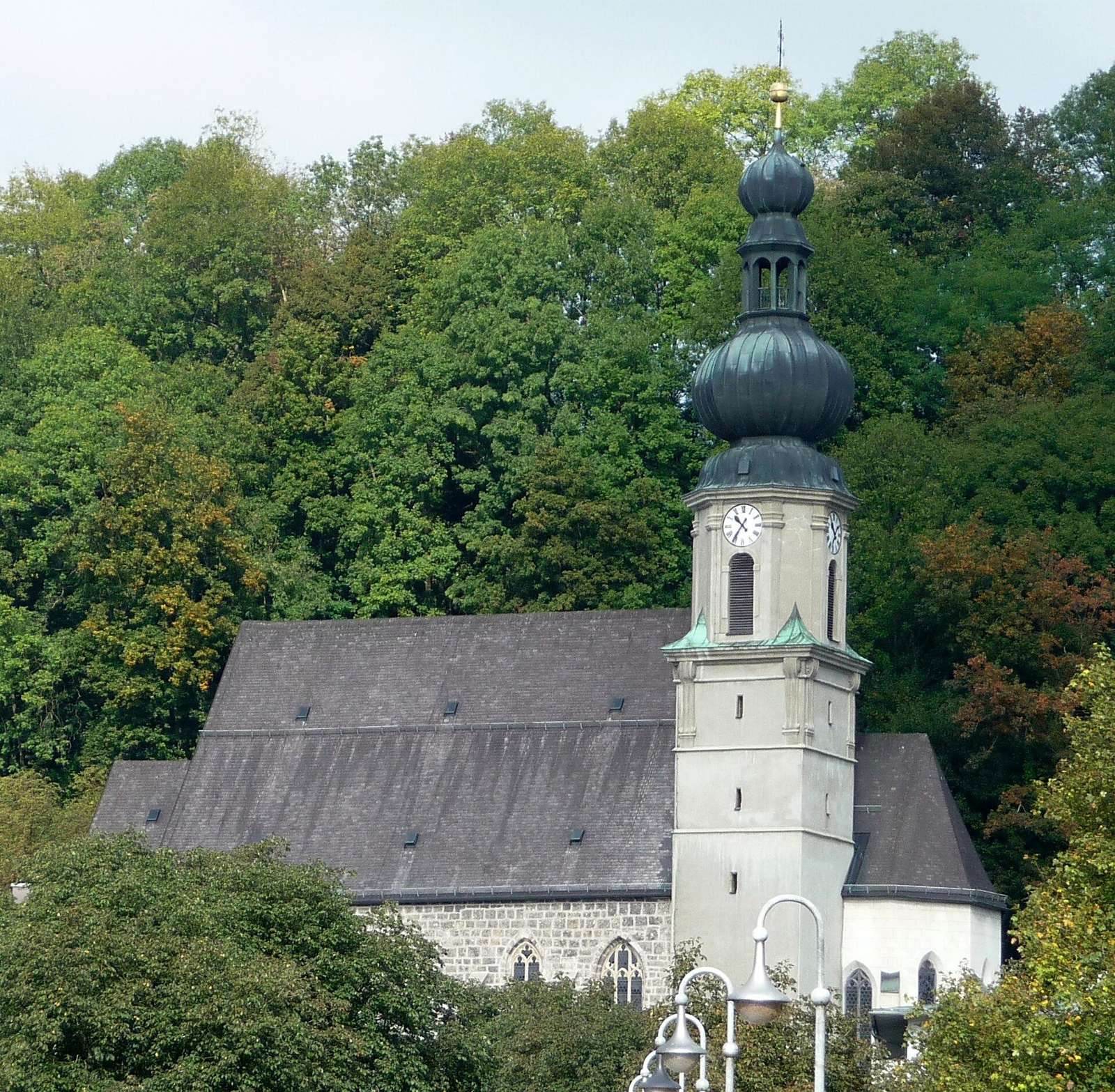
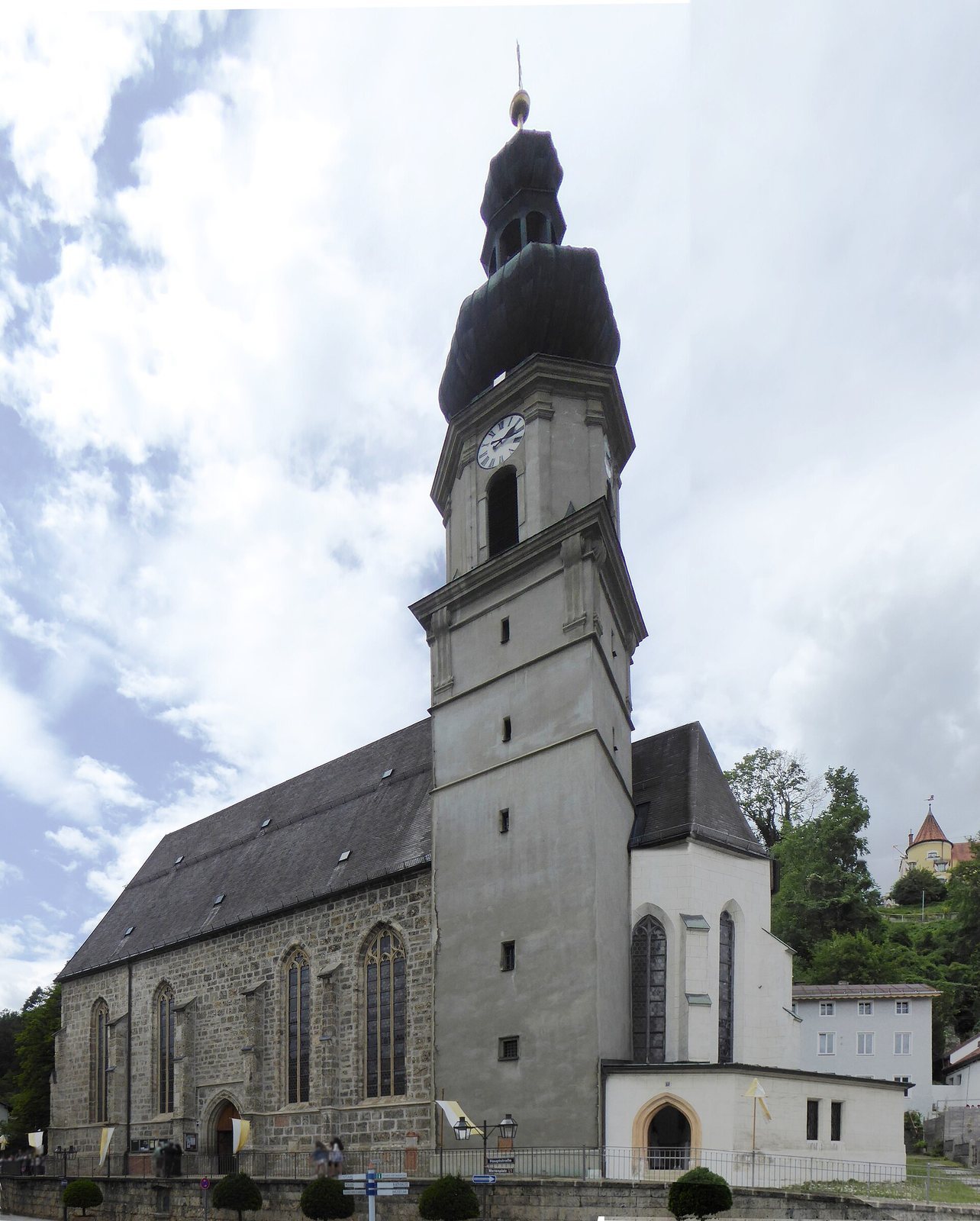
St. Andreas is a three-aisled, five-bay Gothic hall church. In a hall church, the nave and side aisles are approximately equal in height, creating a unified interior space. The building has a plastered choir terminating in five sides, while its buttresses are made from Nagelfluh, a naturally cemented conglomerate of rounded stones set in a hardened matrix. The sacristy occupies the eastern end of the choir, and a tower rises on its south side.
Exterior and entrances
Tower and portals
The tower has a rectangular lower form and an octagonal upper section divided by horizontal string courses. A double dome with a lantern caps it. The west portal was moved to the south wall in 1867 and dates from around 1500. The western entrance also incorporates the portal of the demolished St. Ursula Chapel, made in 1517.
Exterior memorials
A tombstone for Gerhard Schirnegker, who died in 1493, is fixed to the south exterior wall. The stonemason Franz Sickinger made it. Two holy-water basins beside the entrances bear the dates 1500 and 1514.
Nave and vault
Interior structure
The broad nave is divided into bays by slender round pillars. The eastern pair is octagonal and hollow-moulded. These supports carry a complex asymmetrical brick net vault, whose ribs form an interconnected mesh of three-ray figures. At the outer walls, the vault rests on consoles, while fine plant ornament fills its painted spandrels.
Gallery and stained glass
A masonry gallery occupies the west end. Its parapet has tracery, and its keel arches are decorated with crockets and supported by red-marble columns. Near the gallery are carved figures on console busts dating from around 1504. They include Saint Eligius, made around 1530, Saint Anthony from the seventeenth century, and a Vesperbild from the second half of the eighteenth century. A Vesperbild is a devotional image of the dead Christ supported or mourned by the Virgin Mary.
The southeast nave window contains a three-part stained-glass composition from around 1500. Its central scene depicts the martyrdom of Saint Andrew, while saints and the family of Hans von Pienzenau, the administrator of Trostberg, appear at the sides.
Choir and chapels
Choir furnishings
The chancel altar group consists of a crucifix and carved figures of Mary and John, all dating from the mid-eighteenth century. The figures of Mary and John are reportedly from Ettal Abbey. On the north choir wall stands a stone figure of a bishop, probably Saint Erasmus, from the beginning of the fifteenth century.
Two stone retable altars, made in 1828 by Johann Poschner of Tegernsee, stand at the sides of the church. A retable is an architectural or sculptural backdrop behind an altar, and each of these altars is crowned by a gilded angel. The northern altar has a statue of Mary standing on a globe, made around 1760 and attributed to Johann Georg Kapfer of Trostberg. The southern altar has an oil painting of the Holy Trinity by Ludwig Glötzle, made in 1901.
Frauenkapelle
The Frauenkapelle stands in the northern angle of the choir and ends on three eastern sides. Its altar dates from the second half of the eighteenth century. A relief panel of the Nativity, made toward the end of the fifteenth century and probably taken from the former late-Gothic high altar, is preserved there. The chapel also retains the restored stencil decoration associated with the Gothic Revival work of 1869.
Memorials and sacristy
Funerary monuments
Numerous red-marble tombstones stand against the nave walls. On the north side, one memorial shows a knight in high relief wearing Maximilian armor and dates from Salzburg around 1510. Another depicts a kneeling knight before a bust of the Virgin Mary and was probably made by Hans Valkenauer in Salzburg after 1512. Both memorials had previously been associated with the chapel of Heretsham Castle.
The south side contains a three-part epitaph with a coat of arms, inscription, and kneeling knight, probably made by Franz Sickinger of Burghausen in 1497. A heraldic tombstone of the noble family von Eschelbeck dates from around 1410. Other memorials include the Solnhofen-stone tombstone of Wolfgang Zunhamer, who died in 1626, a full-figure relief of Vicar Georg Ranzhofer, who died in 1530, and a memorial to Jörg Ernst, who died in 1541, and his wife Anna, who died in 1532. The latter shows the couple praying before a Vesperbild.
Sacristy and organ
The sacristy contains a carved statue of Mary on a crescent moon from around 1500 and carved figures of Saints Catherine and Barbara from the second half of the fifteenth century. The two saints’ figures once stood temporarily in the castle chapel and were reworked in the nineteenth century.
The organ built by St. Gregoriuswerk in 1959 has 26 stops distributed across two manuals and a pedal. The tower houses four bells tuned to h0, dis1, fis1, and gis1, including one designated “Salve Regina.”