Schloss Frauenbühl: A Bavarian Château and Former Hofmark Seat in Winhöring


Site at a Glance
- Rating
- 4.3
- Popularity
- Very Low
- Country
- Germany
- Primary era
- Early Modern
- Eras represented
- Early Modern
- Civilizations
- Duchy of Bavaria, Holy Roman Empire
- Site type
- Domestic
- Remains
- Castle
On this page12 sections
History
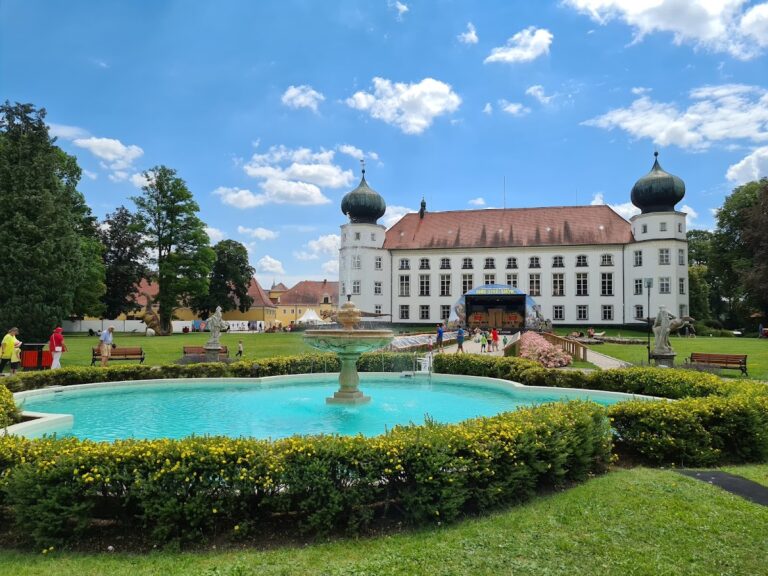
Schloss Frauenbühl, also called Schloss Winhöring, is a château in Winhöring, Germany, whose present complex was rebuilt in 1621–1622 and given its Baroque appearance between 1721 and 1730. It formed part of the Hofmark Winhöring, a manorial estate whose lord exercised local administrative and judicial authority over its inhabitants. The settlement belongs to one of the oldest layers associated with the Bavarians and was first mentioned on 13 February 816, when Rihpert donated several properties to the bishopric of Freising.
Early ecclesiastical lordship
In May 842, Pope Leo IV confirmed Salzburg Archbishop Thietmar’s feudal possession of the papal estate of Winheringen in return for an annual payment. In November of the same year, Pope Benedict VIII exchanged Winhöring, Antiesen, and Wolinbach with Emperor Henry II. Henry then donated the properties for the salvation of his soul to the cathedral chapter of the newly founded Bamberg diocese.
Winhöring remained the property of the Bamberg cathedral chapter until 1554. The chapter did not administer the estate directly. Instead, it leased Winhöring for an annual rent of 180 Rhenish guilders to distinguished knights who acted as local officials. Seifried von Törring is the first known holder of this office, serving for three years from 1357.
Pledges, officials, and the Frauenbühl estate
Winhöring was pledged to Ulrich the Rabensteiner in 1362 and later returned to Seifried von Törring, who held it until 1384. Afterward, Seifried’s widow Agnes, born Grans von Uttendorf, held the possession for a time. In 1395, hereditary claims resulted in Johann von Abensberg receiving the pledged estate. Following his death in 1397, the Bamberg cathedral provosts Johann von Haydeck and Martin von Lichtenstein administered Winhöring.
Conflicts with the inhabitants led to the appointment of Wilhelm von Fraunhofen as local official. He acquired two properties on the Frauenbüchl and established Schloss Frauenbühl there. His actions also challenged Bamberg’s manorial rights. He purchased hereditary rights from his subjects and granted official estates to the Trenbeck family of Burchfried, who claimed them as free property. On 2 December 1429, a ducal court in Landshut ordered the Bamberg cathedral chapter to buy back these properties.
In 1468, the Hofmark Winhöring contained 273 farms that paid rent, producing an income of 238 pounds and 61 pfennigs for the Bamberg cathedral chapter. The Frauenbühl estate itself first belonged to Georg Friesenheimer, a customs official in Ötting who died in 1467. His son Heinrich, the hereditary judge at Winhöring, then held it. In 1506 it passed by purchase or inheritance to Wolfgang Kluegheimer, and marriage transferred it to the Pelkhovers in 1510.
Hans Rueland bought Frauenbühl from Caspar Pelkhover on 2 July 1532. After Rueland’s death, the estate was divided among his ten children and soon sold at auction. Freiherr Johann Veit von Törring acquired Frauenbühl on 17 December 1548, beginning the property’s lasting association with the Toerring family.
Transfer to the Toerring family
On 4 November 1554, the Bavarian chamber councillor Georg von Gumppenberg of Pöttmes and Eurenbach and his wife Maria, born von Seibersdorf, acquired the Winhöring office and other holdings. The Bamberg cathedral chapter initially retained a right to redeem the property. That right was bought out for money in 1560, although the holdings continued to be regarded as Bamberg fiefs. A feudal fief was a holding granted by a superior lord in return for obligations, while investiture was the formal act of granting or renewing it.
Georg von Gumppenberg faced disputes with rebellious subjects and with his feudal lord. He therefore sold Winhöring in 1567 to his friend Johann Veit von Törring of Tüßling and Jettenbach. The château remained with the Toerring family thereafter. Following Johann Veit’s death in 1582, guardians administered Winhöring for his sons, who were jointly invested with the property in 1583.
An inheritance division on 21 March 1621 assigned the Hofmark Winhöring and the seats of Frauenbühl and Tüßling to Hans Veit II. Other possessions, including Jettenbach and Mögling, went to Hans Sigmund. Hans Veit II commissioned a new Schloss Frauenbühl from Michael Oettel, the town mason of Neuötting, and the rebuilding took place in 1621–1622.
Baroque remodelling and the end of the Hofmark
Through the marriage of Hans Veit II’s daughter Maria, who had no son, the properties passed to Margrave Nestor Pallavicini. A margrave was a noble ruler or lord historically associated with governing a border territory. Pallavicini accumulated heavy debts and sold Winhöring to Bartholomäus Richel, an electoral privy councillor and administrator of Rosenheim.
On 22 February 1644, Richel obtained the abolition of Winhöring’s feudal relationship with the Bamberg cathedral chapter. A grant from Elector Maximilian also brought the seats of Burgfried and Frauenbühl into his possession. After three generations, the property had again become heavily indebted. Maximilian Josef Freiherr von Richel sold Winhöring on 8 May 1717 to the widowed Countess Maria Ursula von Törring.
Field Marshal Count Ignaz von Toerring remodelled the château between 1721 and 1730. This work established the complex’s present appearance and followed the Baroque style, an early-modern European approach marked by formal planning, monumental massing, elaborate decoration, and carefully designed gardens. The history of the Hofmark Winhöring ended in 1848, when patrimonial jurisdiction, the later form of private estate jurisdiction, was abolished and all judicial authority passed to the state. Schloss Frauenbühl is privately owned and has undergone recent renovation.
Remains
Castle and chapel
Four-wing château
The present Schloss Frauenbühl is a three-storey, square complex of four wings arranged around an inner courtyard. Arcaded galleries run around the courtyard, giving the buildings a connected internal arrangement. The complex reflects two major building phases. Hans Veit II von Toerring commissioned the new construction carried out by Michael Oettel in 1621–1622, while Count Ignaz von Toerring reshaped it between 1721 and 1730.
During the Baroque remodelling, Ignaz von Toerring constructed the two-storey east wing and raised the other three wings. The surviving château therefore combines the early seventeenth-century rebuilding with the later alteration that determined its current form. The main building is protected as an architectural monument in Bavaria under file number D-1-71-137-7.
Chapel of Saint Bartholomew
The castle chapel dedicated to Saint Bartholomew occupies the second upper storey of the château. It dates from around 1500, making it an earlier element within the later seventeenth- and eighteenth-century complex. A cemetery beside the chapel contains the family necropolis of the Toerring-Jettenbach family.
Park and archaeological remains
Garden complex and Chapel of the Three Kings
The estate includes a garden complex with three pavilions. A chapel dedicated to the Three Kings stands in the castle park. Built in 1532, it formerly belonged to the Frauenpuechel manor before becoming part of the Frauenbühl estate.
Subsurface remains
Archaeological remains beneath the estate relate to Schloss Frauenbühl, its predecessor buildings, the associated service courtyard, the Baroque gardens, and the Chapel of the Three Kings. These late-medieval and early-modern remains are protected as an archaeological monument under file number D-1-7741-0227.