Schloss Altmannsdorf: A Historic Estate in Vienna


Site at a Glance
- Rating
- 3.3
- Popularity
- Very Low
- Country
- Austria
- Primary era
- Early Modern
- Eras represented
- Medieval, Early Modern, Modern
- Civilizations
- Habsburg, Holy Roman Empire
- Site type
- Domestic
- Remains
- Manor House
On this page12 sections
History
Schloss Altmannsdorf is a historic estate in Vienna, Austria, whose origins lie in the medieval Oswaldhof estate at the center of Altmannsdorf. The complex developed through Renaissance and later rebuilding, with its present character shaped especially by its conversion into a Biedermeier country house in the early nineteenth century.
The Oswaldhof and Augustinian lordship
In the fifteenth century, the estate below the Wienerberg comprised two fiefs, 14 farmsteads, and associated fields. It formed a local unit with St. Oswald Chapel, the Oswaldhof, and a herdsman’s house. In 1444, the Viennese citizen and councillor Erhart Griesser bequeathed the property to the Calced Augustinians on the Landstraße. This branch of the Catholic order followed the rule associated with Saint Augustine and was distinguished by its members wearing shoes.
The Augustinians established their administrative seat, the Augustinerhof, at the estate. They exercised manorial lordship over Altmannsdorf, meaning that they held legal and administrative authority over the estate and its dependent settlement, although they did not cultivate the land themselves.
Ottoman sieges and rebuilding
Fighting during the first Ottoman siege of Vienna in 1529 destroyed the building. A provisional reconstruction followed in 1539. In 1570, the property was granted as a life tenure to a chamberlain of Lower Austria. After passing through several further holders, it returned to the Augustinians in 1652.
The farm estate was destroyed again during the second Ottoman siege of Vienna in 1683. It was subsequently rebuilt with alterations, and the surviving complex retains a core associated with the rebuilding around 1700.
From state property to Schloss Altmannsdorf
Napoleonic troops established a field hospital in the Augustinerhof in 1809. After the Augustinian Order was dissolved in 1812, the estate and its buildings passed to the Imperial-Royal Lower Austrian State Estates Directorate of the Lower Austrian Religious Fund.
Johann Baptist Hoffmann purchased the lordship in 1818 or 1819 for 52,300 florins. He converted the court into a Biedermeier country house, which then became known as Schloss Altmannsdorf. Biedermeier was an early nineteenth-century Central European cultural period associated with orderly domestic architecture and interiors. After Hoffmann’s death, the property belonged from 1856 to his daughter Anna and her husband, Johann von Hoffinger. Saxon troops were quartered at the estate in 1866.
The Frankl family and twentieth-century changes
In 1899, Julius Frankl bought the building for 400,000 florins. His son Robert commissioned numerous alterations. The art historian Dagobert Frey lived there as a tenant, and the family of brewery owner Moriz von Kuffner stayed at the estate during the summer.
Julius Frankl transferred the property to his wife Maria in 1926. In 1953, she sold part of the grounds to a housing association, which built a residential complex there. The Schloss and its park received monument protection in 1967.
The Renner Institute period
In 1973, the Renner Institute acquired the estate for 8.55 million schillings. The institute was the political academy and educational institution of the Austrian Socialist Party. Working with the Federal Monuments Office, Austria’s national authority for protecting and preserving cultural monuments, and municipal authorities, it renovated the historic Schloss by 1978.
After the Gartenhotel Altmannsdorf was built on the grounds and connected to the Schloss in 1980, the estate became a setting for seminars, lectures, and discussion events involving international politicians and other politically active figures. The Renner Institute also presented its Bruno Kreisky Prize for the Political Book there and maintained a specialist social-science library.
In June 2017, the SPÖ’s Federal Party Presidium and Federal Party Executive Committee decided to sell the Gartenhotel Altmannsdorf. An Austrian group bought the hotel in early January 2018, after which it ended its operation.
Remains
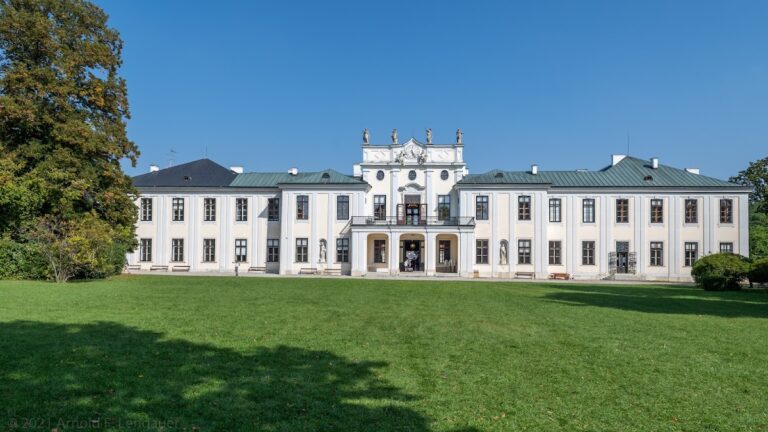
The surviving complex grew from a Renaissance structure that was repeatedly altered by additions and new construction. Its core dates from around 1700 and consists of a two-storey building originally arranged around four wings. The present composition is defined by a projecting east wing, while the historic park and associated structures extend the site beyond the main building.
Main building
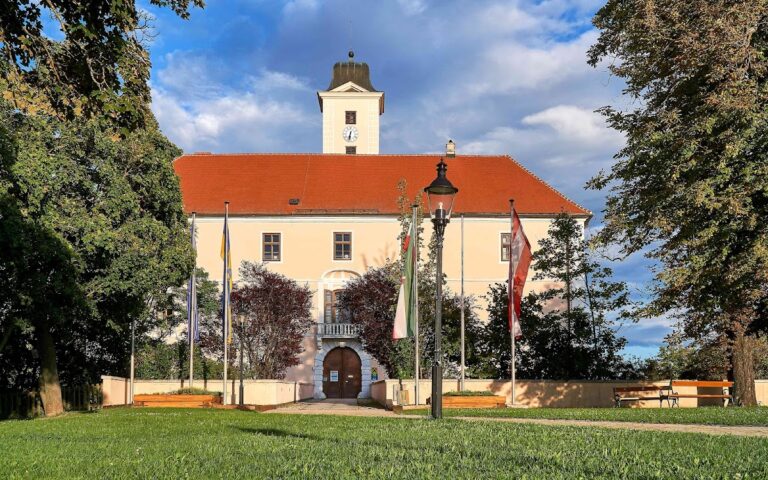
The facade facing Khleslplatz is relatively simple in appearance. Its principal feature is a broad basket-arched gateway with rustication, a masonry treatment that emphasizes individual blocks through recessed joints or roughened surfaces, and a stone surround.
East wing
The east wing was remodelled throughout in the Biedermeier style around 1820. Its facade is marked by a gabled cross-attic storey and an external staircase. The side axes also carry gables and are framed by flat giant pilasters, vertical projections extending through more than one storey.
Two ground-floor rooms in the east wing face the garden. They contain groin vaults, ceilings formed by the intersection of two barrel vaults, and probably early-eighteenth-century barrel vaults with lunettes, curved vault sections or openings intersecting a larger vault.
West wing
A wing extending west toward Oswaldgasse was built during the nineteenth century. Its decoration includes a niche figure of Saint Anne with the Virgin Mary as a child, dating from the middle of that century.
Courtyard and interiors
On the courtyard side, a formerly open arcade has groin vaults. The interiors were largely remodelled for the Renner Institute, although stucco-frame ceilings dating from around 1820 survive in the stairwell and several halls.
Park and garden structures
The north side of the Schloss is connected to the Gartenhotel. In the park, a greenhouse from the first half of the nineteenth century was substantially altered during the most recent remodelling and now serves as a restaurant.
Cast-iron sculptures of Marsyas playing the flute and Bacchus with a faun stand in the park, together with two sandstone lions. Marsyas is a figure from Greek mythology associated with music and the flute, while Bacchus is the Roman god of wine and festivity. A pyramidal poplar and a copper beech are protected as natural monuments, a legal category for natural features recognized for ecological, scientific, or cultural value. Two fig trees stand along the south facade.