Schloss Hetzendorf: A Baroque Garden Palace in Vienna


Site at a Glance
- Rating
- 4.6
- Popularity
- Low
- Country
- Austria
- Primary era
- Early Modern
- External website
- Open
- Eras represented
- Early Modern
- Civilizations
- Habsburg, Holy Roman Empire
- Site type
- Domestic
- Remains
- Palace
On this page15 sections
History
From farm to hunting lodge
Schloss Hetzendorf is a Baroque palace in Austria, in Vienna’s 12th district of Meidling. It developed from a hunting lodge built for the Thun family in the late seventeenth century and became an imperial residence under the Habsburg monarchy.
In 1675, Princess Maria Piccolomini bought a farm at Hetzendorf from an Augustinian monastery. She sold it in 1690 to Franz Sigismund, Count of Thun and Hohenstein, who acquired three more farms and began building a single-storey hunting lodge in 1694. Known as the Thunhof, the lodge is considered a probable work of Johann Bernhard Fischer von Erlach.
The property passed in 1709 to Eleonore, Countess of Thun-Hohenstein, and her husband, Anton Florian, Prince of Liechtenstein. After 1712, Johann Lucas von Hildebrandt refitted the interior and created a French-style park. The more extensive rebuilding planned by the couple was not completed. Before 1719, the estate was extended toward Hetzendorfer Straße. Around the same period, Anton Ospel and Antonio Beduzzi transformed the lodge into a Baroque garden palace, altered its orientation, and created an Ehrenhof, or court of honour.
An imperial residence
In 1742, the Imperial and Royal Court Chamber acquired the palace for Maria Theresa, the Habsburg ruler whose reign lasted from 1740 to 1780. Her widowed mother, Elisabeth Christine, Dowager Empress and widow of Emperor Charles VI, was advised by university physicians that a rural setting would benefit her. In 1743, Maria Theresa commissioned her court architect Nikolaus Pacassi to enlarge the palace and adapt it as Elisabeth Christine’s residence. After the dowager empress died in 1750, Hetzendorf remained vacant for an extended period.
Hetzendorf later became associated with an important medical experiment. When Maria Theresa introduced smallpox inoculation in 1762, early trials took place at the palace on aristocratic children. The children and their families then stayed there for four weeks at court expense, under medical supervision.
Emperor Joseph II, Maria Theresa’s son and a ruler associated with administrative and religious reforms, stayed intermittently at Hetzendorf in 1789 and 1790. Water damage had temporarily made other residences unusable, while the local air was considered beneficial to his health. Joseph commissioned front and side buildings for his court, increasing the palace to 150 rooms. His intention to spend more time there ended with his death in 1790.
War, ceremony, and imperial residence
French occupation troops were quartered at the palace in 1805 and 1809. Under Emperor Franz I of Austria, the park hosted elaborate summer festivities. After Franz died in 1835, Hetzendorf served chiefly as an imperial guest house.
The construction of the Southern Railway in 1839 to 1841 changed the surroundings. The railway was built on a high embankment about 400 metres east of the palace. During the October 1848 revolution, a political uprising that challenged Habsburg rule in Vienna, Hetzendorf served as the headquarters of Field Marshal Alfred, Prince of Windischgraetz, during the imperial recapture of the city.
The palace continued to receive prominent guests. They included the Hungarian prime minister Gyula Andrássy, the German Crown Prince Friedrich Wilhelm and Crown Princess Victoria in 1873, and Nasir al-Din Shah of Persia during his visit to the Vienna World Exhibition that year. Hetzendorf was also the site of a family tragedy: Archduchess Mathilde, the 18-year-old youngest daughter of Archduke Albrecht of Austria-Teschen, died there on 6 June 1867 after a serious fire accident.
A tram route through Hetzendorfer Straße began operating in 1907. With the approval of Emperor Franz Joseph I, Archduke Karl lived at Hetzendorf with his family from 1912 to 1914. Karl succeeded Franz Joseph as Emperor Charles I, Austria’s last monarch, in 1916. Karl’s wife, Zita of Bourbon-Parma, used a writing room at the palace, and their daughter, Archduchess Adelaide of Austria, was born there in 1914.
State property and later use
During the Austro-Hungarian monarchy, Hetzendorf was administered by the Imperial and Royal Palace Administration of Schönbrunn and Hetzendorf and by the corresponding court garden administration. It formed part of the Hofärar, the state property used and administered by the Habsburg imperial household. The state of German Austria assumed practical supervision in November 1918. The Republic formally took over the Hofärar in 1919 under the Habsburg Law, and the two administrations became federal offices in 1920.
The palace acquired new cultural associations during the interwar period. The Austrian sculptor Anton Hanak lived there from 1923 until his death in 1934, and the Polish-Jewish violin virtuoso Bronisław Huberman was another tenant. In May 2022, Vienna Mayor Michael Ludwig unveiled a memorial plaque to Huberman in the court of honour.
At the end of the Second World War, a bomb damaged the left wing of the court of honour. Much of the valuable Baroque interior survived because it had been removed in time to salt mines. In 1946, the City of Vienna leased the palace from the federal government for the Vienna School of Fashion and bought it in 1987. The palace continues to house the school, while most of its facilities occupy former ancillary and utility buildings.
The palace church
The palace church is a rectorate church of the Archdiocese of Vienna dedicated to the Holy Trinity. A rectorate church is administered by a rector rather than functioning as an ordinary parish church. Sigismund von Kollonitz, Archbishop of Vienna, solemnly consecrated it on 27 June 1745. During the Josephinian parish reform, the church functioned as a local curia from 1784 to 1807. It served as the parish church of Hetzendorf from 1832 to 1910 and has also been designated the Blessed Emperor Charles Memorial Church since 13 May 2008.
The rooms containing the church were renovated between 1994 and 1999, with further work in 2000. These interventions form part of the modern care of the palace’s surviving Baroque interior.
Remains
Layout and exterior setting
Schloss Hetzendorf occupies the southwest of Vienna and is connected to Schönbrunn by Schönbrunner Allee, which continues Schönbrunn Palace’s main axis. The original Thunhof was a south-facing, single-storey hunting lodge without a court of honour. Its later conversion changed the orientation of the building and produced the present Baroque garden-palace arrangement.
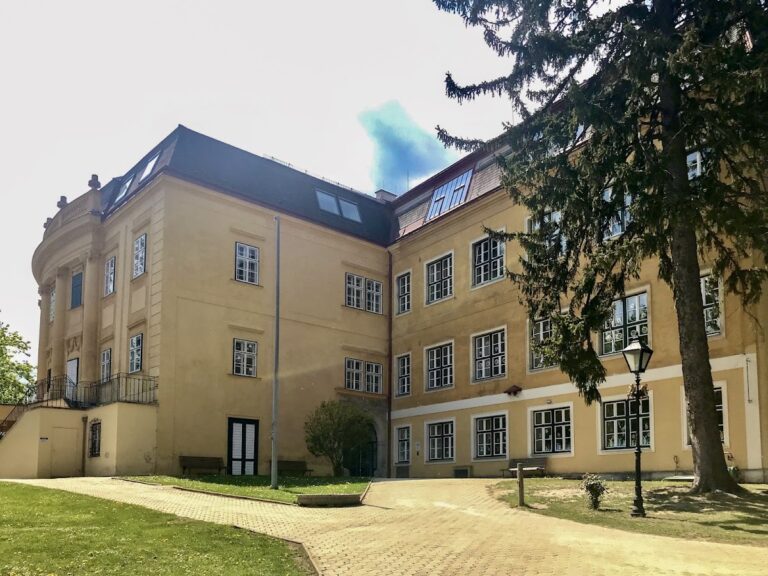
Ancillary buildings stand in front of the palace and extend toward Hetzendorfer Straße, enclosing the Ehrenhof. The principal building lies beyond this court, with the palace park behind it. The palace contains 150 rooms, including the front and side buildings constructed for Joseph II’s court. The park is used by the Vienna School of Fashion for an annual fashion show.
Principal state rooms
Central festival hall
The central festival hall is among the principal state rooms. Its decoration combines frescoes based on designs by Antonio Beduzzi, figural work by Carlo Carlone, and illusionistic architectural painting by Francesco Messenta. Above the fireplaces are allegories of the four elements by Daniel Gran.
Mirror Gallery
On the garden side, the Mirror Gallery contains portraits attributed to Martin van Meytens or his school. The portraits represent Maria Theresa, her husband Emperor Franz Stephan of Lorraine, and her sister Archduchess Maria Anna. Portraits of Maria Theresa’s children were lost when the interiors were evacuated during the war.
Japanese Room
The Japanese Room was created between 1743 and 1745. Nikolaus Pacassi designed it with models supplied by François de Cuvilliés the Elder. Its decoration follows chinoiserie, a European style inspired by imagined or adapted East Asian forms.
Zita’s writing room
The writing room used by Zita of Bourbon-Parma between 1912 and 1914 has survived. It preserves a physical link with the period when Archduke Karl and his family lived at Hetzendorf before his accession to the imperial throne.
Palace church
The palace church is contained within the building and is not recognizable as a church from the exterior. Its nave ceiling carries frescoes by Daniel Gran, while the high-altarpiece painting was made by Johann Karl Auerbach. A signature near the vault above the high altar reads “Fr. Jo. Wiedon P. Architect 1744.” It once led to the mistaken attribution of the frescoes to Franz Josef Wiedon, but the signature refers to architectural painting by Wiedon.
The church’s position within the palace, its frescoed interior, high altar, and later restoration preserve the religious component of the Baroque residence as part of the wider building.
Court of honour memorial
The Ehrenhof contains a memorial plaque to Bronisław Huberman, unveiled in 2022. It records the presence of the violin virtuoso and cultural figure among the palace’s interwar residents.