Schloss Vösendorf: A Medieval Moated Castle in Austria


Site at a Glance
- Rating
- 4.7
- Popularity
- Low
- Country
- Austria
- Primary era
- Medieval
- External website
- Open
- Eras represented
- Medieval, Early Modern, Modern
- Civilizations
- Duchy of Austria, Habsburg, Holy Roman Empire
- Site type
- Military
- Remains
- Castle
On this page8 sections
History
Schloss Vösendorf is a former moated castle in Austria, in the town of Vösendorf in Lower Austria. The building dates to the medieval period, although its original construction date is uncertain. Vösendorf is mentioned in 1175, and the castle is explicitly described as a castrum, meaning a fortified settlement or castle, in 1308. Its history reflects the political conflicts, changing ownership, wartime destruction, and later civic reuse of a fortified estate near Vienna.
Medieval ownership and ducal confiscation
Konrad Breitenfelder owned the castle in 1308. After his family joined a revolt against Albert I of Habsburg, a Habsburg duke and German king, the castle was confiscated. Albert sold it to Wurisch Abraham in 1313. In 1350, Hans den Laher transferred the castle to Wolfgang von Winden.
The Winden family held Vösendorf as a fief from Melk Abbey, meaning property held from a superior lord in return for service or allegiance. Their possession continued, with interruptions, until about 1510. One interruption followed the invasion of the area by Matthias Corvinus, the fifteenth-century king of Hungary, whose military expansion affected the family’s control of the castle.
Sixteenth-century changes and later aristocratic control
The castle had several lords during the sixteenth century. Under Kaspar Erlbeck, the manor underwent substantial structural alterations. Later, Wilhelm I von Hofkirchen joined a revolt against Emperor Ferdinand II, a Habsburg ruler whose reign was marked by major political and religious conflict. The property was confiscated as a consequence.
From 1727, the castle was controlled by Princess Maria Gabriele Colloredo. Emperor Franz acquired it in 1794 and ordered its renovation. This ruler was Franz II of the Holy Roman Empire and, from 1804, Franz I of Austria. A model farm was added and remained in operation until 1824. In 1850, the castle was leased to a member of the von Wittgenstein family.
War damage and municipal restoration
The castle was destroyed and rebuilt several times during wars, including the First and Second Ottoman sieges. After the First World War, it became part of a national Austrian institute for disabled people. In 1934, it was temporarily returned to descendants of the Habsburg-Lorraine family. The property was nationalized in 1938 and administered by the City of Vienna from 1940.
Vösendorf regained its independence from Greater Vienna in 1954, but Schloss Vösendorf remained owned by Vienna and was converted into an agricultural operation. After that operation moved to Laxenburg, some rooms were initially available for rent, while the castle and garden had previously been inaccessible to the public. The City of Vienna subsequently allowed the complex to deteriorate. Red Army troops occupied the castle after the Second World War, causing serious damage.
In 1991, during the mayoralty of Herfried Vincze, the municipality of Vösendorf acquired the nearly derelict castle. Under Mayor Meinhard Kronister, the municipality stabilized the structure, restored the roof structure and covering, consolidated the masonry, dried the walls, repaired the facades, and installed new wooden box windows. The comprehensive restoration was completed in 1999. Innovative architectural solutions adapted the interior, while the work also revealed seventeenth-century frescoes in a ground-floor hall.
Since 1999, Schloss Vösendorf has housed the municipal offices and served as a cultural center. Its uses include classical concerts, readings, and other events. The complex also contains the Vösendorf town museum, a bicycle museum, a Peter Jordan memorial room, a library, a café, a Raiffeisenbank branch, and event rooms. The memorial room commemorates Peter Jordan, a scholar and agricultural chemist who worked at Vösendorf for many years. The castle and surrounding park are protected as Austrian monuments under protection number 40422.
Remains
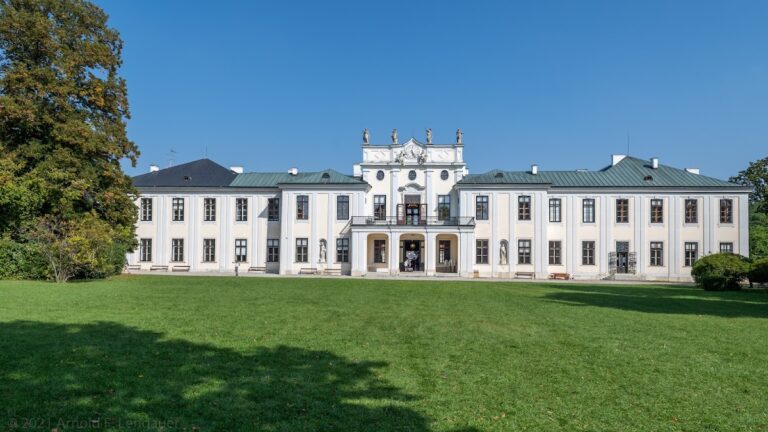
Schloss Vösendorf stands in the eastern part of Vösendorf within an extensive park of approximately 40,000 square meters. A moat, a water-filled defensive ditch surrounding the fortified site, encircles the complex. Four wings form an almost square inner courtyard. During the 1999 restoration, the courtyard was renovated and covered with a large glass dome, creating an enclosed space for events in bad weather.
Exterior structure and entrance
The exterior is plain and plastered, with narrow white bands at the cornice and rusticated treatment at the corners. A square-based clock tower rises seven storeys on the western side. The original principal entrance was the west portal. Because the portal threatened to collapse, it was walled up during the Soviet occupation.
Chapel and frescoed hall
The aristocratic chapel occupies the northeastern corner of the complex and has a groin vault, a ceiling formed by the intersection of two barrel vaults. In the northwestern corner, the principal ground-floor room has a cross vault. Its walls are completely covered by frescoes dating to about 1693. These wall paintings, executed on wet plaster, were rediscovered during the restoration.
Fortifications in the park
Parts of the former fortified curtain wall survive in the park. A partially round fortification tower also remains in the northwestern part of the grounds. Together with the moat and the four-winged plan, these features preserve elements of the castle’s earlier defensive organization alongside the restored and adapted buildings.
Nearby sites