Schloss Aigen: A Historic Castle Estate in Salzburg, Austria


Site at a Glance
- Rating
- 4.8
- Popularity
- Very Low
- Country
- Austria
- Primary era
- Medieval
- External website
- Open
- Eras represented
- Medieval, Early Modern, Modern
- Civilizations
- Holy Roman Empire
- Site type
- Domestic
- Remains
- Castle
On this page9 sections
History
Schloss Aigen is a historic castle estate in Salzburg, Austria, whose construction is dated to 1402 and whose present facade reflects the Biedermeier style, a restrained Central European style associated mainly with 1815 to 1848. The estate began as a manorial property of the Salzburg cathedral chapter, the body of canons administering Salzburg Cathedral and its ecclesiastical lands, and later became an aristocratic residence and landscaped estate south of the city.
From cathedral property to aristocratic residence
The estate was first recorded in 1402 as a free holding belonging to the cathedral chapter. A bath associated with Aigen was mentioned in the sixteenth century. Its mineral or supposedly healing water made the spa famous despite disputes about its effectiveness, and by the early seventeenth century it was regarded as comparable to the well-known spa at Gastein.
After several changes of ownership, Levin von Mortaigne acquired Aigen in 1614 and transformed the farmstead into a country residence for the nobility. Following the death of Johann Dietrich von Mortaigne, the estate passed to the Barons von Pranckh in 1647. They sold it in 1673 to Johann Josef, Count Kuenburg.
The woodland garden
In 1727, Schloss Aigen and its spa passed to Franz Josef Waldherr, secretary to the Kuenberg family. He established the first extensive naturalistic palace park in the wooded area on the Gaisberg. Waldherr’s successor, Basil von Amman, added monuments, grottoes, and other structures. One grotto became a meeting place for the Apollo lodge of the Illuminati, an Enlightenment-era secret society founded in Bavaria in 1776.
Salzburg cathedral canon Willibald Wolfegg enlarged the grotto and park in 1780 as an English-style garden, a naturalistic landscape using irregular plantings, winding paths, water features, grottoes, and picturesque viewpoints. Hieronymus, Count Lodron, and especially the later owner, cathedral canon Ernst, Prince Schwarzenberg, expanded the woodland garden and its healing bath. During the nineteenth century, the estate became known well beyond Salzburg, and King Ludwig I of Bavaria praised the garden in a poem.
Twentieth-century uses and renovation
Since 1921, the estate has belonged by inheritance to the Revertera family. Peter, Count Revertera, acquired it through his marriage to Ida of Schwarzenberg. In 1939, the castle was used by the Reich Labour Service, a state labor organization of Nazi Germany. From 1941, it served as a training facility for the German Red Cross. After the Second World War, the Hallein School Sisters, a Catholic teaching congregation based near Salzburg, occupied the estate until 1948.
The rooms were later rented out. In 1956, during the Hungarian Revolution, the United States Consulate in Salzburg rented the castle as apartments for State Department staff. The last tenant died in 2007, after which the castle remained vacant for more than ten years, while a subsidiary building continued to house members of the Revertera-Salandra family. Comprehensive renovation began in 2017 with support from Austria’s Federal Monuments Office, the national authority responsible for protecting and preserving cultural monuments. The castle again serves as a residence, although it was also unoccupied while major work was under way.
Schloss Aigen gives its name to the Salzburg district of Aigen. The surrounding estate includes Aigner Park, which extends toward the Gaisberg and remains a local recreational and excursion area.
Remains
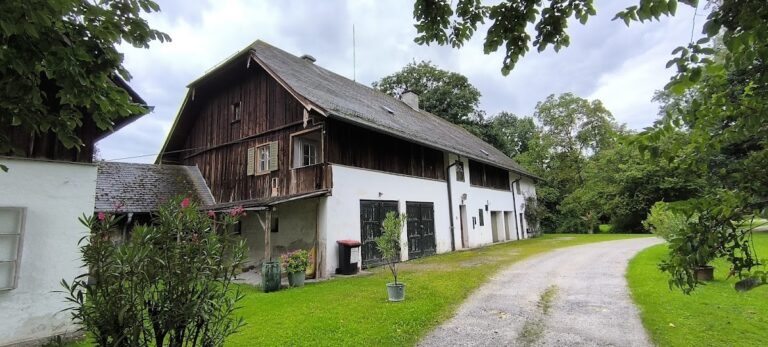
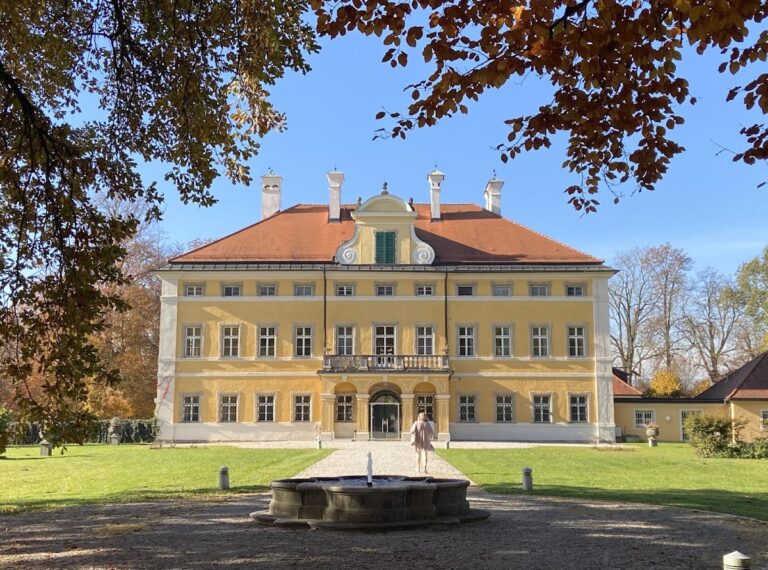
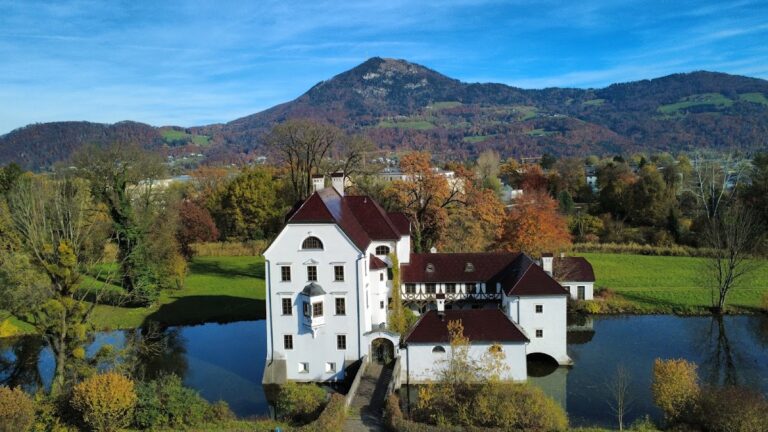
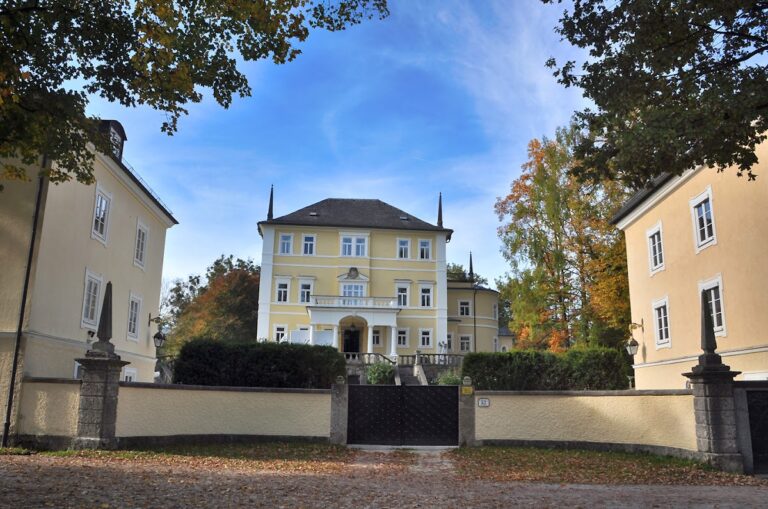
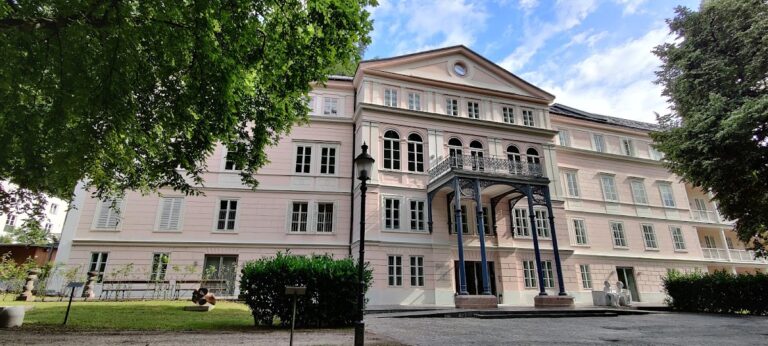
The surviving complex centers on a rectangular, four-storey castle with a Biedermeier facade, a high hipped roof, and a five-storey tower attached to the west front on the courtyard side. Three low former service and farm buildings form a trapezoidal enclosure around an inner courtyard. The complex also includes a church, while Aigner Park stretches behind the castle toward the Gaisberg.
Castle and courtyard buildings
Main castle
The main building is framed by pilasters and topped by its high hipped roof. A southward extension added in 1920 contains an oval hall with a seventeenth-century bust of Cardinal Ippolito Aldobrandini, who became Pope Clement VIII and served as pope from 1592 to 1605. The bust is carved from Carrara marble, a fine white stone quarried in northern Italy. Major renovation began in 2017, when the castle building was in a run-down condition.
Service buildings and entrance
Two masonry pillars flank the approach to the courtyard and carry Classical stone urns from the eighteenth century. The northern entrance is a round-arched gate displaying the marble coat of arms of the Counts Revertera and Princes Schwarzenberg, installed there in 1921. Four seventeenth-century marble slabs, originally gravestones from the estate’s old cemetery, are set into the northern service building. Each bears a skull with four bat wings. The northern former service buildings retain much of their fabric from the second half of the nineteenth century. Part of them houses the Gasthof Schloss Aigen restaurant, and repeated renovations have left those restaurant buildings in reasonably good condition.
Aigner Park
Behind the castle, Aigner Park occupies the wooded ground leading toward the Gaisberg. Its surviving landscape features include waterfalls, viewing pavilions, monuments, grottoes, and other park structures, preserving the estate’s developed woodland character and its sequence of naturalistic landscape features.
Nearby sites