Arenberg Castle, Salzburg: A Historic Castle and Conference Center


Site at a Glance
- Rating
- 4.9
- Popularity
- Low
- Country
- Austria
- Primary era
- Early Modern
- External website
- Open
- Eras represented
- Early Modern, Modern
- Civilizations
- Habsburg, Holy Roman Empire
- Site type
- Domestic
- Remains
- Castle
On this page8 sections
History
From cathedral property to educational institution
The property now known as Arenberg Castle, Salzburg, in Austria, is a castle whose origins reach back to an early seventeenth-century building and whose present form reflects a nineteenth-century reconstruction in the Biedermeier style. It was documented in the fourteenth century as belonging to Salzburg’s cathedral chapter. During the sixteenth century, the estate was associated first with the lords of Pirglstein and later, for a short time, with the lords of Rehlingen.
Originally called Bürglstein Castle, the property came into the possession of Archbishop Johann Ernst von Thun in the seventeenth century. In 1695, he transferred it to the Ursuline Sisters, a Catholic order especially devoted to educating girls and women. They intended to use the castle as a residence and school, but the location proved unsuitable. The nuns and their school moved to Gstättengasse, where construction began in 1699 and the complex was completed around 1720. Bürglstein Castle then became a teaching institution for students of the priest seminary, where future clergy received their education and training.
Park, fire, and the Arenberg name
In 1791, the gardener Joseph Rosenegger acquired the property and reshaped its grounds as an English-style park. Excavations undertaken for the park in 1792 uncovered a large Roman cemetery, a burial ground from the Roman period. The grounds incorporated the Bürglstein rock and became a celebrated destination for people in Salzburg and for visitors, including several heads of state.
A fire in 1814 prompted the rebuilding of the castle in the Biedermeier style, a Central European architectural culture associated with restrained classical forms and domestic comfort between about 1815 and 1848. The geologist Eberhard Fugger was born in the rebuilt castle on 3 January 1842. In 1861, Sophie, Princess of Arenberg, born Princess of Auersperg, acquired the former Bürglstein Castle and enlarged the property. From this period onward, it was known as Arenberg Castle.
Twentieth-century ownership and present use
Between 1912 and 1922, Arenberg Castle was the home of the writer and philosopher Hermann Bahr and his wife, Anna Bahr-Mildenburg, a prominent opera singer and one of the co-founders of the Salzburg Festival. Ownership passed in 1931 to the City and Province of Salzburg together with the Salzburg Savings Bank.
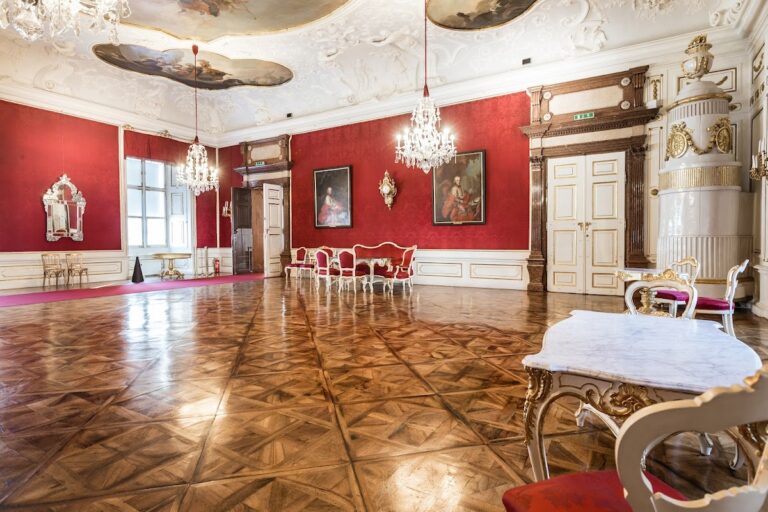
In January 2001, the Salzburg Foundation of the American Austrian Foundation purchased the castle to create an international conference center for physicians, scientists, and artists. Comprehensive renovation led to its opening as a conference center in 2005. A fire caused by welding work on 20 April 2009 destroyed the roof structure, but the roof was repaired and the castle resumed operations in April 2010. Arenberg Castle lies within Salzburg’s historic center, which is protected as a UNESCO World Heritage site.
Remains
Castle buildings and architectural form
Central castle complex
Arenberg Castle stands on the right bank of the Salzach along Arenbergstrasse, formerly known as the Outer Steingasse, in Salzburg’s Outer Stein district. The site lies between the southern foot of the Kapuzinerberg and the northern edge of the small Bürglstein hill, which originally gave the castle and its immediate surroundings their name. The present building is a nineteenth-century Biedermeier reconstruction of a castle dating from the early seventeenth century.
The complex consists of two three-story buildings joined by a central connecting wing added during Sophie of Arenberg’s enlargement of the property in 1861. Its late-Biedermeier design includes a strongly windowed, gabled central section that projects from the main wall and is arranged across six window axes.
Park and Bürglstein hill
A park extends south of the castle and is accessible from Bürglsteinstrasse. It now functions as a sculpture park, with contemporary works including Großer Phönix III, made by Bernhard Heiliger in 1966, and Ohne Titel, made by Gertrude Reum in 2006. Both works belong to the collection of the Würth Foundation.
A path from the park climbs the enclosed Bürglstein hill. Surviving features of Rosenegger’s landscaped grounds include the pedestals of an earlier pavilion and of two stone sculptures.
Nearby sites