Scheyern Abbey: A Benedictine Monastery and Wittelsbach Dynastic Foundation in Germany


Site at a Glance
- Rating
- 4.5
- Popularity
- Low
- Country
- Germany
- Primary era
- Medieval
- External website
- Open
- Eras represented
- Medieval, Early Modern, Modern
- Civilizations
- Duchy of Bavaria, German, Holy Roman Empire
- Site type
- Religious
- Remains
- Monastery
On this page15 sections
History
Scheyern Abbey is a Benedictine abbey in Scheyern, Germany, founded by monks associated with Hirsau in the late eleventh century and dedicated to the Assumption of the Virgin Mary and the Holy Cross. The community became a Wittelsbach family monastery and burial place, developed into a religious and educational centre, and remains part of the Bavarian Benedictine Congregation within the Archdiocese of Munich and Freising.
Foundation and movement to Scheyern
The community began around 1077 at Bayrischzell, where Countess Haziga supported a monastic cell established on cleared woodland. Monks from Hirsau Abbey settled there as part of the Hirsau reforms, a Benedictine movement that promoted stricter observance and changes in monastic administration. The foundation received papal confirmation in 1095.
The monks moved to Fischbachau in 1087 and then to Petersberg near Dachau in 1104. The relocations reflected practical difficulties involving space, water, agriculture and the acquisition of property needed to support the community. Haziga, her sons Bernhard, Ekkehard and Otto, and Count Berthold of Burgeck endowed Petersberg with substantial estates. The monastery had already been raised to abbey status in 1102 and placed under papal protection, which provided freedom to elect its abbot and exemption from a secular protector. From 1107, however, Otto of Scheyern acted as the abbey’s sole protector and exerted considerable influence over its affairs.
In 1119 the monks moved to Scheyern after Count Otto V of Scheyern transferred his residence to Wittelsbach Castle. He granted the former Scheyern Castle to the monks as his family’s monastery and burial place. The new location offered better conditions for estate management, including the operation of a brewery, while strengthening the Scheyern counts’ control over their house monastery. The foundation dynasty endowed the abbey with extensive property, and it served as the Wittelsbach burial place until 1253.
Medieval intellectual and dynastic centre
Wittelsbach influence declined after Duke Ludwig of Bavaria granted the abbey lower jurisdiction in 1315, ending the family’s authority as secular protectors. During the thirteenth century, Scheyern became known for manuscript production in its scriptorium, a monastic writing workshop, and for its school of illumination, which decorated manuscripts with painted initials, borders and imagery. The abbey trained members of the contemporary elite and developed as a spiritual, educational and cultural centre. In a later period it maintained a Byzantine Institute devoted especially to studying and critically examining the works of John of Damascus.
Early-modern change and dissolution
On 26 May 1532, Abbot Johannes Turbeit hosted negotiations between the French envoy Guillaume du Bellay and representatives of Bavaria, Hesse and Saxony. They discussed an alliance against Emperor Charles V, part of the political struggle surrounding the Habsburg ruler. Turbeit also encouraged new service buildings and renovation within the monastery.
The Thirty Years’ War brought severe devastation to Scheyern. The monastery later received extensive Rococo refitting during the eighteenth century, although it did not take part in the South German Baroque revival to the same extent as many other monasteries. Bavaria’s secularization dissolved the abbey on 21 March 1803 after the complex had been placed under territorial administration on 15 November 1802. The buildings were sold and changed hands several times. The church remained comparatively well maintained, while other parts of the complex deteriorated rapidly.
Restoration and modern community
King Ludwig I of Bavaria re-established Scheyern as a provostry on 20 September 1838, and Benedictine monks from Metten returned to the complex. The monastery regained abbey status on 18 March 1842. A boys’ school followed its restoration. Its six-year preparatory grammar school was closed by the Nazi regime in 1939, became a humanistic grammar school after the Second World War, and was transferred to the Schyren-Gymnasium in Pfaffenhofen in 1969. The former seminary later became a boarding facility for the State Vocational High School established at Scheyern in 1976.
During the Second World War, Scheyern sheltered monks from Kremsmünster and Sankt Ottilien. The abbey also protected the library and materials of the Thesaurus Linguae Latinae, along with collections from the Munich Glyptothek, the Bavarian State Graphic Collection, the Bavarian State Library and the Nymphenburg porcelain manufactory. Scheyern is now a protected architectural monument, while its medieval and early-modern archaeological remains, including those connected with the former castle and monastery, have archaeological-monument protection. The abbey church became a minor basilica, a church granted special honorary status by the Catholic Church, in 1980.
Brewing has taken place at Scheyern since no later than 1119. It initially supplied the monks and generated income, and Abbot Georg Spörl established a brewhouse within the complex between 1467 and 1489. After a period when the beer was made in Augsburg, brewing resumed in the old brewery building in 2006. The abbey brewery is described as the third-oldest monastic brewery in Germany. Other traditional activities included bookbinding, laundry, butchery, beekeeping, carpentry, distilling, dairy production and an inn. Several were closed during the 1990s and later modernized and re-established. Since 2016, the surrounding agricultural land has again been managed organically, with productive work supported by photovoltaic and biomass energy systems. The community comprised eleven Benedictine monks in 2021, and Markus Eller has been abbot since 2008.
Remains
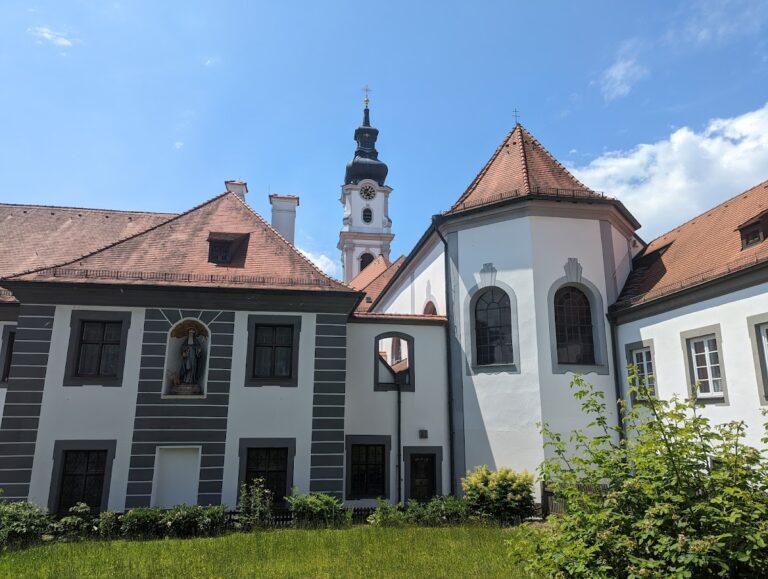
The monastery occupies the site of Scheyern Castle, built around 940. After the monks arrived, part of the castle was demolished so the new complex could be oriented eastward, while the chapter church and Wittelsbach burials remained close to the original castle chapel. The plan follows the Hirsau model and retains a quadrilateral cloister arrangement. A tradition associates the former castle chapel with the engagement of King Stephen I of Hungary and Gisela of Bavaria in 996.
Castle chapel and burial places
Choir chapel
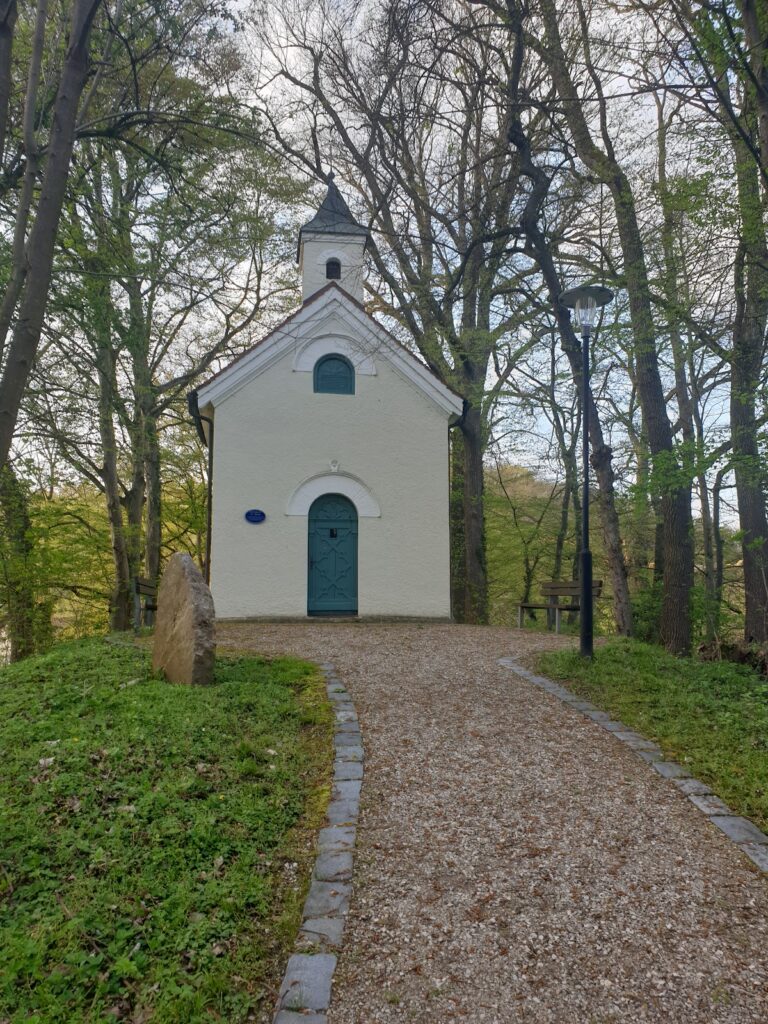
The former castle church of Saint John survives as the choir chapel and contains the oldest Wittelsbach burial place at Scheyern. Its burials include Otto I, Duke of Bavaria, his wife Agnes of Loon, their son Otto, Ludwig I of Bavaria, Otto II and Otto II’s wife Agnes. The arrangement was altered repeatedly and consolidated into a single high tomb in 1967 to 1969. The tomb is covered by a slab dating from the beginning of the seventeenth century.
Former Saint Martin’s Church
A church dedicated to Saint Martin was built in 1144 in the area now used as the cemetery. It was demolished during the secularization of 1803.
Abbey and parish church
Romanesque basilica
The abbey and parish church of the Holy Cross and the Assumption of the Virgin Mary is essentially a Late Romanesque building of the twelfth and thirteenth centuries. It was consecrated in 1215 and served as the Wittelsbach burial church until 1253. The building was altered substantially in the sixteenth and eighteenth centuries. Between 1548 and 1558, the chapter church of Saint John was renovated. During the following decade, the basilica was extended by about seven metres, and the Chapel of Saint Elizabeth was added.
Bell tower and sacristy
The bell tower was added between 1226 and 1259 and gained another storey during the Gothic period. Lightning damaged it in 1656, after which it received a lantern-like upper termination. The present Neo-Romanesque roof, based on the forms of Romanesque architecture, replaced that termination in 1843. A sacristy was created by demolishing one of the church’s three apses, or rounded sanctuary ends. It was rebuilt in 1697 with its earlier coffered ceiling retained.
Saint Elizabeth’s Chapel and Rococo remodeling
The Chapel of Saint Elizabeth retains its Gothic appearance and is described as one of the few Gothic buildings in Bavaria. From 1768 to 1770, the basilica underwent extensive Rococo remodeling, a light eighteenth-century style with curved ornament and elaborate decoration. The central nave was lengthened, the window shapes were changed and new furnishings were installed. Much of the Rococo work was removed during the Neo-Romanesque restoration of 1876 to 1878, although some elements returned in a further remodeling in 1924. The nineteenth-century work also regularized the lengths of the nave areas.
Holy Cross Chapel and relic
The Cross Chapel was begun in 1738 and houses the relic of the True Cross, a fragment traditionally believed to come from the cross on which Jesus was crucified. Since 1180, the relic has been kept in a reliquary at Scheyern. The Scheyern Cross takes the form of a Byzantine patriarchal cross with two crossbars, the upper one representing the inscription traditionally associated with the cross displayed for veneration in Jerusalem.
The relic came into the possession of the counts of Dachau in 1156 and was kept hidden. It reached Scheyern with the body of Konrad II, the last member of that family, and has been venerated at the abbey since then. It remains the focus of pilgrimage, with special services held each year for the Finding of the Cross and the Exaltation of the Cross. These feasts are traditionally observed on 3 May and 14 September, with the May service held on the first Sunday of the month or the nearest Sunday.
Library, bells and brewery
The library acquired its surviving arrangement between 1734 and 1757. Until May 2009, the tower held five cast-steel bells made by the Bochum Association in 1947. Their technical condition and acoustic defects made renovation uneconomic. The earlier bronze bells cast in 1816 and 1921 were then returned to service, joined by a small Christ bell made at Maria Laach in 2004. Rudolf Perner of Passau added eleven bells, creating a fourteen-bell ensemble weighing about 24 tonnes. Divided between upper and lower ringing chambers, the bells hang in wooden frames with wooden yokes and are operated electrically.
The large Christ-Saviour bell, tuned to E0, forms the foundation of an ensemble described as the lowest-pitched in Bavaria and among the lowest-pitched and most extensive in Germany. The bells were consecrated on 28 June 2009 and brought into use at the Feast of the Holy Cross. In the historic brewery building, the brewing process continues with water from the abbey’s own well, together with malt, hops and yeast.