St. Ursula: A Baroque Parish Church in Dachau, Germany
Site at a Glance
- Rating
- 5
- Popularity
- Very Low
- Country
- Germany
- Primary era
- Early Modern
- External website
- Open
- Eras represented
- Medieval, Early Modern, Modern
- Civilizations
- Duchy of Bavaria, Electorate of Bavaria, German, Holy Roman Empire
- Site type
- Religious
- Remains
- Church
On this page12 sections
History
St. Ursula is a Roman Catholic parish church in Pellheim, a locality of Dachau in Germany, built in the Baroque period in 1688–89 around surviving medieval walls. Its chancel-flanking tower contains a core from the fifteenth century, linking the present church to an earlier phase of worship. The parish belongs to the Dachau–St. Jakob parish association in the Dachau deanery of the Archdiocese of Munich and Freising.
Medieval fabric and Baroque rebuilding
The rebuilding of 1688–89 created the present hall church while incorporating parts of the medieval structure. The older fabric was retained most visibly in the tower, whose core dates from the fifteenth century. The resulting building combines an earlier ecclesiastical foundation with the spatial and decorative character of a Baroque parish church.
Decorative and liturgical changes
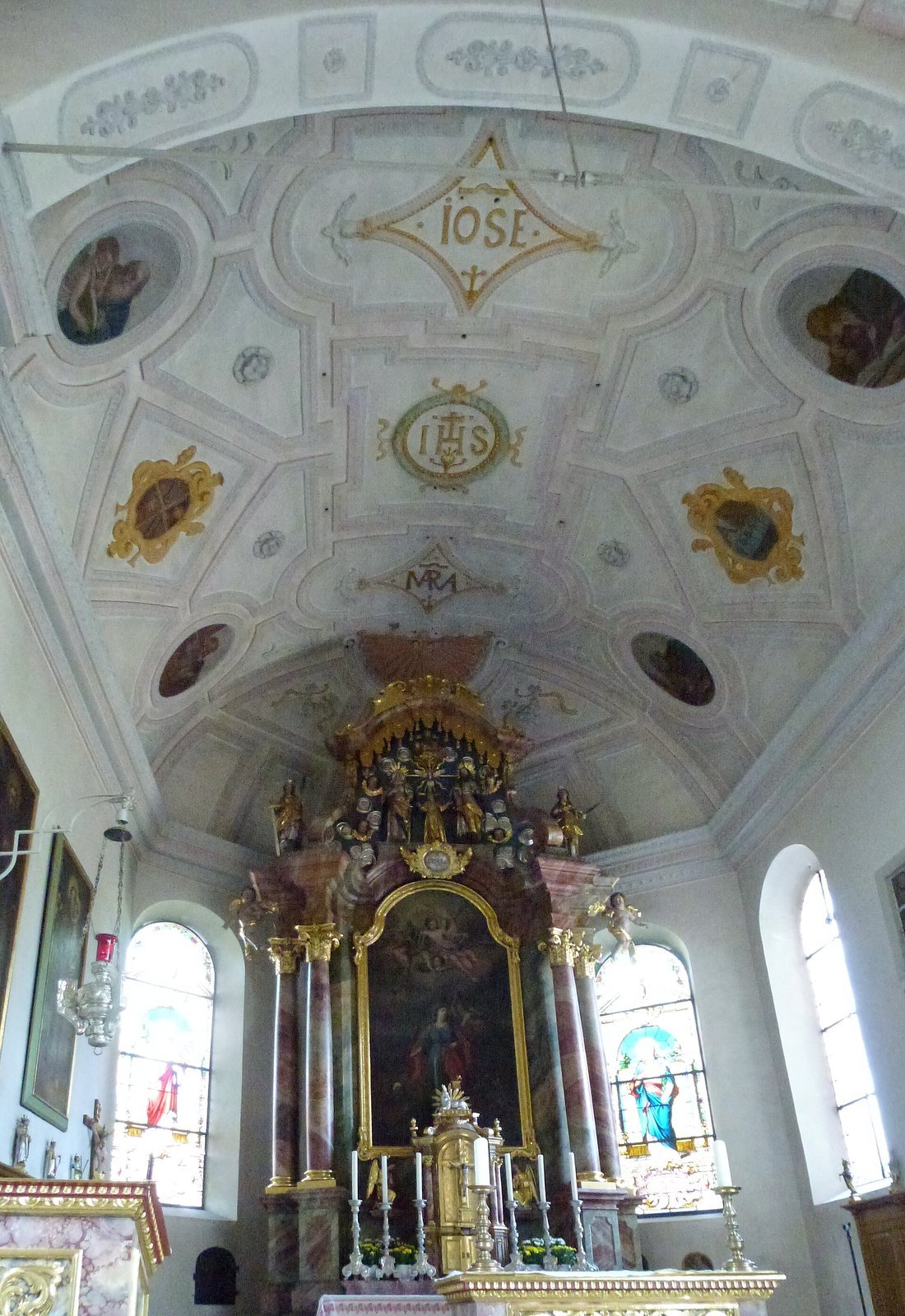
The nave’s barrel vault was renewed in 1912 and decorated with frescoes by Josef Albrechtskirchinger. The front scene shows John the Baptist, the New Testament prophet who baptized Jesus. The central fresco depicts the weather saints John and Paul, Christian martyrs traditionally commemorated together, while the rear fresco shows Saint Martin in episcopal clothing. Six medallions along the ceiling edge present scenes from the Old Testament.
The principal furnishings developed over several centuries. The high altar was made around 1740, and its central painting was completed in 1746 by Franz Mayr of Lauterbach. It presents Saint Ursula, the church’s patron saint, with the 11,000 virgins associated with her traditional martyrdom at Cologne. The side altars date from around 1770. Their paintings include a nineteenth-century image of the crowned Virgin Mary and Child and a scene of Saint Leonhard with Saint Florian and a bishop probably representing Saint Corbinian.
Georg Beer II built the organ in 1878. In 1980, Wolfgang Gebauer of Hechenberg created the altar used for liturgical celebration and designed the ambo, a raised stand for readings or preaching, to match it. St. Ursula is protected as a historic monument and appears in Dachau’s architectural monuments list under registration number D-1-74-115-72.
Remains
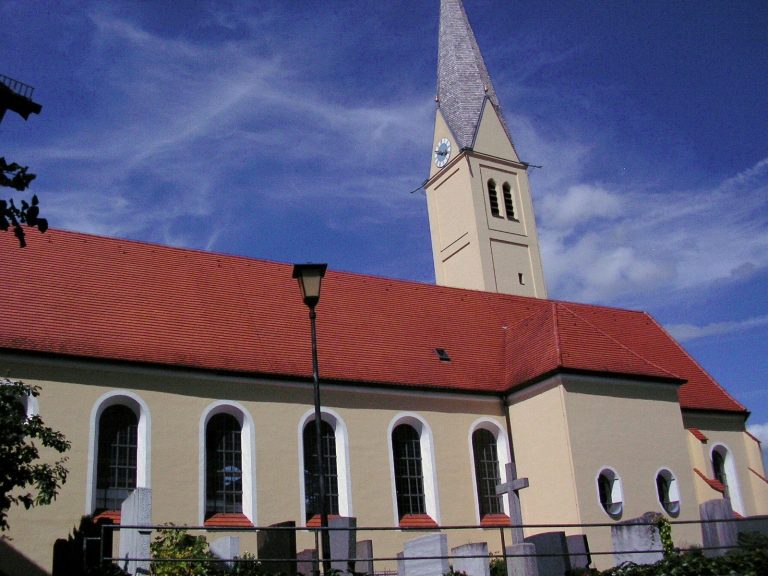
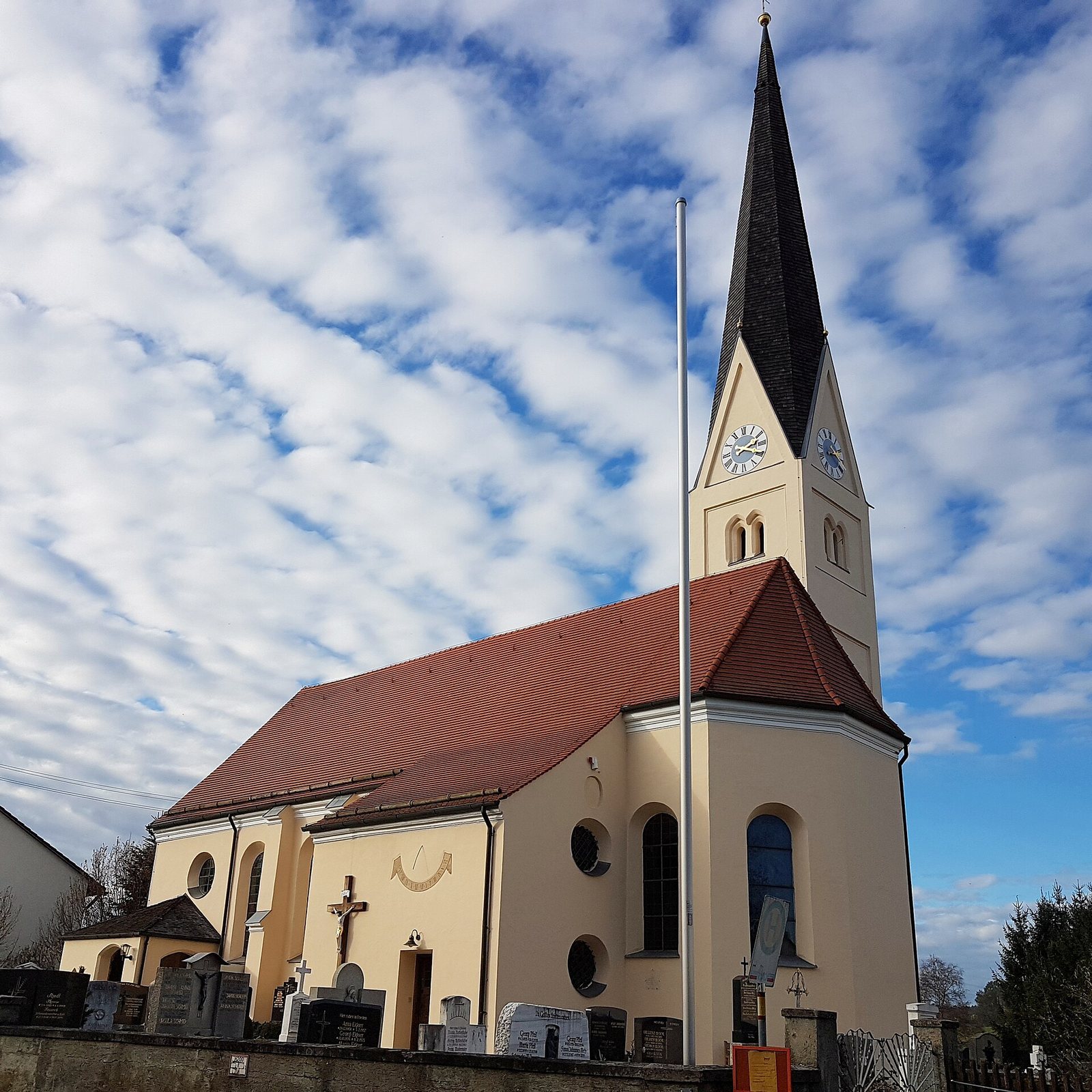
St. Ursula is a Baroque hall church with a four-bay nave, a narrower chancel closing on three sides, a south sacristy, and a tall tower beside the north side of the chancel. Buttresses support the nave, while the tower rises to a pointed spire. The surviving interior and furnishings preserve the church’s changing architectural, artistic, and liturgical history.
Church layout and tower
The nave measures 13.80 metres in length and 9.23 metres in width. It is covered by a barrel vault and supported by buttresses. To the east, the chancel is 8.40 metres deep and 6.62 metres wide, making it narrower than the nave and closing on three sides. A sacristy is attached to the south wall.
Chancel-flanking tower
The 48-metre-high tower stands on the north side of the chancel. Its uppermost storey contains the belfry, with clock faces set between the gables, and the structure is crowned by a pointed spire. Four bells hang in the belfry. Three are historical, cast around 1480 by Ulrich von Rosen, in 1599 by Martin Frey, and in 1629. The fourth was added in 1950. Together, the bells sound the motif Salve Regina in G-flat, B-flat, D-flat, and E-flat.
Vault paintings and altars
The nave frescoes occupy the renewed barrel vault. In the image of John the Baptist, the saint stands on clouds and points towards a cross in the background. A putto holds his cross staff, and the Lamb of God, a Christian symbol for Jesus, rests on a cloud below. Saint Martin appears with a goose standing on a book. This detail recalls the story that geese betrayed Martin when he hid to avoid being chosen bishop. The village represented behind him is Unterbachern.
High altar
The high altar has a tall retable, the architectural framework behind an altar, with four columns painted to resemble red and white marble. Their capitals support a projecting cornice and an upper section. Beneath a baldachin, the upper section contains a relief of the Holy Trinity, referring to the Father, Son, and Holy Spirit, above Mary and Joseph with the Christ Child. Small figures of Saint Barbara and Saint Catherine stand at either side.
Saint Ursula appears in the principal painting wearing a blue-and-red garment and a crown. She holds arrows and a martyr’s palm branch, while the 11,000 virgins associated with her legend are shown behind her and Cologne forms the background. The altar also includes a masonry altar block with a red-marble mensa, or altar table, supporting a two-storey tabernacle with gilded doors.
Side altars
The side altars are unusually tall and narrow. The left altar painting is a mid-nineteenth-century oil on canvas showing the crowned Virgin Mary seated on a throne. She wears a red dress and a blue mantle with gold edging and holds the Christ Child. The predella, the lower section of an altarpiece, contains a reproduction of the Black Madonna of Altötting.
The right altar painting shows Saint Leonhard in dark clothing, holding a book and chains. The chains refer to prisoners traditionally said to have been freed through his prayers. Saint Florian stands to Leonhard’s left, extinguishing a burning house, while a bishop probably representing Saint Corbinian stands to his right. A model of a church rests at the bishop’s feet.
Organ and later liturgical furnishings
Celebration altar
The altar made by Wolfgang Gebauer in 1980 measures 104 by 140 by 80 centimetres. A silver reliquary, a container for relics, dates from around 1745 and is decorated with coloured stones. It is displayed behind a glass panel on the front of the altar. The matching ambo forms part of the same later liturgical arrangement.
Organ
The organ stands on the upper gallery. Georg Beer II built it in 1878. The instrument has 14 stops, two manuals, and a pedal. Its action is entirely mechanical with slider chests, and it has a detached console and a Neo-Renaissance case.